
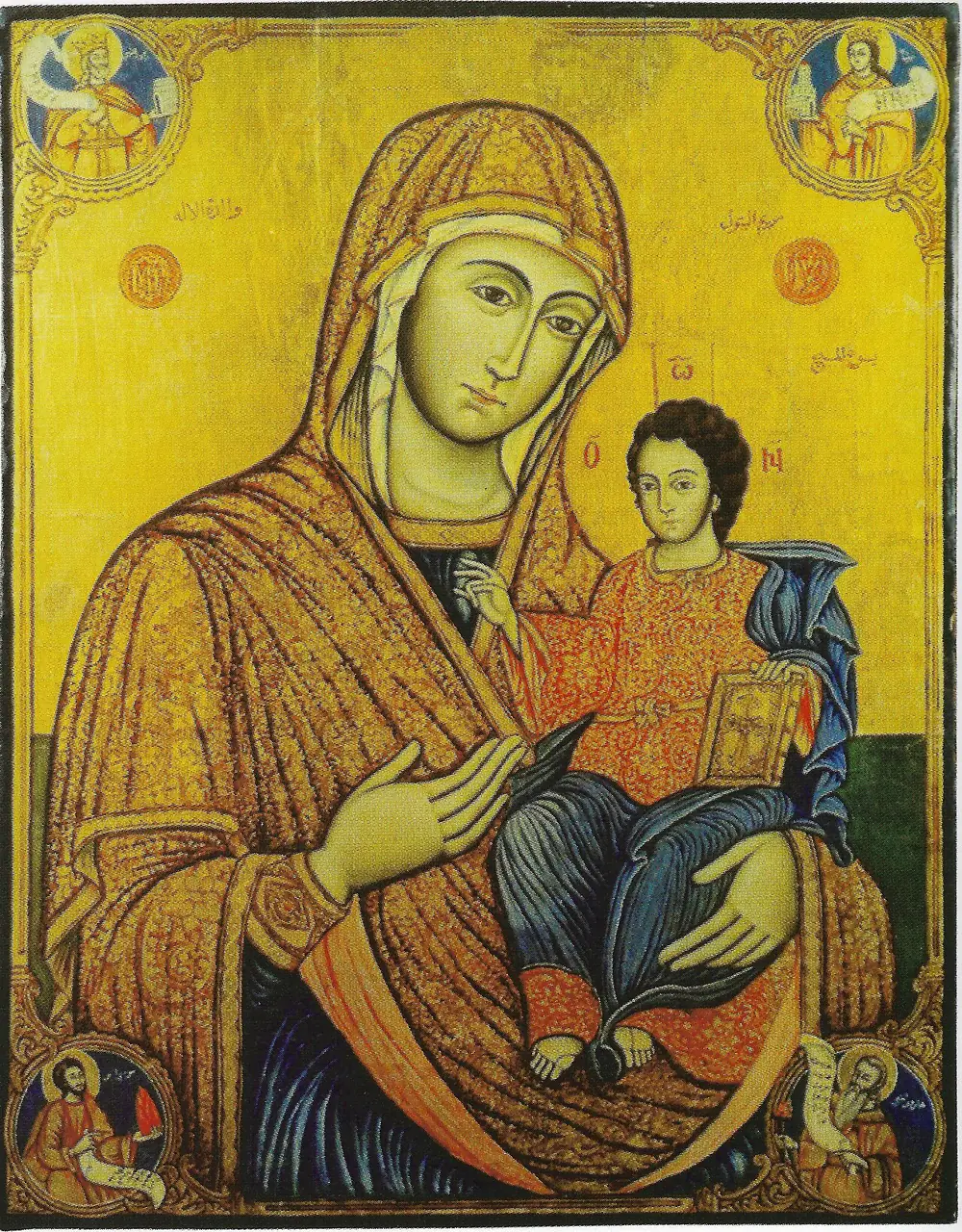
The Mother of God… What Was She Like?
A description of the bodily beauty of the All-holy Theotokos has come down to us in the writings of Saints Theophanes and Nicephorus. This is what they say: she was of middle height, her face was the colour of wheat, her hair light brown, shading a little into gold, her eyes bright, clear and pure, her glance quick and piercing, her eyebrows slightly lowered and dark, her nose of middling size, her lips rosy and sweet in speech, her face not quite round, the fingers of her hands long. There was no pride in her; in everything simplicity, without the least pretence. No softness or affectation; in everything complete obedience. She wore simple clothing and preferred natural colours. Abundant grace shone divinely in all that she did. Such was the Mother of God in appearance.
Wonderful are the words of Saint Dionysius the Areopagite, that had he not been instructed in the knowledge of God by the Apostle Paul, he would certainly have taken the All-holy Virgin for God! If there was such majesty in her outward appearance, what then is to be said of her inward, spiritual majesty? What shall we say of the glory, of the beauty that was in the soul of this Queen?
Her mind, in divine things, possessed a wisdom that no man has had or ever will have. For her upbringing she was sheltered in the temple of Jerusalem, and after some time she understood the Holy Scriptures so clearly and rightly that she amazed even experienced and skilful teachers of the law. The singular understanding of the Mother of God is all the more astonishing in that she was far ahead of her years in wisdom. When she was only three she understood that a holy and divine mystery was being accomplished around her; and that she had so early the grace-given gift of communion with the heavenly world, and was counted worthy to converse with the citizens of heaven, passes all our understanding.
Her moral height sets before us, for our imitation, the highest example of perfection. There was no vice in her: spotless, she was a vessel of virtue. All that was required by the old law and all that was revealed by the law of the Gospel she fulfilled with complete exactness. What could stand higher than her humility? The heavenly messenger, the Archangel Gabriel, announces that she will bear the Son of the Highest — the Messiah, the King of kings; righteous Elizabeth greets her as the Mother of the Lord — and she, far from exalting herself, is even made afraid by such honour: she is troubled at the angel’s words and calls herself the handmaid of God, on whom the Lord has looked. Righteous Joseph falls into suspicion, and she humbly keeps silence; she submits to the supreme authority and flees into Egypt. And what could be more perfect than her poverty? The daughter of wealthy parents, she disregarded everything in which the daughters of men who love the goods of this world find comfort: she had no house of her own and lived in the wretched hut of Joseph the carpenter. After the crucifixion of her Son she had not even where to lay her head, and lived in the house of Christ’s closest disciple. What could be holier than her purity? The hypostatic Word of God Himself raised her and chose her womb for His dwelling. Saint Ambrose of Milan describes her spotlessness thus: “She was a virgin not in body only but also in mind, humble of heart, wise in God in her speech; she spoke little, and in her speech she was without fault.”
And what is to be said of her courage amid the greatest trials and sorrows? She did not lose heart when the road to Egypt lay before her, full of danger. With what firmness she followed her Son — to the amazement of the human heart and of all nature, visible and invisible — when He set out on the way of the Passion: she was on Golgotha when her Son was crucified, she stood by His cross, she was present at His burial! How watchful she was over herself, how untiringly vigilant — and this when she was filled with grace and holiness! When she heard the angel’s words, “Rejoice, thou who art full of grace, the Lord is with thee,” she did not believe at once, but considered with caution whether the same thing was not happening again that had befallen Eve. How she entrusted herself to the will of God when, setting her hope on Him, she said: “Behold the handmaid of the Lord; be it unto me according to thy word!” Of her prayer to God Saint Ambrose says that the Theotokos was as it were always conversing with God; she spent the greater part of her life in prayer. And her prayer was so strong that it subdued the heavens, brought God Himself down from heaven, and at her falling-asleep gathered the holy apostles from every corner of the earth. The Mother of God, for all her holiness and majesty, even when misfortune and hardship threatened her, did not rely on her own grace-filled powers, but herself taught us that God shelters all the godly: “And his mercy is on them that fear him from generation to generation.” For all her moral height she did not forget to fulfil the duties of a devout person: she too, as her Son and God once did, was baptised by the hand of a servant; she submitted to the rite of purification that the law of Moses required; every year, at the feasts, she visited the temple of Jerusalem. The All-holy one never forgot those close to her, and loved those outside. Saint Ambrose says: she never hurt anyone, did not know contempt, and did not despise even the most wretched of men. She had nothing of her own to speak of, and before her falling-asleep she gave away her clothes to the poor. She had a holy love for the true good of her homeland. Her heart was filled with unspeakable joy, and she ever magnified the Lord, because the Lord had visited His people Israel, for He had fulfilled what He had spoken to Abraham and to his seed. She loved even her enemies: when her Son was being crucified, no one heard from her lips a word that was insulting, or even impatient. Saints Epiphanius and Nicephorus say: in every circumstance she kept a venerable dignity and was unchanging. She spoke very little, and only what was necessary and profitable; her words were sweet; she listened gladly to others and gave each the honour due to them; in her speech she always kept a seemly grace; she never laughed and did not know agitation; her disposition was peaceable and free of anger.



