
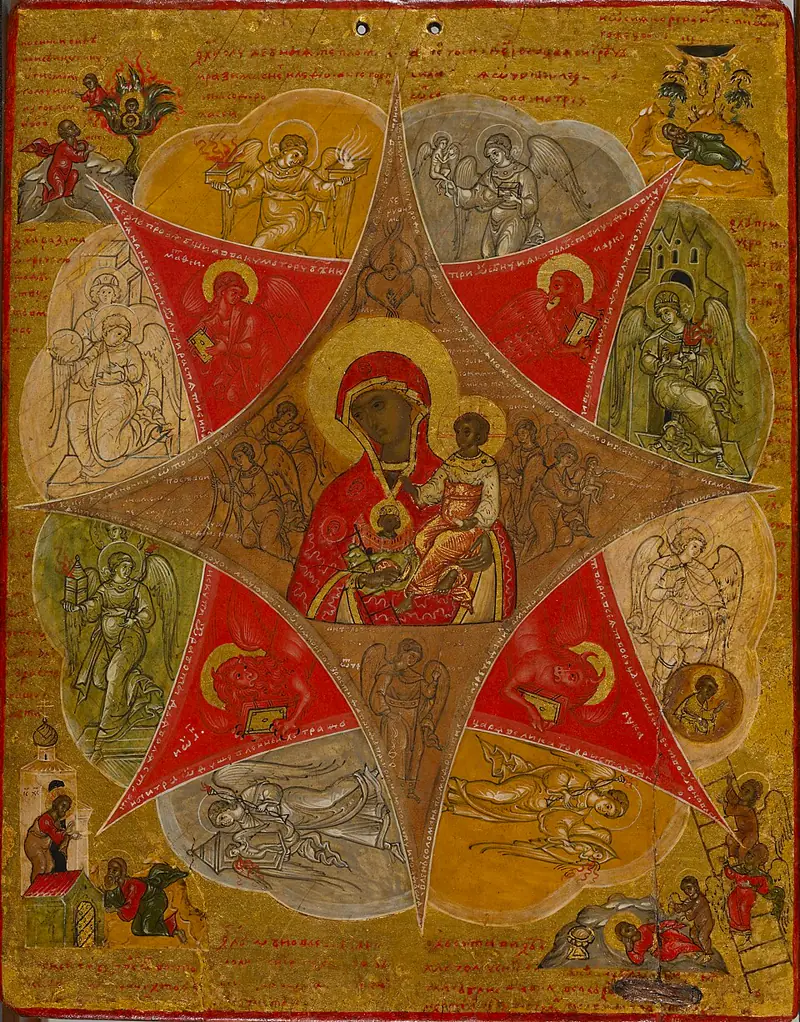
The Entry of the Most Holy Theotokos into the Temple
The angels, beholding the entry of the All-pure one, were amazed at how the Virgin entered into the Holy of Holies
The child Mary, anointed with the grace of God and surrounded by her parents’ care, grew and waxed strong. Tradition tells that when she was six months old her mother set her down on the ground, wishing to see whether she could stand on her feet. Mary took seven steps and came back to her; then righteous Anna caught her up in her arms and cried out: “As my God liveth, thou shalt not set foot upon the ground until thou goest into the temple of the Lord.” After this Anna made a special dwelling in her own bedchamber, into which nothing unclean was allowed, and gathered undefiled daughters of the Hebrews to care for the child chosen of God.
When Mary was a year old, Joachim invited the priests, the scribes, the elders and his friends and held a festive banquet; to this gathering he brought Mary as well and asked everyone to bless her. “O God of our fathers, bless this child and magnify her name among all generations” — such was the blessing the priests pronounced over Mary, and those present answered: “Amen, so be it.”
Mary turned two. Those around her marvelled at the uncommon maturity of her heart and mind, which far exceeded her years. Her childlike wisdom was like the kindly light of the sun; Mary was not like other children of her age, and righteous Joachim was eager to bring her to the temple of God as they had vowed; but Anna, moved by a mother’s heart, asked that it be put off for one more year. The wise parents prepared their daughter for the service of the Lord and formed in her the thought that she had been promised to God, that to be with God is far better than to be with one’s parents, that parents cannot give what God bestows. “Hearken, O daughter, and incline thine ear; forget also thine own people, and thy father’s house,” says King David in the psalm; and now the time had come for the mystery of God’s providence to be fulfilled. The holy child enters the Holy of Holies, and with this begins the mystery of the reconciliation with God of the race of men, which until then, because of its countless sins, had been shut out of the Kingdom of Heaven.
Divine tradition has preserved a detailed account of the entry of the All-holy Virgin into the temple.
In Nazareth many kinsfolk and friends of Joachim and Anna gathered for this feast; there too was a whole company of young maidens, Mary’s companions of her own age, to escort her to the temple. They all set out for Jerusalem, three days’ journey from Nazareth. After entering the holy city and purifying themselves there with seven days of fasting and prayer, according to the custom that those who offered sacrifice in the temple were bound to keep, Joachim and Anna with their companions approached the temple, bearing in their arms their three-year-old daughter, Mary full of grace. A band of undefiled maidens escorted her, and acquaintances and kinsfolk followed after — all with lighted candles in their hands, eager to have a share in the entry into the temple of the Virgin Mary, the only child of aged parents, and they sang sacred hymns. The priests came out of the temple singing to meet them, and the high priest Zacharias went before them.
The stairway leading into the temple had fifteen steps, after the number of the psalms that the priests and Levites sang on each step as they entered the temple. The righteous Ancestors of God set the Virgin Mary on the first step. To the amazement of those present, the three-year-old Mary, with no one’s help, went quickly and boldly up the stairway to the very last step. There the high priest Zacharias met her, surrounded by the priests. He did not keep her on the stairway, where by custom the worshippers stood, but, passing through the first and the second veil, led her into the depths of the temple — the so-called “Holy of Holies”. Not only women but even priests had no right to enter there; the high priest himself went in only once a year, after long fasting and prayer, to cleanse his own sins and the sins of the people by sprinkling the blood of the sacrificial animal — but this came to pass by the inspiration of God. The Theotokos entered the Holy of Holies just as, in times past, the Ark of the Covenant had done, which was a figure of the Mother of the Saviour of mankind, Christ.
When the high priest, by God’s inspiration, had led the Virgin Mary into the Holy of Holies, he appointed a place there for her to pray. Other maidens, who were brought from childhood to pray, were strictly forbidden to approach the temple; they were not allowed near the place between the temple and the altar where Zacharias was afterwards slain.
The aged parents, having committed their daughter to the will of the Heavenly Father, offered a sacrifice of thanksgiving for her and returned home. They praised and glorified the Lord; they did not weep at parting from their beloved daughter, nor were they troubled by the grief of loneliness or of separation from the object of their joy. They gave thanks to God, who in their old age had granted them a divine gift, and rejoiced that they had been counted worthy to dedicate this gift to Him who had made the race of men know comfort and joy.
At that time, around the wall of the temple of Jerusalem, which Solomon had founded and Zerubbabel later renewed, thirty fine three-storeyed buildings stood close to one another, with spacious and well-appointed rooms most conveniently arranged for living in. In one building lived maidens who had given themselves to the service of God, in another undefiled widows, and in separate cells the Nazarites (members of a community who, like the prophets, set an example of self-denial and holy living). They had dedicated their lives to the one God and followed a way of ascetic struggle like that of the monks of the Church of the New Testament. Other lodgings were set aside for the rest of pilgrims who came to Jerusalem to worship God.
After her entry into the temple the three-year-old Mary was placed in the house of maidens, which had existed from the most ancient times. The older maidens, with the high priest’s blessing, taught her to read the Holy Scriptures and to do women’s handiwork. She had a place set apart for reading, for work and for rest, and entered the temple only to pray.
The Virgin Mary’s life in the temple was marked by a singular purity and holiness; her way of life inspired a particular reverence toward God. By the appointed rule she rose at dawn and, according to tradition, prayed three times a day: in the morning (before nine o’clock), at midday (about twelve) and in the afternoon (about nine o’clock). Such at that time was the custom of devout people and the duty of those who served in the temple. The rest of the time she was occupied with reading the holy books and with handiwork. In the hymns of the Church there is testimony that the holy angels appeared to her and brought her heavenly food: every day they visited her and spoke with her. Her life in the temple was hallowed by the Holy Spirit. Her handiwork was spinning flax and wool, and for the most part she embroidered priestly vestments with silk. She did handiwork far better than her companions, and her natural understanding was excellently developed by reading the holy books and strengthened by godly thoughts and prayer. For about nine years from her entry into the Holy of Holies she lived and laboured in the fear of God and with a pure heart. The aged priests looked upon her as a precious ornament of the holy temple and never passed near her without asking God’s blessing upon her in prayer.
For many years now Mary had been under the shelter of the temple, and her life had been untroubled and cloudless as a bright sky; but after nine years of life in the temple she knew her first earthly sorrow: she lost her aged parents. Joachim died first (at eighty years of age), and soon afterwards Anna too, in extreme old age, reposed.
The Church calls the righteous Joachim and Anna the Ancestors of God, and every day, at the dismissal after the service, asks salvation and help from the Lord for all who pray, through the prayers and intercession of the All-holy Theotokos and of the righteous Joachim and Anna. Their memory is kept every year on the 9th of September, the second day of the feast of the Nativity of the Theotokos.
The place of their burial is pointed out to this day by the stairway that goes down into the cave of the tomb of the All-holy Theotokos in Gethsemane.
At parting from her beloved parents Mary felt the bitterness of being orphaned and understood that nothing now bound her to this world. With her whole heart she entrusted herself to the one God and desired only to remain the handmaid of God to the end of her life and always to submit to His holy will; she made a vow before the Lord to keep her virginity for ever.



