
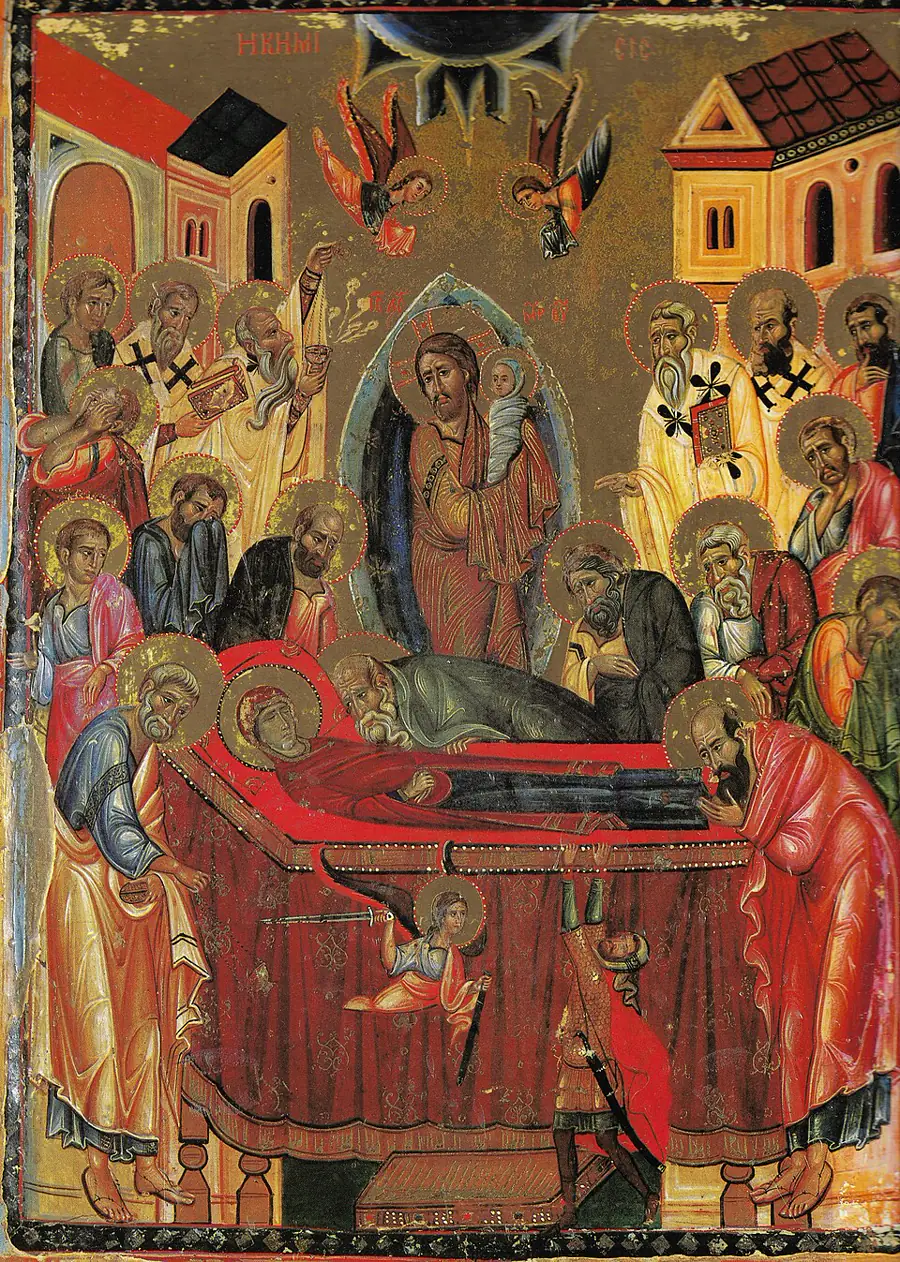
The Dormition of the All-holy Theotokos
We magnify thee, O all-holy Mother of Christ our God, and glorify thine all-glorious Dormition
The All-holy Virgin yearned ceaselessly for heaven and prayed to be taken to the heavenly dwelling, that she might delight in the radiance of her Son and God. As a sower of Christ’s teaching on earth, she saw that the holy harvest of human souls was already ripe: the founding and ordering of the Church had been accomplished, and Christianity, and with it the glory of the Theotokos, had spread through the whole world. Now she besought her Son still more fervently to take her up to heaven as soon as might be.
The All-holy Mary lived on Mount Zion, in the house of John the Theologian, and often went to the places hallowed by the footsteps of the Saviour of the world. But most often she chose for prayer Golgotha and the Mount of Olives, at the foot of which lay a garden that John the Theologian had inherited from his father Zebedee. Once, as she was praying on the Mount of Olives, the Archangel Gabriel appeared to her and announced that the time of her going up to heaven was drawing near, and that it would come to pass in three days. In confirmation of these tidings he gave her a branch of a date palm planted in paradise, and told her that this branch, which shone with divine grace, was to be carried before her bier. With godly joy the Theotokos received the branch from paradise. She fell down before the Lord, gave thanks, and besought Him that at her departure from the body her eyes might not see the prince of darkness and the terrors of hell, and that the Lord Himself might receive her soul with His divine hand. She asked too that before her end she might be granted to see the holy apostles, who were scattered over the world to preach.
When she learned the joyful news of her approaching blessed falling-asleep, her face shone with such heavenly joy that her divine glory struck awe into everyone.
The All-holy Mary made ready for her falling-asleep and told John the Theologian of it first of all. She bade that the branch from paradise be carried before her bier. She gave her instructions calmly: she had candles, incense and everything necessary for the burial made ready. John at once told everything to the Apostle James, the son of Joseph the Betrothed, the first bishop of Jerusalem, who spread the news not only in Jerusalem but in all its surroundings, on all four sides. People came from every direction to the house of John the Theologian. When they learned from the Theotokos herself that she was to be taken up to heaven, they wept bitterly and filled the house with loud lamentation, begging the Comforter of all not to leave them orphaned and without protection. The Theotokos gave them hope and promised that she would not forsake them, and that to all who turned to her in sorrow and despair she would be a swift helper and intercessor. In this promise of hers lies hidden the consolation of all mankind.
All looked upon her face with reverence and listened to her words; and the Theotokos did not forget to leave instructions concerning her scant possessions and her burial. Her two garments were left to two poor widows, who received their food from her and served her with fervent love. She loved everyone, but especially those who needed her help. She wished her body to be buried in the cave of Gethsemane, by the valley of Jehoshaphat, between the Mount of Olives and Jerusalem, where her righteous parents and Joseph the Betrothed rested.
As she was telling her wishes to John and James, suddenly a loud noise was heard, like that which goes before a storm, and everyone saw a bright cloud surrounding the house. The Lord fulfilled the wish of His All-holy Mother: caught up by divine power, the holy apostles came from the various ends of the world on these clouds to the house where she was. Grace was given to the eyewitnesses and disciples of the Lord to be present at the falling-asleep and burial of the Theotokos. The apostles, gathered at the door of the house, rejoiced, and could not understand at all why this wonder had happened. John the Theologian came out to meet them and told them that the day had come for the Theotokos to go to the Lord.
When they saw the All-holy Theotokos full of radiant gladness, they could no longer hide their tears: it was dreadful and bitter to take leave of the Mother who had taught and comforted them, who had taken the place of their King and Teacher. How were they to bear such loneliness and orphanhood, how were they to remain in this world without their Mother and guide?!
Mary full of grace asked them not to weigh down her joy with tears but to rejoice with her: “I am going to my Son and Lord; you will carry my body to Gethsemane, bury it there and go on with the preaching laid upon you; and if the Lord wills, you will see me again after my falling-asleep.” At this time the Apostle Paul and his disciples were there: Dionysius the Areopagite, Hierotheus, Timothy and others of the Seventy. The Lord had gathered them and granted them to see the Theotokos, to receive her blessing and to be present at her burial.
The All-holy Virgin called everyone to her, calling them by name; she spoke kindly to each for their faith and for the labours they had borne in preaching Christ. She comforted them and gave them hope that she would not leave the world orphaned and would hear the prayer of everyone who turned to her.
The third day after the angel’s appearance came. The third hour of the day drew near, the time foretold for her falling-asleep. Candles were burning in the house; the apostles, standing around the bed of the Theotokos, glorified the Lord, and she prayed fervently. Suddenly the roof of the house opened, the light of divine glory shone upon those who were there, everyone was struck with awe, and the rays of heavenly light darkened all things earthly. Surrounded by hosts of heavenly powers, the King of glory — Christ Himself — appeared to His All-holy Mother. Gladdened by the radiance of her Son and God, she spoke the words of the God-inspired song: “My soul doth magnify the Lord, and my spirit hath rejoiced in God my Saviour.” She raised herself from her bed, bowed down to the Lord and heard the divine call: “Come, My chosen one, come, My beloved, and inherit the dwelling of eternal life.” The All-holy Theotokos repeated her prayer: “Receive my soul in peace and deliver me from the realm of darkness.” The Lord calmed her: the dark power of the serpent has been crushed, and He Himself is calling her, that she may pass boldly from earthly life to heavenly. The Ever-Virgin cried out with joy: “My heart is ready, O God; be it unto me according to thy word.” She lay down again on her bed and gave up her soul into the hands of her Son. Without pains she had borne Him, and He without any pain released her soul from the body, and kept her holy body from corruption. Then the song of the angels was heard: “Rejoice, thou who art full of grace, the Lord is with thee, blessed art thou among women!” — and the soul of the Theotokos, in the hands of the Lord, solemnly and accompanied by the heavenly powers, went up into the Kingdom of Heaven.
The apostles, who had been counted worthy to see the All-holy Theotokos go up to heaven, stood trembling and gazed at the sky, as once they had gazed at the ascending Lord. They had forgotten everything earthly — even themselves. When they came to themselves, they looked at the all-holy body and saw that her face shone with heavenly light and that a wondrous fragrance came from it.
The company of the apostles sang to her with love: “In the heavenly dwelling of thy Son thou art ever received, O Theotokos, for the help of thy people.”
And from the height of heaven the voice of the Theotokos was heard, speaking boldly to her Son and Lord: “Keep for ever those whom Thou hast given me.”
All who were present bowed down before the all-holy body with trembling and the fear of God. By touching her bed every sufferer received healing, and they magnified her with the Archangel’s song: “Rejoice, thou who art full of grace, the Lord is with thee.” The holy apostles made ready for her burial; though they mourned the earthly parting, they were comforted by the thought that they had gained in heaven an intercessor and one who prays for them before God. Peter, Paul, James and the other apostles carried her body on their own shoulders. John the Theologian went before them with the radiant branch from paradise. The rest of the faithful and a multitude of people followed her bier with censers and lighted candles, going with singing from Zion to Gethsemane; throughout the procession, until the very burial, a cloud like a radiant crown looked down from above upon the body of the Theotokos and upon those in the procession. The singing of angels was heard from heaven.
Many unbelieving Jews heard the extraordinary sounds, saw the solemn procession, and reported it to the high priests and elders. These were filled with fury and envy when they saw with what honour the Mother of Jesus, whom they had crucified, was being escorted. The leaders of the Jews sent a band of soldiers to scatter the people. They ordered them to kill the apostles and burn the body of the Theotokos. But the divine power did not allow this evil deed. The crown of the radiant cloud came down and surrounded the procession like a wall. The pursuers heard the singing and the footsteps, but, struck with blindness, saw nothing. In the crush many of them broke their heads against the city wall; others lost their way and looked for guides. One Jewish priest, Athonius, behaved with particular insolence. He dared to utter terrible blasphemous words at the bier of the Theotokos and reviled her Son, the Lord Jesus Christ. Seething with long-held envy and enmity, he rushed at the bier to throw the all-holy body to the ground; but as soon as he touched it, an angel of the Lord with the sword of God’s wrath cut off both his hands. The severed hands fell upon the bier, and he himself fell to the ground with a terrible cry. The dreadful punishment brought him to his senses. He felt his guilt and turned to the apostles: “Have mercy on me, servants of Christ!” The Apostle Peter halted the procession and said to Athonius: “It is not in our power to heal you; all things are possible only to Him whom you crucified — our Lord Jesus Christ; but He will not heal you either, until you believe with your whole heart and confess with your lips that Jesus is the true Messiah and the Son of God.” Then Athonius said aloud: “I believe that Christ is the promised Messiah and the Saviour of the world.” The salvation of a soul that had been perishing greatly gladdened the apostles and the faithful, and the Apostle Peter told Athonius to turn to the Theotokos with faith and to set his arms to the severed hands that lay upon the bier. The hands at once grew back, and Athonius was made whole. Along his forearms there remained only thin red lines, like threads. Athonius fell down before the bier and worshipped the Lord Jesus and His All-holy Mother, praised and glorified her, and went on with the apostles. Many Jews, when they learned of this wonder, repented and venerated the bier of the Theotokos; they were healed, and their sight was restored. The merciful Mother of the human race, as by her giving birth she had bestowed joy on the whole world, did not wish to grieve anyone by her falling-asleep: she received everyone, and gave hope even to her enemy.
When the procession reached Gethsemane, all with tears and lamentation venerated the all-holy body for the last time, and only in the evening were the holy apostles able to lay it in the tomb. They closed the entrance of the cave with a stone. After the burial they did not leave the place for a long while. For three days they offered prayers and hymns to the Theotokos there. At that time the angels glorified the Lord and the All-holy Virgin with heavenly song.
It fell to the Apostle Thomas to have a part in the revealing of the resurrection of the Theotokos, just as once by his doubt he had borne witness to the truth of Christ’s resurrection. By the will of God he came to Gethsemane on the third day after the burial of the Theotokos. Filled with deep grief, he approached the tomb lamenting, and with weeping poured out the pain of his heart that he had not been counted worthy to see the Mother of God for the last time and receive her blessing. Nor had he seen the wonders that took place at her falling-asleep and burial. The holy apostles, out of heartfelt pity, decided to roll away the stone from the tomb and allow Thomas to see the holy body of the Theotokos and venerate it. But as soon as the stone was rolled away, they saw that only the grave-clothes remained in the tomb, and an unspeakable fragrance came from them. Her precious body was nowhere to be found. They were astonished and dumbfounded. Reverently they kissed the mantle left in the tomb and besought the Lord to reveal to them the mystery of this glorious wonder. That same evening the Queen of Heaven herself set their minds at rest.
According to ancient tradition, after the Resurrection of Christ the first place at the table of the Christians was left empty, and on that place there always lay a portion of bread, as “the Lord’s portion”, in honour and remembrance of Christ. After the meal all in turn took this bread, called on the name of the All-holy Trinity and ended the prayer thus: “Lord Jesus Christ, help us.” After this they divided “Christ’s portion” and ate it as a blessing from the Lord.
The apostles always kept this custom, whether they ate alone or with others.
So they did too at the evening meal after their return from Gethsemane; they were thinking and speaking all the time of the Theotokos and could not understand what had become of her precious body. At the end of the meal, when they had lifted up “Christ’s portion” and were glorifying the All-holy Trinity, suddenly the singing of angels was heard and they saw the All-holy Virgin in the height of heaven; surrounded by the heavenly powers and shining with unspeakable glory, she said to the apostles: “Rejoice, I am with you all the days.” The apostles in their joy, and the faithful who were there, cried out together: “All-holy Theotokos, help us.” So the holy apostles were assured, and handed on to the whole Church the unshakeable faith that the Mother of God was raised from the dead on the third day by her Son and God and taken up bodily into heaven.
To comfort the sorrowing and to assure those who had not been there, the apostles took the mantle left in the tomb, returned to Jerusalem, and very soon appeared again in the various ends of the world preaching the Gospel.
The Church calls the end of the Theotokos her Dormition, her falling-asleep, because she slept for only a very little while and rose as from sleep. The Theotokos overcame the laws of nature. The death by which a body made from earth returns to earth did not touch her body. In giving birth she kept her virginity; at her end she joined it to life; after giving birth she remained incorrupt, and in death she kept life. She fell asleep in order to awaken to blessed eternal life. She stands before the Life-giving Fountain, that by her prayer our souls may be delivered from eternal death. The Theotokos, who prays unsleeping, intercedes for us and in sorrow gives us faith for our comfort.
The tomb of the Theotokos hewn in the rock, like the tomb of her Son, has remained an object of veneration for all the faithful. From the most ancient times the Church has appointed the 15th (28th) of August for the commemoration of the Dormition of the Theotokos. It is among the Twelve Great Feasts, because on this day the Saviour of all met His Mother and brought her to dwell in His abode.
Even after her Dormition the All-holy Theotokos did not forsake the world and, as she promised, intercedes for all who turn to her; to many who sorrow and suffer she has shown many wonders of mercy. Which of us, tossed on the troubled sea of life, does not feel that the Theotokos hears our lament — how quickly she listens to us, how swiftly she helps and comforts us! Calling on the Theotokos as intercessor has become a part of Christian worship. From the first century the Church has asked her help and glorified her; the evening service ends every day with a prayer to her: “O most glorious, blessed Theotokos, ever-virgin, offer our prayer to thy Son and our God, that through thee He may have mercy on our souls.” The Mother of God comforts all who turn to her:
“O all-holy Theotokos, help us and save us who honour thee; O Lady, save us.”



