
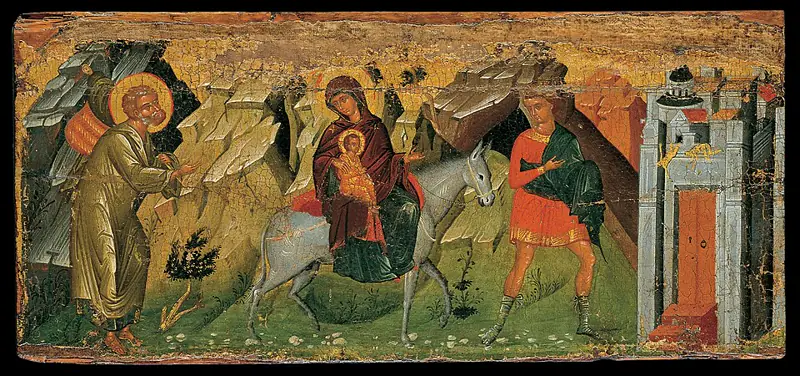
The Flight into Egypt
Rachel weeping for her children, and would not be comforted, because they are not
After their return to Lower Galilee, the All-holy Mary and righteous Joseph the Betrothed soon sensed that a great danger threatened the life of the Child Lord: this was the first pain which, through the tidings Joseph the Betrothed received, wounded the heart of the Theotokos.
The Magi had not carried out King Herod’s errand and had not returned to Jerusalem to tell him where the Child King was. Herod took this as an insult and a mockery and flew into a terrible rage. Besides, rumours had reached him of the prophecy of Symeon and Anna. This sharpened still further his suspicion and his fear that the newborn Child, as the lawful king, would take the sceptre from him. Herod searched with all his might for the place of the Child’s birth, but his efforts were in vain. Out of his mind with fear and malice, he ordered that in Bethlehem and all its borders every male child should be slain, from the newborn to two years old, sure that the newborn King would be killed among them. A thousand swords were bared to kill the Child Jesus, and the ambitious evildoer sacrificed fourteen thousand children. Herod was so blinded by his own folly that he hoped to overcome the almighty Creator and destroy the promised Messiah; but Herod was only a blind instrument in the fulfilment of the divine design. The echo of the bloodshed in Bethlehem spread still more widely the news of the event so long awaited. And the children themselves, baptised in their blood, became forerunners of the Passion of the Saviour, who with His blood sanctified and washed the earth defiled by lawlessness.
What words can describe the calamity of Bethlehem? The blood that burst from the wounds of the children and their mothers ran in one great stream. Groans and lamentation filled the land; the weeping of children and the shrieks of mothers mingled in the air and reached the heavens: the mothers wept for their children and nothing could console them, because they were no more!
The merciless bloodshed did not satisfy Herod. Darkened by madness, he gave orders to kill his counsellors, the elders, the Pharisees, the scribes; to kill his own son, his sister and his sister’s husband, his wife Mariamne together with his son Antipater, and many others — so the ancient historians testify.
Great were the power and the wrath of this tyrant, but the object of his hatred, overshadowed by the power of the Highest, was not in his hands. For this divine providence chose a simple way: an angel of the Lord appeared to Joseph in his sleep and said: “Arise, and take the young child and his mother, and flee into Egypt, and be thou there until I bring thee word: for Herod will seek the young child to destroy him.”
Joseph obeyed at once, and holy Mary did not delay either, trusting the revelation given to her betrothed. That same night Joseph and the All-holy Mary took up the eternal Child in their arms and set out for Egypt. James, Joseph’s eldest son, went with them. They set off on the road, and neither its hardships nor the dangers ahead troubled them: they had entrusted the care of their lot to the Lord and thought only of submitting without murmuring to the will of God.
Neither Holy Scripture nor tradition tells which road to Egypt Saint Joseph chose. But from certain indications it may be supposed that he took the safer way, which crosses the mountains of Judea to Gaza, and from there, by the coast road across the level desert, goes on to Egypt. The Holy Family had to bear great toil and trials, but they always found shelter from cold and foul weather.
Ancient tradition tells that during this journey the Child Jesus worked many wonders, which convinced people of His divinity. Before they entered Egypt the Holy Family were surrounded by robbers who meant to rob and kill them. The leader came forward with his sword drawn to look at the travellers from close by: before him stood Joseph and Mary with the Child in her arms. The robber looked in amazement at this old man white with grey hair, unarmed, a staff in his hand, like one of the patriarchs of old; he looked at the young mother pressing the Child to her heart with all her strength as if she wished to protect Him herself — he looked, and his soul softened; he lowered his sword and said: “If God had taken human flesh, He could not be more beautiful than this Child.” He did not allow his companions to do the poor travellers any harm, and sternly stopped one of them who meant to rob them. The All-holy Virgin Mary said to the kindly bandit: “This Child will repay you.” These words had a prophetic meaning. This was that wise thief of whom the Saviour, hanging on the cross, said: “To day shalt thou be with me in paradise.” Tradition adds that the good thief’s name was Titus, and the other’s — the evil thief’s — Dumachus.
There is no certain information about the Holy Family’s stay in Egypt, but traditions have survived among the Arabs which are of particular interest to believing Christians.
It is known that on entering Egypt the Holy Family’s first resting place was in a settlement called Matariyah. According to the researchers’ sources, by then they had covered a hundred miles. Matariyah lies to the left of the city of Cairo and is surrounded by flourishing gardens. The road to it is covered with splendid greenery. Joseph went with James into the settlement to look for shelter, and left the Theotokos with the Child at the entrance, beneath a huge tree, which bowed its crown to the ground and so worshipped its Creator and His All-holy Mother, and sheltered them from the sun’s rays with the shade of its rich foliage. Below, at the roots of the tree, a cleft opened, in which the Theotokos hid. Ever since, the tree that knew its Creator has remained bowed in the same way and has received healing power. Every sickness is healed by its leaves. And in the cleft a lampada burns to this day in honour of the All-holy Virgin and the Child Jesus.
The tree (the local people called it a sycamore fig, and it stands to our own day in a garden belonging to an Englishman. He gladly gives the tree’s leaves to pilgrims; of its huge boughs six have already withered, but four are full of life. It is one and a half sazhens high and as many wide, and the circumference of its crown is more than three sazhens.) Besides this wonder, close by lies the source of a holy spring which appeared on the earth where the Child Lord set His foot. With this water the holy travellers quenched their thirst.
The source of this beautiful fresh water exists to this day and in its properties is wonderfully different from the other waters of the district, which, as in most of Egypt, taste of salt. The wonders remembered of this tree and this spring have amazed us for two thousand years and remind us of the words of the prophet Isaiah: “Be glad, thou thirsty desert: let the wilderness exult, and flower as the lily.”
This is all the more astonishing when we see that the strongholds of Memphis and Heliopolis were destroyed long ago, and only from their ruins do we learn that cities renowned for magnificence and splendour once existed.
Not far from this place the Arabs show the ruins of the house in which the holy travellers lived for some time before continuing their journey. Their road went on to Hermopolis, within the borders of the Thebaid, that is, Upper Egypt. A tradition survives among the Egyptians that in this city there was a tall tree called Persis, by which various sicknesses were healed when a leaf or a piece of its root was laid on the painful place. The tree received this miraculous power after the Holy Family drew near to it and it bowed its crown to the ground in worship of the Child Jesus. According to tradition this tree was of uncommon height and would not stand boldly before its Creator. During the stay of Jesus Christ in Egypt there were other miraculous signs too. In the city of Ermolaos itself, as throughout Egypt, idols were worshipped and sacrifices offered to them. Of these sacrifices the prophet Isaiah had already said: “Behold, the Lord rideth upon a light cloud, and shall come into Egypt: and the idols of Egypt shall be moved at his presence.”
According to an ancient Coptic tradition, the Holy Family lived near Cairo, in a cave that was made into a church in the most ancient times.
Wondrous is the providence of God: a land full of idols gave the Saviour shelter, afterwards became a dwelling place of the followers of Jesus Christ, and in its desert raised up those shining lamps of the faith who by their preaching and the astonishing holiness of their lives drove out the darkness of idol-worship: it is well known that the deserts of Egypt became famous for the greatest fathers, for saints, and for companies of men equal to the angels.
It is impossible to say exactly how long the holy travellers stayed in Egypt. Some traditions give two or three years, others five and seven. One thing is clear: they remained there until the death of Herod, and at the appointed time the Heavenly Father, according to the prophecy of Isaiah, called His Son out of Egypt: “Out of Egypt have I called my son.”
A short while after the slaughter of the children Herod died, and with him the kingdom for whose sake he had done so much evil. In his terrible death his contemporaries recognised heavenly justice: an unknown disease tormented him with an unbearable inward burning, his whole body was covered with sores, the worms of the grave gnawed his joints, he breathed with difficulty, and because of the stench of his breath no one could come near him. At the same time he was tormented by a terrible hunger that he could in no way satisfy. Eaten by worms, he vomited his wretched soul out of his belly.
Herod the murderer died, and the prophecy of the patriarch Jacob was plainly fulfilled: the rule of the Jewish kings came to an end, and the Roman Empire divided Judea into four parts. A ruler was appointed over each of them.
The angel appeared again to Joseph and said: “Arise, and take the young child and his mother, and go into the land of Israel: for they are dead which sought the young child’s life.”
Joseph took the Child and His Mother and returned again to the land of Israel. But when he reached the border of his own country, he stopped at a spring on the road from the Jordan toward Melek; at this time a new revelation came to Joseph: he learned that after Herod his son Archelaus reigned, and he was afraid to stay in Judea, lest by being there he should give Herod’s son a pretext for a new persecution of Jesus. But an angel was sent who calmed him and told him to withdraw into the parts of Galilee and settle in Nazareth. So the prophecy was fulfilled by which the future Saviour of mankind would be humbled and scorned by all even in His own homeland.



