
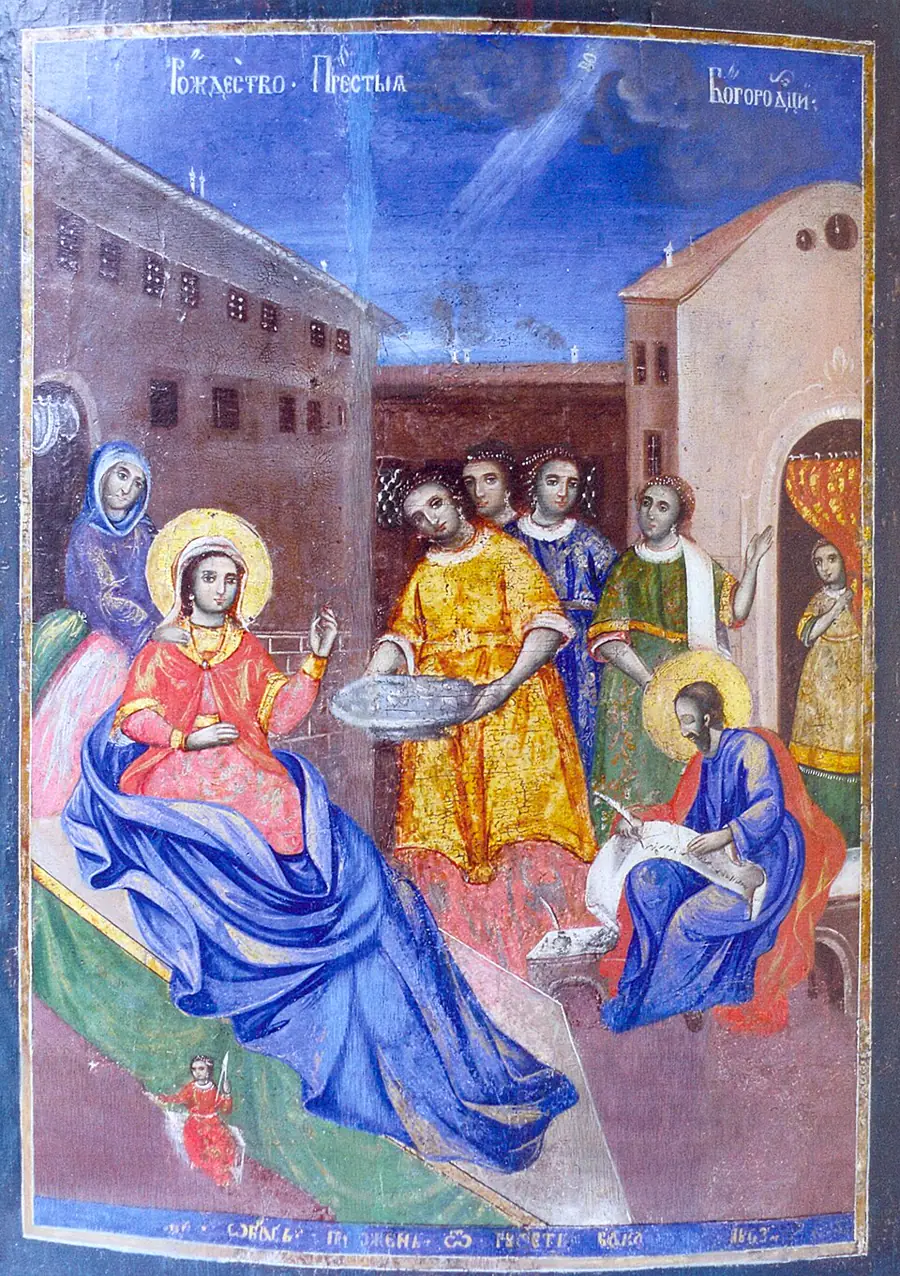
The Nativity of the Most Holy Theotokos
Thy Nativity, O Virgin Theotokos, hath proclaimed joy to the whole world
The All-holy Mother of God was born of barren and aged parents in the town of Nazareth, which lay spread over a hillside, three days’ journey from Jerusalem. “Can there any good thing come out of Nazareth?” the Jews would say when they learned that the great prophet Jesus had come from there.
According to the foretelling of the prophets, the promised Saviour of the world was to come from the royal line of David; but after the Babylonian captivity the descendants of King David gradually lost their rights, and when the house of the Maccabees grew strong, the royal branch lost all distinction and became as the rest of the people.
When the time foretold by the prophets had come and the sceptre had passed to Herod, a foreigner; when the all-crushing dominion of the Romans had begun; when morals and faith had been utterly suppressed — then the Jews understood that the time appointed by Daniel was running out, and they began impatiently to await the Messiah, who would free them from the yoke of the foreigners and give them dominion over other peoples.
In Nazareth there lived a devout husband and wife, Joachim and Anna. Joachim was descended from the royal tribe of Judah, and Anna was the youngest daughter of Matthan, a priest of the tribe of Aaron. Matthan had three daughters: Mary, Sobe and Anna; Sobe’s daughter Elizabeth is the mother of John the Prophet. Joachim and Anna were righteous before God and kept His commandments with a pure heart. They were known not so much for their lineage as for their obedience and mercy.
Thus they reached a great old age. Their whole life was filled with love for God and compassion for their neighbour. Of their considerable income they gave away two thirds every day: one third they offered to the temple of God, the other they shared among the poor and the old; the rest they used for their own needs. They were happy, but barrenness filled their hearts with sorrow: in the understanding of that time childlessness was counted a disgrace and the greatest of punishments — all the more grievous because the descendants of David hoped to become, through the birth of the promised Messiah from them, the instrument of mankind’s salvation.
Fifty years of their married life went by, and they were reproached for their childlessness. Under the law, which the Pharisees upheld, Joachim could have demanded a divorce from his barren wife; but the righteous man loved Anna and honoured her for her uncommon modesty and piety, and so did not wish to part from her. With sorrow hidden in their hearts, yet without murmuring, they bore the weight of the trial together and went on living in fasting, prayer and almsgiving, strengthening one another with love and never losing hope that the Lord is always able to have mercy on His servant.
It was their custom to go up to Jerusalem for the great feasts. Joachim too came to the feast of the Dedication of the temple, to offer sacrifice together with his fellow countrymen; but the high priest Issachar would not accept Joachim’s gift, reproached him for his childlessness and said to him: “The Lord has withheld His blessing from you for some secret sin.” Others of his age who were present added: “You have no right to offer sacrifice with us, because you have raised up no seed in Israel.” It was very hard for Joachim to bear such reproach before all the people, and he did not return home but went into the wilderness. For forty days and forty nights the righteous old man wept, fasted and prayed. He poured out his sorrow in tears and besought God to take away his shame and reproach and to grant him a child in his old age.
At the same time Anna, when she heard how her husband had been shamed, wept inconsolably, and to hide her grief from the household she went out into the garden. Sitting beneath a laurel tree, she did not cease weeping, and prayed with unshaken faith that God is mighty and makes possible what is impossible with men! Then she raised her eyes to heaven and saw among the branches of the laurel a nest in which helpless fledglings sat — and at this her eyes filled with tears all the more, and prayer poured from her heart with still greater entreaty: “Only I am wretched,” she lamented. “In this world all are comforted by children. To the birds of the air and the beasts of the earth Thou hast given fruitfulness, O Lord; the earth too brings forth its seed in due season, and all this comes to pass by Thy blessing! Only I am a field barren, lifeless and bearing nothing. Look upon me, O Lord, and hear my prayer!”
Suddenly an angel of God stood before her and said: “Anna, the Lord has heard your prayers; you shall have a child, and in your seed shall all the tribes of the earth be blessed; your daughter’s name shall be Mary, and through her mankind shall receive salvation.”
The angel bade Anna go to Jerusalem and foretold that she would meet her husband at the Golden Gate. Filled with God-inspired joy, Anna cried out: “As my God liveth, if a daughter is born to me, I will offer her to God; let her serve Him day and night and glorify His holy name.” After this vow she hastened to Jerusalem to offer glory and thanksgiving to the Lord.
The angel appeared also to righteous Joachim, who stood at prayer in the wilderness, and said to him: “The Lord has accepted your prayer; your wife shall bear a daughter who will bring joy to all. Go to Jerusalem, and there at the Golden Gate you will find your wife, to whom I have already made this known.”
They met one another, together offered a sacrifice of thanksgiving in the temple of God, and together returned home in the deep faith that they would receive what God had promised. From time immemorial the Orthodox Church has celebrated on the ninth of December the conception of the Theotokos by aged parents who had been denied children; since the birth of a child was counted a special mercy of God, and since it was needful that various wonders should prepare the greatest wonder of all — the tidings that a virgin would bear the Saviour of the world — according to the teaching of the Orthodox Church the All-holy Virgin Mary, in accordance with the Lord’s promise, was conceived and born of a husband and wife, and only the Lord Jesus Christ was born of the spotless Mary without a husband, by the descent of the Holy Spirit.
The All-holy Theotokos Mary was born in a little-known place, Nazareth; she came of the once-renowned house of David, which by then had been humbled and stripped of all splendour, and no earthly glory or honour surrounded her cradle. Every earthly advantage paled in the light of an unseen glory which for many centuries had been preparing the glorious birth of the Lord. According to the Gospel she was called blessed and highly favoured from the day on which the Saviour of the world was conceived in her. The wisdom of God veiled this mystery and appointed that human understanding should receive it by faith and grace.
By the custom of the Jews a newborn child was to be named on the fifteenth day; at the angel’s direction the child was called Mary, which in Hebrew means “lady” or “hope”. Mary became the Mother of God, and so became the Lady and the Hope of all creation.
The commemoration of the Nativity of the All-holy Theotokos was established as a feast of the Orthodox Church in the most ancient times, as early as the fourth century. Helen, Equal to the Apostles, raised a church dedicated to the Nativity of the Theotokos; this great, universal feast, one of the Twelve Great Feasts, is kept on the 8th of September. It is a feast of undivided joy, for through the Theotokos the whole race of mankind was renewed and the sorrow of Eve, our first mother, was turned into joy.
Thy Nativity, O Virgin Theotokos, hath proclaimed joy to the whole world: for from thee hath shone forth the Sun of Righteousness, Christ our God, who, having annulled the curse, hath bestowed the blessing, and having abolished death, hath granted us life everlasting.



