
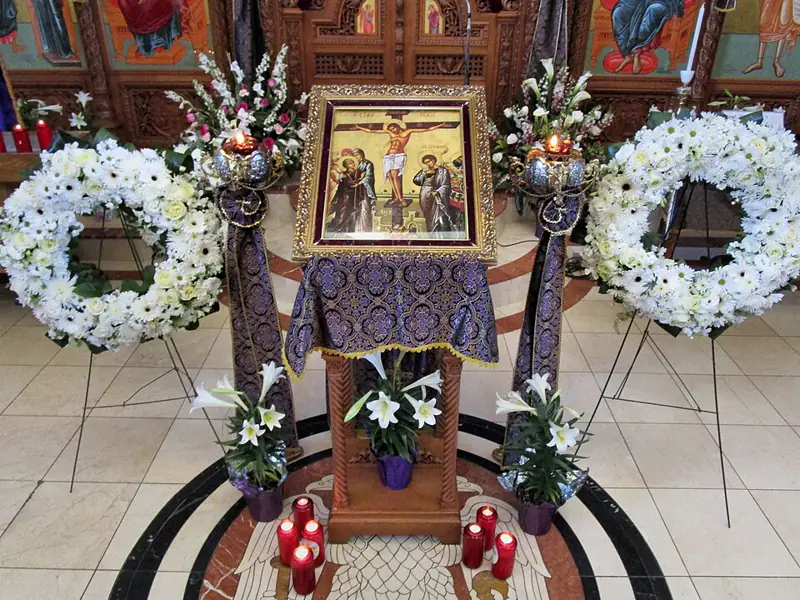
The Theotokos at the Cross of Her Son and God
Weep not for Me, O Mother, beholding in the tomb the Son whom thou didst conceive in thy womb without seed: for I shall arise and be glorified as God, and shall exalt in glory unceasingly those who in faith and love sing thy praise.
At last the hour came when the divine economy of the salvation of mankind was to be fulfilled. In the last years of the Saviour’s earthly ministry the Theotokos could no longer often be at His side. But when the hour arrived, the Mother of God was in Jerusalem, and together with other women she herself went with Him to His death and torment — to Golgotha. “And many women were there, which followed him from Galilee, ministering unto him.” The greatest sorrow wounded her. Her heart was pierced by suffering as by a sword.
The sword foretold by Symeon passed through her soul. For three and a half years Jesus had served the work of the salvation of mankind. When His preaching was finished He entered Jerusalem as the King of glory and a conqueror; the people spread their garments in the way. The heavens were filled with rapturous cries: “Hosanna to the Son of David: Blessed is the King that cometh in the name of the Lord; Hosanna in the highest.”
The high priests, the Pharisees, the scribes and the elders were enraged at the glorification of the Nazarene they hated as King. They resolved to give the Righteous One over to death, but by day they did not dare to seize Him, did not dare to stir up the people who paid Him honour. A few days later, when the darkness of night had covered the land, armed soldiers led by Judas Iscariot lay in wait for Jesus near Gethsemane, where He loved to pray in solitude. He prayed for the race of men until His sweat was as blood, while men at that very time, like beasts of prey, were lying in wait for their victim. We cannot even picture without tears the state of the Theotokos in the hours of these terrible events. She submitted to the will of God and accepted the death of the God-man on the cross as the sacrifice for the redemption of mankind. But a mother’s loving heart suffered cruelly as she saw the torments and insults inflicted on Him by the evil enemy. If she did not see, she learned at least all that her divine Son endured at the judgement of Caiaphas, before the procurator Pilate, in the palace of Herod. She was able to see Him only when Pilate brought Him out to the shame of the whole land and, handing the divine Sufferer over to the people, spoke the words: “Behold the man!” Bloodied, covered with wounds, His face disfigured by blows, clothed in mockery, with the crown of thorns on His head and a reed in His hand, He stood all alone, defenceless and forsaken by all. What words can convey a mother’s feeling? O All-holy Theotokos, how thy heart groaned when thou didst see thy Son and God so humbled?! Standing by the palace, she heard the voice of the herald proclaiming the sentence of death passed by Pilate! She saw the heavy cross raised up, which the Saviour of the world was to carry to the place of execution, that there He might be nailed to this very cross.
After some hundred paces, at a turning of the street, the Saviour’s strength failed Him and He sank to His knees under the weight of the cross; the road climbed steeply uphill again, and Jesus’ strength gave out once more. Heavy was the suffering of the Theotokos, who saw His torment; the women who went with her also wailed and lamented. Jesus Christ turned to them and said: “Weep not for me, but weep for yourselves, and for your children.”
Here is the steep ascent to Golgotha — to the “Gate of Judgement”, on which the sentences of criminals were also hung up and at which Jerusalem came to an end; from here began the Place of a Skull — Golgotha.
Golgotha! Terrible Golgotha! Here they brought the divine Martyr, and here for the first time the Mother had to see the inhuman suffering of her Son! She sees all the preparations for the execution, she hears the blows of the hammer that nails the hands and feet of her Son and God to the cross, and the sound echoes heavily in the mother’s heart. Only One — the God-man — could read the grief that tormented the Mother through these days, when only His grace upheld her. She came up to her crucified Son and stood close by; she looked for human sympathy from no one, trusting in God alone. With fear and with an unspeakable pain of soul she watched His torment until His last breath. The Mother of God was nowhere to be seen when Christ was glorified: she was not on Tabor, nor did she appear anywhere in the hour of the people’s rapture, when cries of “Hosanna” were heard on every side. And now, when not even the apostles remained, except John, when even strangers could not look on this terrible sight unmoved but “smote their breasts, and returned”, she stood fearlessly near the crucified Jesus: she understood that the redemption of mankind was being accomplished on the cross, that her Son had offered Himself for the reconciliation of mankind with God.
When Jesus Christ was crucified, those most devoted to Him stood far off, because a crowd of enraged people surrounded the cross and let no one come near. But when at midday darkness covered the sky and the people went away, the Lord’s worshippers followed His Mother to the cross. The women with her wailed and lamented, but the Mother of the Lord did not weep: she was silent! Her grief stood higher than tears; she was silent from boundless sorrow: the Source of life, the Consolation of Israel, had been slain, mocked, numbered with the transgressors! In the Saviour all fallen mankind died, that, redeemed by the divine blood, it might rise again to life eternal.
The holy Church expresses in moving hymns this suffering state of the Theotokos as she stood by the cross: “Beholding Thee, the Creator, nailed upon the tree, she who bore Thee cried out: Where, O my Son, is Thine unfading beauty? I cannot bear Thine unjust slaying, O Sweetest One; but fulfil the abyss of Thy mercies and arise, that I may behold Thy glorious Resurrection on the third day and worship.”
From the cross the Saviour saw what grief was rending His Mother’s heart. In all the world only she was left — yet no longer as the mother of that Jesus who had been the object of all Israel’s hope, but of Jesus condemned and numbered among evildoers. He had accomplished the redemption of the race of men and, nailed to the cross, was ready to seal His redeeming mission with His death; crucified and racked with unbearable pains, with what could He comfort His Mother?! Suddenly the Son spoke to her from the cross — to her who shared in His suffering — and pointed to His beloved disciple: “Woman, behold thy son!” He is dying, and wishes to leave His Mother a pledge of divine love. He possessed no treasure in this world, He had not even a stone on which to rest His head, even His tomb He received from compassionate disciples; He could leave His Mother no earthly good — but what an unspeakable treasure He entrusts to her with these few words: He appoints her mother of His disciple and shows her that she must love him as a son, and in his person He gives her the love of all redeemed mankind.
“Behold thy mother!” — Christ goes on, turning to the disciple. He points to the All-holy Theotokos with a look that is the Son’s last farewell greeting to His Mother. “Behold thy mother,” He says, as it were, to the disciple: I am leaving this world and I leave you My Mother; give her the honour that is her due, do her will, turn to her in the time of trial, sorrow and pain, call on her for help in weakness and distress; she will bring you peace and protection and will be your intercessor.
The disciple understood the Saviour’s words before His death: he took the Theotokos into his own house, cared for her as a son and did not leave her until her death.
John the Theologian is an example of the reverence with which we should turn to the Theotokos, whom the Saviour gave us as our mother in the person of John: that we should never depart from her throughout our lives, and should seek her intercession in every circumstance.
When He had accomplished the work of the redemption of mankind, the Son of God commended His spirit to God the Father and rested in the flesh. His All-holy Mother took care of His burial. Of this care the holy Church says:
“Straightway she who bore Thee hastened in secret to Thy disciple Joseph, and with lamentation besought him in secret that he would fervently ask for Thine incorrupt body from the judge of falsehood, the all-transgressing Pilate.”
“When Joseph beheld Thy Mother mourning, O King, and heard her sorrowful words, he was moved with compassion to lamentation and made haste, that he might worthily ask for Thine all-incorrupt flesh.”
When they had received permission, the secret disciples of Christ, Joseph and Nicodemus, took His holy body down from the cross with the fear of God. According to the hymns of the Church, the Theotokos too was with them at this time.
“The Spotless one embraced Thee and kissed the wounds of Thine incorrupt flesh, and said to Thee: With Thee will I die, for I cannot bear to see, my Child, this stream of Thine all-pure blood.”
“Thy Mother fell at Thy knees, O King; with lamentation she kissed and embraced the blood flowing from Thee, and made it her anointing, sprinkling it with understanding.”
“I cannot bear Thy silence, Thou whom I nursed as a babe carried in my bosom; if Thou goest down into hell to Adam, I too will go down with Thee and tell Eve the mysteries.”
“To the bearer of the mystery of the Nativity the Virgin said, O King: Woe is me, Gabriel, where is thy ‘Rejoice’? Where are thy tidings? Where is thy ‘Blessed art thou’? The Light of my womb has been quenched upon the cross.”
The day was drawing to a close, and so they hastened the burial. The noble Joseph and Nicodemus laid the body of Jesus, washed with spices and wrapped in a shroud, in a new tomb, and rolled a great stone to the door. At the taking down from the cross and the laying in the tomb the All-holy Mother lamented beside the body of the Lord, and the holy Church has set down her lament in a moving hymn.
“Today upon the tree He is put to death who was well pleased to come forth from my womb, as He knoweth.”
“Instead of swaddling bands Thou art clothed in winding sheets, O my Son; instead of a manger they have laid Thee in a dark tomb.”
“Thou didst go down, my Child, into hell, and as God didst raise up those of mankind given over to corruption together with Adam himself.”
The Jewish elders were not content that Jesus Christ, whom they hated, had been put to death, nor did their fear of danger subside: for complete peace of mind they sealed the tomb with the seal of the Sanhedrin and asked Pilate for soldiers to guard it. But what are the wiles of the evil one worth?! The seal could not stifle divine justice, and the flesh of the Righteous One “saw no corruption”! The Saviour rose from the tomb in glory.
Let all flesh keep silence and stand with fear and trembling!.. Alleluia!..



