
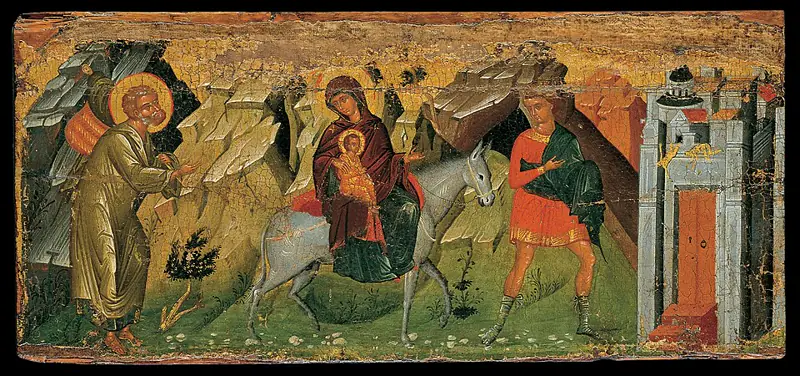
The Life of the Holy Family after the Return from Egypt
“And he went down with them, and came to Nazareth, and was subject unto them”
The road back from Egypt lies across the plain of Ascalon, and from there turns toward the spring of the All-holy Theotokos and passes through the valley of the giants. Near Jerusalem there is also a mountain resting-place with excellent water, where according to tradition the holy travellers spent the night, and where Joseph was told to withdraw into Galilee and settle in Nazareth.
So after a long absence the Holy Family returned to their humble home in Nazareth. Here, until the Lord was thirty years old, the Virgin Mary led a wholly unnoticed life. The days passed quietly and peacefully in work and prayer. The boy Jesus grew and waxed strong in spirit, filled with wisdom, and the grace of God was upon Him. Righteous Joseph went on working as a carpenter, and the Lord Jesus, who gave life to all that was made, was fed with His All-holy Mother from the hands of a carpenter; He Himself helped in the work, and with such diligence and obedience that the Jews called Him the carpenter’s son, or simply the carpenter. According to the custom of the time a father was bound to care for his son until the age of twelve, and from then on the son began an independent life (Joseph cared for Jesus in such a way that the Theotokos herself called her aged betrothed the father of her Son).
After the return from Egypt the holy Virgin was busy with her usual tasks — prayer, reading and handiwork. She worked tirelessly. Among her other work she wove with rare skill the tunic that afterwards became the constant garment of Jesus. This tunic was of one piece, without seams, and red in colour.
For the All-holy Mary there was no greater joy than the gradual revealing of divine majesty in her Son; she lovingly took upon herself the earthly care of Jesus, although He needed neither protection nor instruction. The All-holy Mother watched with reverence all that she saw in her Son; all that she heard from Him and about Him she kept.
In the promised Messiah the whole treasury of wisdom and grace lay hidden: He had no need to learn anything from men, but according to His human nature everything in Him was revealed little by little: “But his mother kept all these sayings in her heart.”
From the Gospel of John it can be seen that the learned Jews of Jesus’ time were amazed at His deep knowledge of the Holy Scriptures; they knew well that He had not studied anywhere, and found by experience that not one Pharisee, scribe or lawyer knew as much as He. Throughout His open ministry to mankind He was constantly surrounded by their narrow views, according to which the rulers of the synagogue, possessed by thirst for glory and wealth and by other unworthy aims, kept the law to the letter. He did not teach as the scribes and Pharisees did, who constantly needed to be taught by one another, but as one having authority: His every word came forth from the truth, His every saying was the fruit of a mind so lofty, holy and bright that whole companies of lawyers, scribes and Pharisees could not answer Him; every word and teaching was His own; the life-giving fountain of wisdom, which gave drink to all and led them to perfection, needed no one’s support. Such a word could only be spoken from God and by God.
His life was so simple, humble and unnoticed that the Apostle Nathanael, who came from Cana of Galilee, an hour’s walk from Nazareth, had heard nothing of Jesus, and only learned from the Apostle Philip that Jesus of Nazareth was He of whom Moses and the prophets had written.
Joseph and the Virgin Mary, from a deep sense of godliness, kept the law exactly, and according to it went up every year to Jerusalem for the feast of the Passover. Jesus was twelve years old, which by Jewish custom was reckoned the age of passing from childhood to youth: at this time a boy became a son of the law and was bound to keep its commandments, to know some trade and to take part in public worship. The All-holy Virgin, going to Jerusalem with Joseph, took the twelve-year-old Jesus with her. When the days of the feast were over, the pilgrims went home. The Virgin Mary and Joseph the Betrothed set off home with the company of pilgrims from Nazareth and its neighbourhood. They were sure that Jesus too was following them, with acquaintances and kinsfolk, and so went on their way untroubled. Up to two million people gathered in Jerusalem for the feast of the Passover; naturally, in such confusion it was very hard for each family to keep together. They all set out in small groups and in the evening stopped at an appointed place, near the village of Michmash. The All-holy Mary and Joseph went round all the groups of pilgrims who had stopped to rest and did not find Jesus. A terrible grief seized them, and there rang in their souls a reproach: how could they have let out of their keeping the most precious treasure of God entrusted to them? Forgetting their weariness they hurried back to Jerusalem, and for three agonising days searched for Him in vain. Crushed and worn out by grief and trial, they went into the temple to pour out their sorrow before God and ask His help. What a wondrous sight their eyes then beheld: at one of the gates of the temple a boy of twelve sat among the renowned teachers of the people and the interpreters of the word of God, surrounded by listeners! He listened to their words with a boy’s obedience and questioned them with the authority of a King. Fear seized the learned elders and scribes when they saw the wisdom and knowledge of the boy. With grief and fear, overcome with the deepest love, the Theotokos said to Jesus: “Son, why hast thou thus dealt with us? behold, thy father and I have sought thee sorrowing.” The Lord Jesus heard His Mother’s words and reminded her that besides His earthly duties another, weightier duty lay upon Him: “How is it that ye sought me? wist ye not that I must be about my Father’s business?” These are the first words from the Saviour’s lips that we hear in the Gospel. As a Son He answered His Mother with love; and as the King and Saviour of mankind He taught her who bore Him to prepare to see in Him the doer of those works for which the Heavenly Father had sent Him. But He did not free Himself from obedience to His Mother and His foster-father, and returned with them to Nazareth.
Tradition says nothing of their later life in Nazareth, but the Gospel narrative teaches us that Jesus, having returned to Nazareth, was in full obedience to Mary and Joseph: “And Jesus increased in wisdom and stature, and in favour with God and man.” With these words the holy Evangelist ends his account of the childhood of Jesus Christ.
Some years later, before the Saviour went out to His ministry, the angel of death came to the Holy Family: the aged Joseph died; he had recognised in Jesus the long-awaited Messiah, and this righteous man, surrounded by the love of the All-holy Theotokos and her Son, reposed in peace. Tradition says that he died at the age of a hundred and ten and was buried in the cave of Gethsemane.
The all-incorrupt Mary bade farewell to her earthly protector and entrusted herself wholly to the protection of the Heavenly Father; she awaited the open establishment of her Son’s Kingdom — not an earthly kingdom, but the spiritual Kingdom of grace and truth.
So, unnoticed, thirty years of the Saviour’s earthly life went by.



