
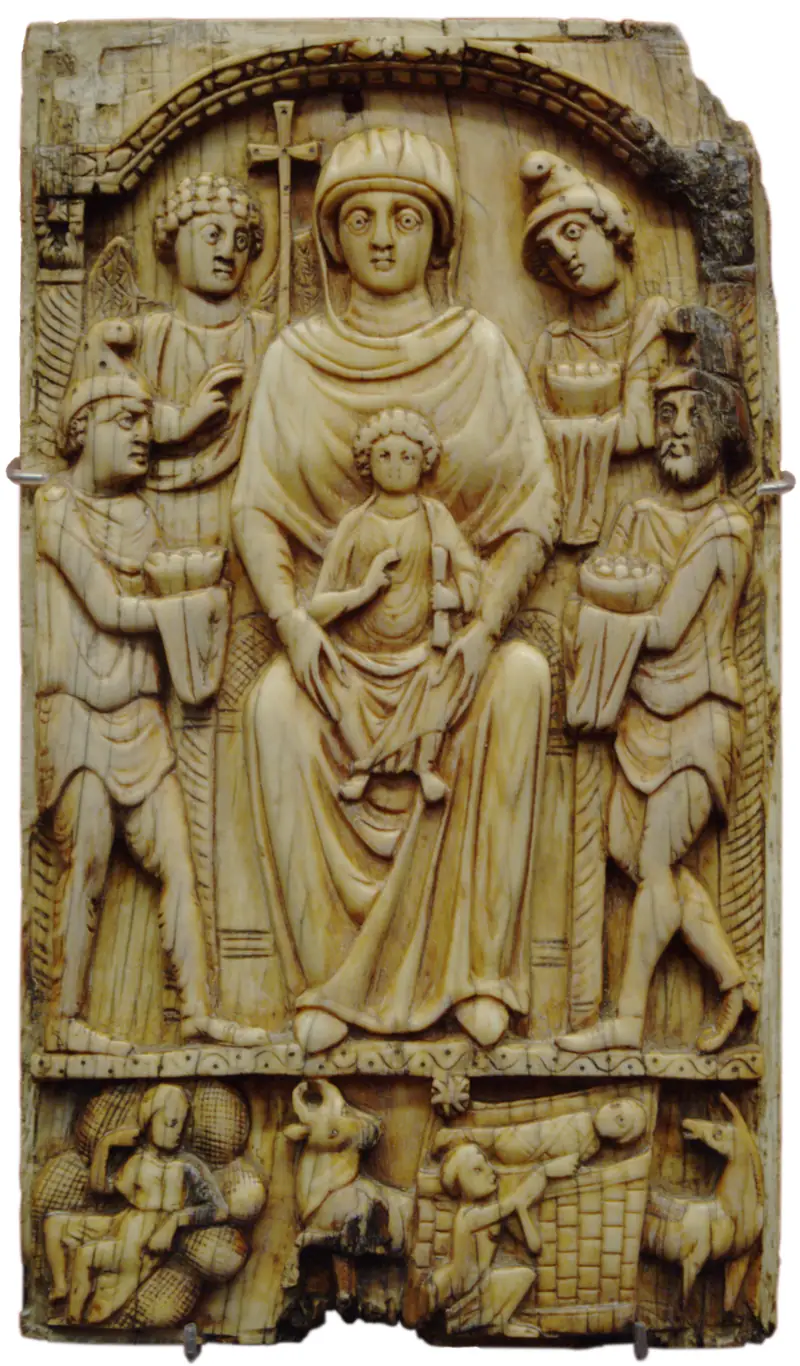
The Adoration of the Magi
Now when Jesus was born in Bethlehem of Judaea in the days of Herod the king, behold, there came wise men from the east to Jerusalem.
The glory of the divine Child did not stay hidden in the darkness, in the cave and the manger; it was not the field of Bethlehem alone that answered Him who lay in the manger, and not to the poor shepherds alone that the glory of God was made known: they were only the first of the chosen, the pointers of the way that leads to the light. A wonder came to pass in the knowing and confessing of Christ the Saviour: every creature brought a gift to the new-born Lord: the angels a hymn, the heavens a star, the shepherds a wonder, the Magi gifts, the earth a cave, the wilderness a manger, mankind a Virgin Mother, paganism a Christian beginning in the persons of the Magi. So the divine power shone forth from the new-born Saviour of mankind.
Before the Nativity of Christ a wondrous star appeared to the east of Bethlehem, in which the Chaldean Magi recognised the star of Jacob foretold by the prophet Balaam in 1450 BC. Because of this prophecy the belief had spread through the whole East from the most ancient times that a great king would be born in Judea who would rule over the whole earth, and that his birth would be announced by the appearance of an extraordinary star.
As soon as this marvellous star appeared, which in its motion did not obey the common law of the heavenly luminaries, the astronomers of the East, comparing it with the prophecy of Daniel, understood that it pointed to the expected birth of the divine King. These chosen ones among the wise set out for Jerusalem to find the King of the world and to worship Him.
According to tradition the Magi were kings, or chosen leaders from Persia — of three ages and of three races. Melchior, an old man, a descendant of Shem; Caspar, a beardless youth full of strength, a descendant of Ham; and Balthazar, a man just come into his maturity, a dark-skinned descendant of Japheth. They are called Magi not because they practised magic or sorcery, but because in Persia and the other lands of the East this was the name given to wise observers of nature, students of the uncommon science of the starry sky.
Having left their flourishing country, the Magi travelled long along the sandy road of the Palestinian desert; since they came to Bethlehem a short time after the birth of Christ, it is supposed that the star appeared long before the Saviour’s Nativity. As the holy fathers hold, this happened on the very day and in the very hour of the Annunciation. The whole time the guiding star went before them — as once the pillar of light on the shores of the Red Sea showed the way to fleeing Israel. This truly wondrous star did not obey the law common to the heavenly bodies. It always went ahead of their caravan, travelling in a straight line toward Jerusalem, from the east to the south-west. Besides this, it moved continually in the lower layers of the air and was so low and so near that they could follow it. From time to time it stopped and hid in the clouds, as if giving them time to rest. From its outward appearance some compared it to a comet, others called it a fiery meteor. In truth this heavenly phenomenon should be called an invisible, rational power that pointed to the incarnate Saviour of the world.
Just before they entered Jerusalem the guiding star vanished from the eyes of the astonished Magi. Did this mean that they had reached the goal of their journey?! Was the royal Child in Jerusalem?! But had this star shone out in Jerusalem, would not the whole people have followed it to Christ, and would not Herod himself, with the envious leaders, have tried to put Him to death with all haste?! The star hid itself, the Magi entered Jerusalem and began to proclaim and tell of the star that had appeared, which after long waiting was the herald of the Messiah’s coming. But this joyful news did not bring general happiness to Jerusalem. From the splendid attire of the travellers and the luxury of their caravan, everyone took them for kings and leaders come from the East. At their question — where is He that is born King of the Jews, whose star they had seen in the east — Herod was troubled, and all Jerusalem with him.
Herod was troubled — and how could he not be troubled?! He had become king neither by the blessing of God nor by the will of the people. He had obtained the right to reign by flattering the Roman rulers. He had bought this right with heaps of gold, and wrung it from the Jewish people by violence and lies. The rich nobles hated him just as much, for their heads fell at the first breath of suspicion. He was hateful too to the Jewish clergy, whose rights and privileges he had curtailed. The people hated him with all their strength for his foreign birth, his cruelty and his loathsome hypocrisy.
To please the Romans he frequented the pagan temples dedicated to their Caesar, Augustus, and to win the Jews over to them he spared no treasure in adorning these temples.
How could he not tremble with fear for his own fate and that of his descendants?! This was not the first time he had heard of approaching danger: shortly before the appearance of the Magi the Pharisees had foretold the fall of his throne and had refused with hatred to swear allegiance to him.
The general expectation of a great King from the East — and from Judea in particular — frightened him all the more because while still in Rome he had learned of the King’s expected birth.
When the news was brought to him of the arrival of these renowned foreigners, who were asking everyone where the King of the Jews had been born, whose star they had seen in the east, Herod was afraid, but did not wish to let the people see it. He summoned the high priests and the Pharisees and found out from them the time of the star’s appearance. A plan for killing the Child King had already taken shape in his soul; but he told the Magi that the promised King was to be born in Bethlehem, and asked them to hurry there, search diligently for the Child and, when they found Him, let Herod know too, so that he also might come and worship the King.
Like people of deep thought in general, who are occupied with science and contemplation, the Magi were warm-hearted and sincere and did not suspect cunning and malice in those around them. They understood that a ruler of a country might be wilful and cruel, but lies and treachery they could not imagine at all.
After their conversation with Herod the Magi went out of Jerusalem to the left, by the mountain road to Bethlehem. Suddenly the star shone again in the sky, came swiftly down toward them to show them the way, and went before them until it stood over the place where the Child was. At the entrance to the cave it came still closer to the earth. When they saw the star standing motionless in one place and shedding a brilliant light over the entrance to the cave, the Magi were filled with true, unshakeable faith, and the greatest joy was given them by the understanding that the expectation of the old world had come to an end, and with it its turmoil, its falsehood and its error.
Coming into the cave, the Magi felt no disappointment at the poverty and want of the Holy Family, but meekly set foot in the underground temple hallowed by the presence of the Lord Himself, and bent the knee. According to the custom of their people they took off their shoes and, falling prostrate on the ground, worshipped Him as the true God. In keeping with the ancient commandment given by God they offered costly gifts — all that they thought fitting for the God-man. Melchior, king of the Chaldeans, offered the Lord frankincense, that is, incense, as to God; Balthazar the Persian, gold, as to the eternal King; Caspar the Ethiopian, myrrh, as to the God-man who by His death on the cross would redeem the sins of the whole world.
The All-holy Mary and Joseph the Betrothed watched with amazement this humble worship of the kings of the East and listened attentively to the account of the miraculous appearance of the mysterious star. They marvelled at the godliness of the pagans, and their journey astonished them too: a great light had shone upon those who until now had walked in darkness, and the Magi fell to the ground once more to worship the Child Lord and His All-holy Mother. Having reached the goal of their journey, the Magi meant to go from Bethlehem by way of Jerusalem again and, as Herod had asked, to tell him where the promised Messiah dwelt; but an angel of the Lord appeared to them in a dream, told them of Herod’s evil intent and commanded them to return by another way.
Herod laid skilful plans of murder, but the experience of the ages has shown that cunning and lies are foolishness in the eyes of God. Every false and evil design is as nothing before almighty God, and leads only to the fulfilment of His holy will.
When the Magi, by the will of God, did not carry out Herod’s errand and left Bethlehem by another way, a new design took shape in his evil soul, and in carrying it out he astonished the whole world with his cruelty.
The example of the Magi, who in ancient times were the representatives of learning, has shown us that great and deep knowledge is a grace of God that leads to the knowledge of the true God.
Holy tradition tells that these wise worshippers of the Child Jesus, made wise by divine grace, were afterwards baptised by the Apostle Thomas, who preached the Gospel in Persia.
The people which sat in darkness and in the shadow of death — to them light is sprung up!..



