
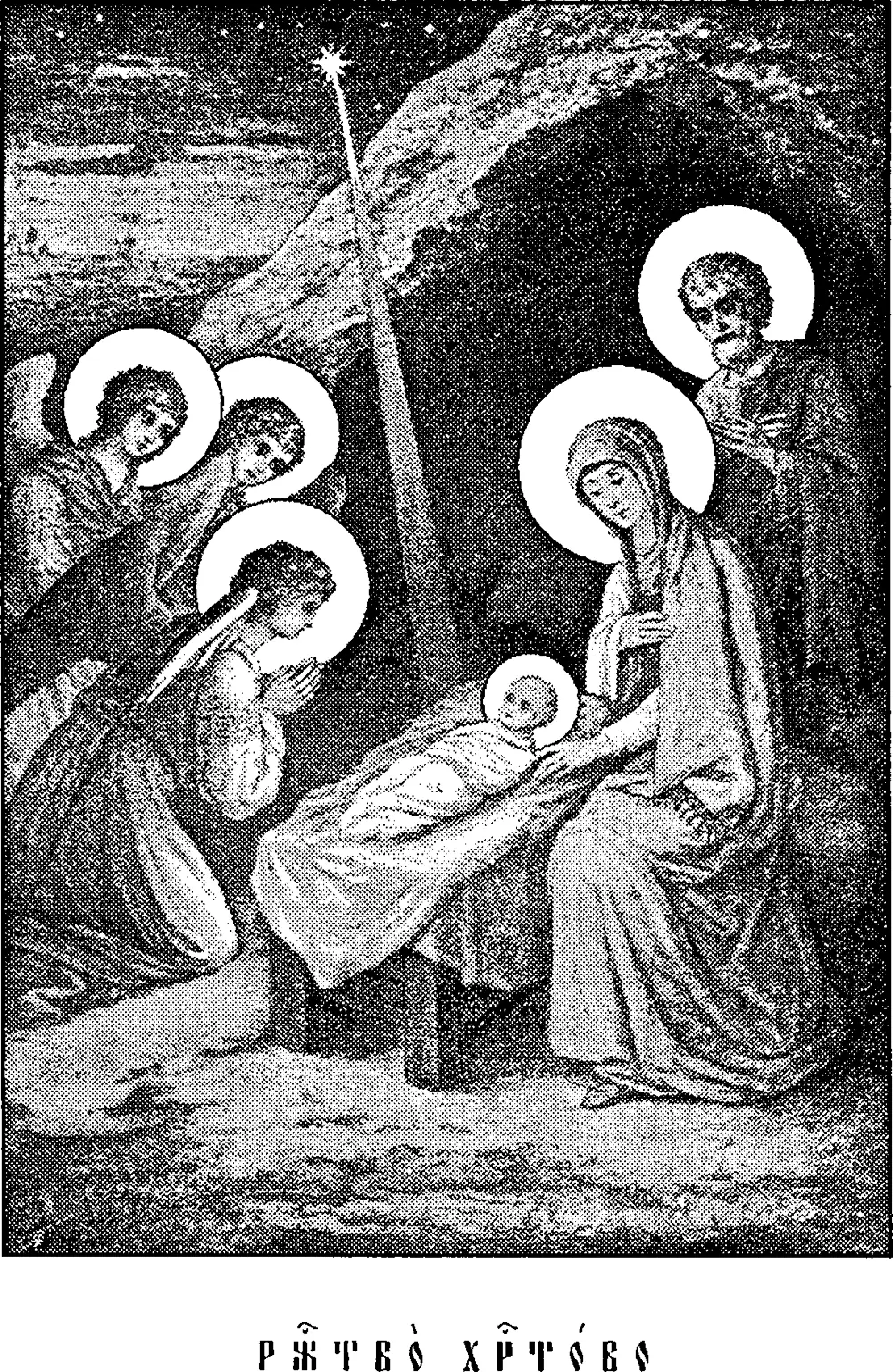
The Nativity of Christ
Glory to Thee, O Lord!
When the first parents of the human race were driven out of paradise for breaking God’s commandment, the Lord in His ineffable mercy gave fallen mankind the promise of redemption. In this promise there was also a prophecy about the All-holy Virgin: “The seed of the woman shall bruise the serpent’s head.” This first joyful tidings of the All-holy Mother of our Saviour was repeated many times, to prepare men for the coming of the Messiah.
Before the Nativity of Christ a universal expectation of the Saviour’s appearing prevailed. The Jews reckoned this event from the prophecies. The pagans too were waiting impatiently for deliverance from unbelief and from every lawlessness. All the foretellings and prophecies connected with the incarnation of the Son of God were fulfilled. The patriarch Jacob foretold that the tribe of Judah would lose the sceptre; the prophet Daniel announced that the Kingdom of Christ would come after a kingdom had been established as strong as iron, which would crush and break all things in pieces, and that the Saviour of the world would appear seventy weeks after the going forth of the decree to restore Jerusalem.
And now the time had truly come when the sceptre had been taken from the descendants of Judah and had passed into the hands of Herod the Idumean; the iron state of Rome had arisen, destroying all, and the date announced by Daniel had arrived. Peace had settled upon the world, which according to prophecy was to go before the coming of Christ, the One who unites heaven and earth.
A small number of the chosen awaited the Messiah as the Deliverer from sin and death; most of the Jews were waiting for the coming of a Saviour who would be a conquering king, who would deliver them from the rule of foreigners and make them masters over other peoples.
Rome had stretched its iron sceptre over almost every country then in existence and united them into one empire; Palestine had become a Roman province. Matters of faith were governed by the great Sanhedrin, made up of the high priests, the priests and the elders. The expectation of the race of men was fulfilled when Augustus ruled the Roman Empire and Herod ruled Judea.
At this time there went out a decree from Caesar Augustus that a census of the people should be taken in all his lands, Judea among them. By force of this decree every Israelite hastened to his native town to be entered in the state census. Wondrous is the work of divine providence! Caesar, proud of his earthly glory, appears as the blind instrument of the Lord’s will and serves God’s design. The will of an earthly king summoned Joseph and Mary to Bethlehem, that the will of the Heavenly King might be fulfilled. Joseph and Mary had to go to Bethlehem, the birthplace of King David, where the genealogical records of the royal line were kept, so that the name of Jesus, before whom every knee of the heavenly powers bows, should be enrolled among the subjects of a pagan ruler. Glory to Thy lowliness, O Lord; let all pride vanish from our hearts!
In a harsh season of the year and entirely without means, in unfavourable circumstances, Joseph and Mary had to set out on a difficult road. At best the journey required more than three days and nights. Bethlehem, a small town once called Ephratah, lay north of Jerusalem on the Hebron road, three days’ journey from Nazareth. David was born in Bethlehem, and it was here that he was anointed king. The whole house of David was in Bethlehem, and so it was rightly called the ancestral city of King David.
At last they reached Bethlehem, but found nowhere to rest. The little town was full of newcomers. The holy pilgrims looked for shelter in vain. No one took them in, “because there was no room for them in the inn”. In the whole town not even a free corner could be found. Without murmuring they went away from the dwellings of men and sought a lodging in the outskirts of the town, near the gate. North of Bethlehem, some two hundred paces from David’s well, there is a cave among the rocks in which shepherds sheltered with their flocks from storms and foul weather. In the depth of the cave a hollow cut into the rock served the animals as a manger. In this poor cave the holy travellers settled and remained in complete quiet and peace, far from the stir and turmoil of the crowd — alone, with the unseen Creator. A veil of mystery fell over the cradle of the Son of God, and so was fulfilled the prophecy of Isaiah: “Behold, he that shall dwell on high: his place of defence shall be the munitions of rocks.”
Amid these firm rocks, at midnight, the Virgin Mary without corruption gave birth to Him who was begotten of the Father before all ages, and “laid him in a manger”. Wondrous, beyond the grasp of human nature, was His conception; just as wondrously, just as far above nature, was His appearing before His young Mother. So a radiant luminary breaks through a cloud in an instant, to pour life over the world with its light and warmth.
The birth of the Saviour was not accompanied by pains: the Virgin gave birth in such a way that she kept all her cheerfulness and strength. When the All-holy one had borne her Son and our God, she at once set about serving Him. She needed no help from others and felt neither pain nor the weakness that women usually suffer. The Mother of God with her all-pure hands herself wrapped Him in swaddling clothes, laid Him in the manger and was the first to worship Him. She nursed Him at her breast; the Lord’s infancy passed in her arms; He spent His youth inseparably with His Mother until the age of thirty, until He declared to the race of men that He was taking upon Himself the sins of mankind, to grant salvation to the world by His death on the cross.
With trembling and reverent silence Joseph worshipped the All-holy Mother and her Son, our God. Seized by the joy of amazement, he perceived the wonder above nature and at once sensed that her Son was truly of the Holy Spirit; he understood that until she brought forth her firstborn Son — the Firstborn of the new life, the Firstborn of the New Covenant — Joseph had not known the Theotokos: he had not known who she was or of what he himself had been counted worthy; he had not known her as the Mother of God, because it had been hidden from Joseph what divine mystery was concealed in her. Only here, at the natural birth of the Son, did he fully grasp that it was of this that it had been said: “Behold, a virgin shall conceive.”
By the birth of the King and Saviour of mankind God showed the world a great and new wonder: instead of a palace, a cave in the wilderness; instead of a bed, a handful of straw. The Lord, who leaves not even a bird of the air without His care, in His wise almightiness prepared no earthly dwelling for His Only-begotten Son. The Son of God, the Master of heaven, lay in a manger; for the Lord and King of the universe, when He took flesh for the salvation of men, no place was found on an earth covered with sin and lawlessness. He Himself bears witness to this when He says: “The foxes have holes, and the birds of the air have nests; but the Son of man hath not where to lay his head.” Christ was conceived by an unknown woman, and in glorious Jerusalem was nailed to the cross; in little Bethlehem He was born, and in great Jerusalem He was given over to death. Wonderful are Thy works, O Lord!
At the moment of the birth of the Son of God heaven was opened, the glory of God lit up the earth that lay in deep darkness, hosts of angels came down from on high and sang with joy that peace had settled upon the earth and the mercy of God had been restored to men.
And what was the earth doing at this time, lit up by the glory of God? Everything was sunk in deep sleep: the Jews, awaiting the promised Messiah from whom they expected earthly glory, kept the law, and the pagans were drowning in sin before their idols.
So too they slept in Bethlehem — but not all. In the field of Bethlehem, ringed by hills and lying half an hour’s walk from the cave, stood a tower known by the name of Edar, near which the great King David had tended his father’s flock. At this hour of the night shepherds were keeping watch over their sheep. A sudden light shone upon them, an angel of the Lord stood before them and said: “Fear not: for, behold, I bring you good tidings of great joy, which shall be to all people. For unto you is born this day in the city of David a Saviour, which is Christ the Lord. And this shall be a sign unto you; Ye shall find the babe wrapped in swaddling clothes, lying in a manger.”
When the heavenly messenger had finished his tidings, suddenly, as if in confirmation of his words, there appeared a countless host of angels praising and glorifying the Lord: “Glory to God in the highest, and on earth peace, good will toward men.”
Not to the wise, not to the noble, not to the mighty and rich of this world did the Lord reveal His mystery, but to the poorest, the lowliest labourers on earth. He hid it from the wise and prudent and revealed it unto babes. O blessedness of poverty, giver of obedience and of silent meekness, destroyer of pride and arrogance! The Lord Himself comes down to the poor and pours out upon them a fountain of love and mercy. The angels went away into heaven, the great vision ended, the shepherds came to themselves, and all as one resolved to go to Bethlehem and see what had come to pass there. They knew well the places along the road to Bethlehem where there were mangers for the cattle and where poor travellers found shelter. They went, and found the All-holy Virgin and the Babe lying in a manger, and worshipped Him.
After the radiant appearance and the tidings of the angels, the divine Child, surrounded by simplicity and poverty, seemed to them all the more heavenly and full of light. Those who came to worship brought all they had: holy love, firm faith, and fervent praise of the Saviour and King. And since they wished to express their godly feeling, they told His All-holy Mother everything they had seen and heard from the angels. The Virgin Mary followed closely all that concerned the God-man born of her, and as she listened to the shepherds’ account she imprinted it on her memory and rejoiced that events were confirming God’s promise. Saint Joseph the Betrothed stood amazed and in awe before the true Light; the happy shepherds once more worshipped the Child God and His All-holy Mother and went away to their duties, praising and glorifying God and spreading through the whole country the joyful news of the wonder that had come to pass that holy night.



