
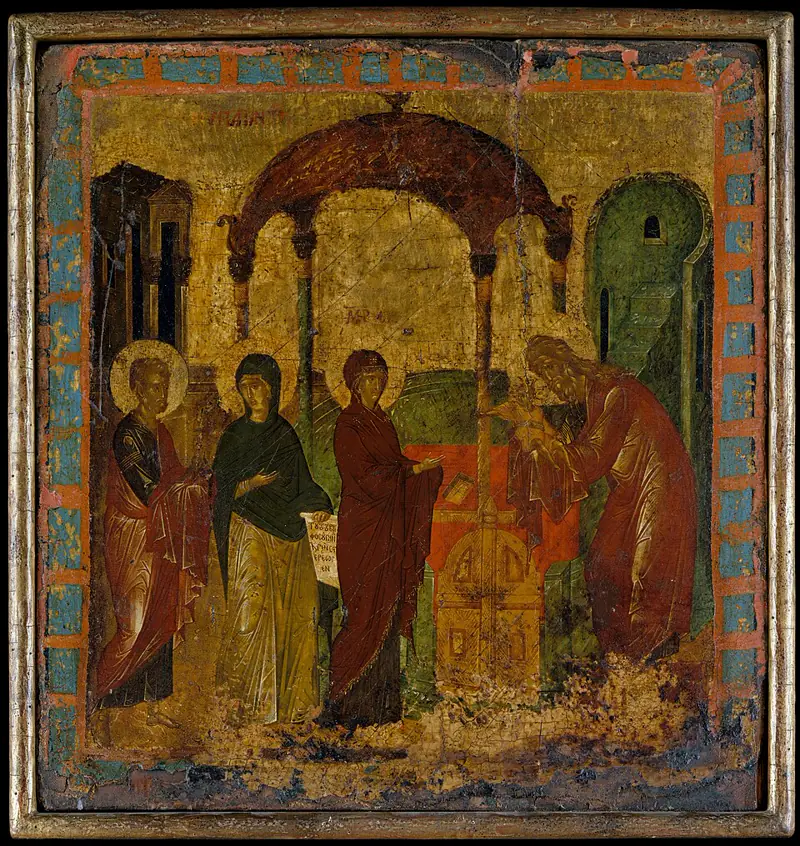
The Meeting of the Lord in the Temple
This is He who is from God, the Word of God, who for our sake became man and saved mankind: Him let us worship
After Israel came out of captivity, and in remembrance of the slaying of the firstborn of Egypt, the divine law required of the Hebrews that every male child, as the Lord’s own, should be brought to the temple on the fortieth day after birth, offered to God and redeemed from the Lord: this was called the presentation of the child in the temple. The firstborn of the Virgin Mary fulfilled the law: He was brought into the temple and redeemed — He who had come to earth to cleanse, redeem and raise men up by His death from eternal sin and death.
By the law of Moses a woman who bore a male child was counted unclean for seven days, and after that for thirty-three days she could not take part in public worship. On the fortieth day after the birth of her firstborn she was to go to the temple and offer God a lamb of the first year for a burnt offering, or, if she was poor, a pair of turtledoves or two young pigeons. The meaning of this rule is that if childbearing is a gift of God, then to whom but God should we offer the first fruit of that gift? The Hebrews were bound to dedicate their firstborn to God in token of thankfulness, because when He smote the firstborn of the Egyptians He spared theirs.
The Virgin Mary had become the Mother of the Lord; she had been sanctified by the birth and remained a holy Virgin, incorrupt, and so she had no need of purification; yet out of obedience she did not depart from the appointed rite. She was not puffed up by her purity, but on approaching the gate of the temple she stopped at the place set apart for women after childbirth. She brought an offering, but it was the offering of the poor: two young pigeons. When the priests had received the offering and made the burnt offering, the All-holy Virgin, with the divine Child in her arms and accompanied by Joseph, entered the temple.
At this time, at the prompting of the Holy Spirit, the aged Symeon came into the temple, approached Mary full of grace and took the newborn Child in his arms. That is why we call him Symeon the God-receiver. Filled with holy joy, the old man glorified God and sang prophetically to the Saviour of the world: “Lord, now lettest thou thy servant depart in peace, according to thy word: for mine eyes have seen thy salvation, a light to lighten the Gentiles, and the glory of thy people Israel.”
Holy Scripture says of this Symeon that he was “a man just and devout, the firstborn of Israel”. In the hymns of the Church Symeon is spoken of as a priest and high priest who offered sacrifices according to the law. There is also a tradition that Symeon, one of the most learned men of his time, was among the seventy-two interpreters who, at the command of Ptolemy Philadelphus, king of Egypt, translated the Holy Scriptures from Hebrew into Greek. The History of Nicephorus Callistus relates that while translating the first book of the prophet Isaiah, Symeon stopped at the well-known prophecy “Behold, a virgin shall conceive”; he wished to correct this place, to strike out the word “virgin” and write “woman”, but an angel was sent who held back his hand and forbade him to correct the prophecy, telling him that he would not see death until this prophecy had been fulfilled: “Believe what is written; you shall see its fulfilment with your own eyes.” After this Symeon went to the temple every day, and at the prompting of the Holy Spirit he recognised the Virgin Mary with the Child Lord in her arms, for they shone with an uncommon light.
“Lord, now lettest thou thy servant depart, for mine eyes have seen thy salvation,” cried Symeon, seized with divine rapture. The righteous old man addressed Jesus not as a newborn child but as the King and Lord who has power to end another’s life or, on the contrary, to prolong his earthly existence.
Giving the newborn Child back to Mary, Symeon blessed her and Joseph. At the prompting of the Holy Spirit Symeon foresaw the Saviour’s Passion on the cross and the tears and grief of His Mother, and he continued his prophecy: “Behold, this child is set for the fall and rising again of many in Israel; and for a sign which shall be spoken against; (yea, a sword shall pierce through thy own soul also,) that the thoughts of many hearts may be revealed.” Your Son, he explained, has brought salvation into the world, but not all will profit by it: He will be a raising up from the fall for His followers and for the faithful, but a stone of stumbling for those who will not believe in Him and cast Him aside. He will always be a sign that is spoken against, that the thoughts of men may be revealed: men will give the Saviour over to death, and you will be a witness of all these torments, and a sword will pierce your own soul too — such was the foretelling of Symeon, the representative of the Old Covenant, who went out to meet the coming of the Firstborn of the New Covenant, the promised Messiah.
As though for the full glorification of the eternal Child, the prophetess Anna came up to them, a holy widow who lived by the temple; at the prompting of the Holy Spirit she offered praise to God and glorified the divine Child in the hearing of all who in Jerusalem were waiting for deliverance and salvation. Anna was the daughter of Phanuel, of the tribe of Aser — known for her wealth and standing, and at the same time for her humility and meekness. She had lived seven years with her husband; after his death she dedicated herself to God and served at the temple in Jerusalem. Her days were spent in fasting, prayer and labour, and so she reached the age of eighty-four, when the greatest joy was granted her — to see and glorify the Saviour of the world. The holy Church calls her the all-praised widow, spotless, made like the desert-dwellers and the prophets.
When all the rites of purification had been fulfilled, the Holy Family returned to Nazareth.
The feast of the Meeting of the Lord has been kept by the Church from the most ancient times on the 2nd of February, as one of the Twelve Great Feasts; it confirms the undoubted truth that Christ appeared on earth not in thought, as a phantom, but in very truth. On the next day, the 3rd of February, the Church commemorates Symeon the God-receiver and the prophetess Anna: by the will of God Symeon’s life was prolonged beyond the ordinary, so that he might see the Child Lord with his own eyes and pass in peace into life eternal.
Rejoice, O Virgin Theotokos full of grace, for from thee the Saviour of the world, Christ our God, became incarnate; rejoice thou also, O righteous elder Symeon, for thou didst receive in thine arms the Deliverer of our souls, who granteth us great mercy.



