
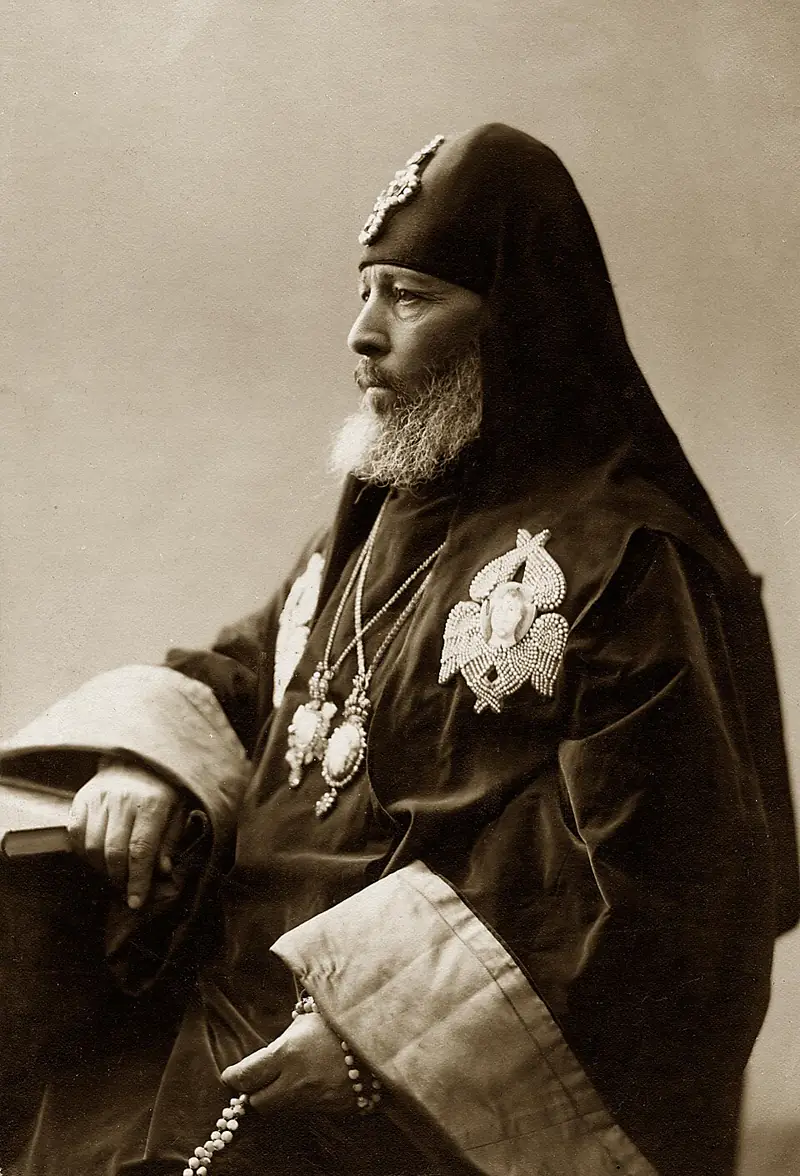
Kyrion II
Kyrion II (in the world Giorgi Sadzaglishvili, son of Ieronime; born 10 November 1855, Kvemo Nikozi, Gori district — died 27 June 1918, Martkopi) was a Georgian historian, churchman and public figure, and the first Catholicos-Patriarch of All Georgia after the restoration of autocephaly, in 1917–1918. In 2002 the Georgian Orthodox Apostolic Church numbered him among the saints.
Ancestry and family
Kyrion II's forebears did much to spread Christianity among the mountain peoples of the Caucasus, the Didoi and the Ingush. Patriarch Kyrion's father, the priest Ieronime Sadzaglishvili, also served among the mountaineers and laboured hard to restore and establish Christian traditions among the Ossetians.
Early years
Patriarch Kyrion, in the world Giorgi, was born on 10 November 1855. His family, which was poor, sent seven-year-old Giorgi first to the Ananuri church school, and from 1862 he continued his studies at the Gori Theological School. In this period, as the well-known populist writer Soprom Mgaloblishvili recalls, he and Giorgi Sadzaglishvili went round almost all the historic places of Shida Kartli, and then the Georgian antiquities of Maghran-Dvaleti.
Church and teaching work
In 1876 he graduated from the Tbilisi Theological Seminary, after which he went on to the Kiev Theological Academy, graduating in 1880 as a candidate of theology. The same year he was appointed assistant inspector of the Odessa Theological Seminary.
In 1883 he returned to his homeland and was assigned to the Telavi Theological School. Until 1896 he taught at the theological schools of Gori, Kutaisi and Tiflis and at the Tiflis Diocesan School for Girls, teaching Georgian and Russian, sacred history and geography.
In 1896 he was appointed dean of the monasteries of Georgia and inspector of the schools of the Society for the Restoration of Orthodox Christianity in the Caucasus. In this period he founded 19 parish schools and had schools built at Atsuriskhevi, Vanati and Tianeti; he gave every school a book store and a library. At the same time he published articles and studies in Georgian and Russian journals and newspapers on the history of the Georgian Church, folklore and Georgian literature, under the pen-names Iverieli, Sadzagelov and Liakhveli.
Monastic life
After the death of his wife and children, in 1896, he was tonsured a monk with the name Kyrion and took charge of the Monastery of Kvabtakhevi as its abbot. In this period Kyrion collected folk poetry and sayings in the villages of Kartli and studied the people's customs and the antiquities of the churches and monasteries. While abbot of Kvabtakhevi he brought 96 manuscripts from Kvabtakhevi and handed them to the Tiflis Church Museum, among them an eleventh-century Gospel book, a Psalter copied in 1494, and many other manuscripts.
As a member of the Moscow Archaeological Society, Kyrion described the historic monuments of the Liakhvi valley, publishing the description in 1898 (it is still of great importance, since many of those monuments were later destroyed by the Ossetians).
In 1891 Kyrion gave to the Society for Spreading Literacy among the Georgians: the Triodion, the Markhvani, the Georgian dictionary of Sulkhan-Saba Orbeliani, the Life and Conversation of the Blessed Andrew the Fool, a World History, a book in khutsuri letters, “A Festal Book, Most Profitable to the Soul in its Godly and Beautiful Narration, Called the Crown”, “The Divine Pearl” — an old church book written in khutsuri on parchment — an apocryphon on the Gospel of the All-holy Mary and on Joseph, an eighteenth-century manuscript of the Liturgy of Chrysostom, a Russian “Asamaghlebeli” written in Georgian letters, leaves from various manuscript books, “A History, or Narrative, of Holy Scripture, Old and New Testament”, glass bracelets, and four old silver coins found in the yard of the Ghvtaeba church in Telavi.
In the same period Kyrion studied an unknown manuscript of old Georgian apocrypha, which had been kept in the family of Ivane Ratishvili, marshal of the Gori nobility.
Bishop of Alaverdi
In 1898 Kyrion was consecrated bishop of Alaverdi and appointed second chorbishop (vicar) of the Eparchy of Kartli-Kakheti. Ilia Chavchavadze's Iveria greeted his appointment in these words:
As soon as he arrived in the Alaverdi vicariate, Kyrion began to care for the Cathedral of Alaverdi, which neglect had brought to the edge of ruin: its roof needed replacing and its enclosure wall repairing. Bishop Kyrion had a plan drawn up and began the repair of the cathedral at his own expense.
At the same time he gave 68 manuscripts to the Church Museum of Georgia, among them a Gospel book copied in 1089 (until this find Georgian scholarship had known nothing of a Gospel book from the time of Bagrat IV).
Kyrion turned his attention to a tendency that had spread in nineteenth-century Georgia. After 1811, when the Russian government, in gross breach of church law, abolished the autocephaly of the Georgian Church and imposed services in Russian, the people left the churches in protest. The leaders of the Armenian Gregorian Church took advantage of this and unlawfully occupied Georgian Orthodox churches. Georgian churches in Tbilisi, Gori, Telavi and Dusheti fell into their hands. On this question Bishop Kyrion addressed a long and well-argued memorandum to the Exarch of Georgia, demanding the return of the Georgian churches unlawfully seized by the Armenians. In reply to an article in an Armenian newspaper insulting to the Georgians, Bishop Kyrion, drawing on the Armenians' own historical sources, painted this picture of the Armenian nation:
He added at the same point that “historical sources must be looked at with human eyes, and we must not try to use them to belittle others.”
Bishop of Gori, and the beginning of persecution
In 1901 he was transferred to be bishop of Gori and first chorbishop (vicar) of the Eparchy of Kartli-Kakheti. Educated clergy gathered around Bishop Kyrion, openly voicing their discontent at the abolition of the Georgian Church's autocephaly. The government of tsarist Russia and the Exarchate of Georgia saw clearly the great danger that came from Kyrion's work. From this time began the persecution and harassment of Kyrion, and his transfers from place to place.
In the eparchies of Russia
In 1902 Kyrion was sent to the Eparchy of Kamenets-Podolsk, from there in 1903 to Kherson, and in 1904 to the Eparchy of Oryol.
It was precisely the result of Bishop Kyrion's work that in 1905 a great church assembly met in Tbilisi, where the Georgian clergy discussed the restoration of the autocephaly of the Georgian Church. At the demand of Exarch Alexy of Georgia, the Viceroy, Illarion Vorontsov-Dashkov, used Cossacks to break up the assembly. Russian Slavophiles printed letters in the Petersburg press condemning the attack on the Georgian clergy in Tbilisi. The leading part of Georgian society, headed by Ilia Chavchavadze, went to Viceroy Vorontsov-Dashkov and formally demanded that the question of the Georgian Church's autocephaly be considered. The tsarist government was forced to set up, formally, a special session in Petersburg at which the restoration of the autocephaly of the Georgian Church was to be discussed. Bishop Kyrion read two papers there:
“What Moves the Georgians to Strive for the Restoration of Their Church's Autocephaly”;
“The National Principle in the Church”;
In these papers Kyrion argued that bondage in the Church is worse than any other bondage. The commission, appointed as a formality and dominated by followers of Archpriest Ioann Vostorgov, rejected the demands of the Georgian clergy, after which the persecution and harassment of Kyrion grew still harsher.
In Sukhumi
In 1906 Kyrion was transferred to the Eparchy of Sukhumi, where he did a great deal to restore and strengthen the Georgian churches and monasteries. The bishop's work caused serious displeasure among the Russian officials, and as a result, on 27 January 1907, Kyrion was transferred from Sukhumi to the Eparchy of Kovno, accused of trying to make the Abkhaz Georgian.
In Russia again
In September 1907 Kyrion was not allowed to come to Georgia for the funeral of Ilia Chavchavadze. From Kovno he managed only to send a telegram of condolence.
In 1907 the Georgian Historical and Ethnographic Society was founded, which was to live on donations. Bishop Kyrion joyfully told the society's chairman, Ekvtime Takaishvili, that he was ready to help both financially and morally. E. Takaishvili recalled:
Suspension from ministry
In the winter of 1908, by decree of the Russian Synod, Kyrion was arrested and deprived of the right to serve as a priest. The bishop, at first left without a post, was sent under escort of gendarmes to the Kuryazh Monastery (Kharkov Governorate). From there, in January, the sick bishop was taken by gendarmes by way of Moscow to the Sanaksar Hermitage, where he was put in a cold, damp room and watched by policemen in plain clothes. Besides this, the Russian government accused Kyrion of the murder of Exarch Nikon, killed in Tbilisi on 28 May 1908. Such slander outraged the democratic part of both Georgian and Russian society. In this connection Evgeni Gegechkori, a deputy of the State Duma, answered a question from the press in these words:
In Europe a society for the defence of Kyrion was also set up, and it began collecting signatures demanding his release. On 20 March 1909 Georges Lorand, chairman of the society for the defence of human rights in Belgium, wrote from Brussels to Nikolai Khomyakov, chairman of the State Duma, asking him to protect Bishop Kyrion from persecution and harassment.
In spite of his hard conditions, Kyrion did not lose faith in the future. In a letter to the priest Ioseb Chijavadze he wrote:
The end of the persecution
In 1915 the Russian government ended the persecution and harassment of Kyrion. His right to serve was restored and he was given the Eparchy of Polotsk and Vitebsk, but he was not allowed to come home.
The restoration of autocephaly and the first Patriarch
Taking advantage of the February Revolution of 1917, the Georgian clergy resolved at an extraordinary church assembly:
that from now, from 12 March, the autocephaly of Georgia continues;
that until a Catholicos is elected, Bishop Leonid of Guria-Odishi is appointed to govern the Church for the time being;
that the government of the Georgian Church is entrusted to an executive committee made up of both laymen and clergy.
A group of Georgian believers led by Chito Kapanadze sent a delegation to Kyrion asking him to return to Georgia and take part in the election of the Catholicos-Patriarch of All Georgia. Kyrion thanked them for their regard but firmly declined the invitation; yet, at the insistent demand of Georgian society, in the summer of 1917 Bishop Kyrion set out for his homeland. As he came home, around a hundred horsemen led by Gigo Karangozishvili met the bishop in the Aragvi valley. He was escorted with great honour to the capital, and in Tbilisi he was given a splendid welcome. As soon as he arrived Kyrion threw himself into the preparations for the Council of the Church of All Georgia.
In the middle of April Bishop Kyrion had been offered the office of Metropolitan of Petrograd, which he declined, choosing instead to settle in the Monastery of Armazi.
On 8 September 1917 the Council of the Church of All Georgia opened in Tbilisi. It was chaired by Giorgi Zhuruli, Tripon Japaridze and Spiridon Kedia. The Council considered the eparchies of the autocephalous Georgian Church and the creation of the Council of the Catholicate. A commission to count the votes in the election of the Catholicos-Patriarch of Georgia was formed under the chairmanship of Archpriest Nikita Talakvadze. The election of the Catholicos-Patriarch was set for 17 September. Three candidates were admitted to the ballot — Metropolitan Leonid, Bishop Kyrion and Archimandrite Ambrosius, who withdrew. The election of the Catholicos-Patriarch of All Georgia was held in the Sioni Cathedral, and 448 people took part. By a margin of twelve votes the Council elected and confirmed Bishop Kyrion Catholicos-Patriarch of All Georgia.
On Sunday, 1 October 1917, the day of Mtskhetoba, Kyrion II was enthroned.
Although the Council had elected His Holiness and Beatitude Kyrion II Catholicos-Patriarch of All Georgia, it did not abolish the office of Metropolitan of Tiflis. The step was justified because Exarch Platon, appointed by the Russian government, had been calling himself Metropolitan of Tiflis since the proclamation of the Georgian Church's autocephaly, and this weakened Exarch Platon's position. His Holiness Kyrion II did not serve at Sioni: Leonid, Metropolitan of Tiflis, served there, and Kyrion at Anchiskhati, according to the ancient historical tradition.
As soon as Kyrion was elected Catholicos-Patriarch, intrigues appeared, fanned by the Russian Exarch's spies. Ioseb Imedashvili recalls:
Davydov was a spy of the Exarch and an enemy of everything Georgian. He was not elected, but the incident gave much cause for thought: Davydov tried more than once to insult Kyrion II and to do away with him physically.
Patriarch Kyrion II created a strong Council of the Catholicate, in which laymen sat alongside the clergy. The Georgian people celebrated with special solemnity Kyrion II's installation as Catholicos in Mtskheta, in Svetitskhoveli. The day fell on Svetitskhovloba. The consuls of England, Belgium and France attended the installation. The newspaper Sakartvelo reported:
In his address at his enthronement in Svetitskhoveli, Kyrion II stressed the need to keep the faith pure and for the Church and the nation to be one; respect for the other peoples living in Georgia; a greater role for the Georgian Church in learning and education; and the need to raise a national spirit among the clergy:
Kyrion II sent letters to the heads of the Orthodox Churches of the world, setting out briefly and with evidence the history of the Georgian Church and asking for recognition of its autocephaly.
The newly elected Patriarch had many problems to solve: gathering again the plundered and ruined property of the Church, restoring the eparchies and setting them in order, publishing Georgian religious literature, securing the barest means of living for the clergy, and more.
On 26 January 1918, the day of the commemoration of St David the Builder, the university opened in Tbilisi. Kyrion II, Catholicos-Patriarch of All Georgia, served a moleben in the university church.
Kyrion II greeted the declaration of Georgia's independence with delight: on 27 May 1918 he served a solemn moleben on Freedom Square and addressed the crowd with a fiery speech.
Murder
On 28 June 1918 the newspaper Sakartvelo reported:
Archpriest N. Talakvadze recalls:
Nikita Talakvadze suspected those who had prepared the ground in ideas for the Patriarch's murder and who were stirring up unrest and strife in the Georgian Church. For this Noe Ramishvili, then Minister of Internal Affairs of the Menshevik government, summoned Archpriest Talakvadze and reprimanded him. Noe Zhordania expressed his grief at the death of Catholicos-Patriarch Kyrion II, but the investigation was not directed where the truth would have come to light. The well-known writer Ioseb Imedashvili carried out an investigation of his own, on a voluntary basis.
Kyrion II was buried on 7 July, at 4 o'clock in the afternoon, in the Sioni Cathedral.
After the murder of Catholicos-Patriarch Kyrion II, the monk Mirian (Kyrion's bodyguard), Bishop Anton Giorgadze of Kutaisi and the priest Timote Bakuradze were killed.
The funeral procession
Kyrion, murdered in Martkopi, was laid first in Anchiskhati and then buried in the Sioni Cathedral.