
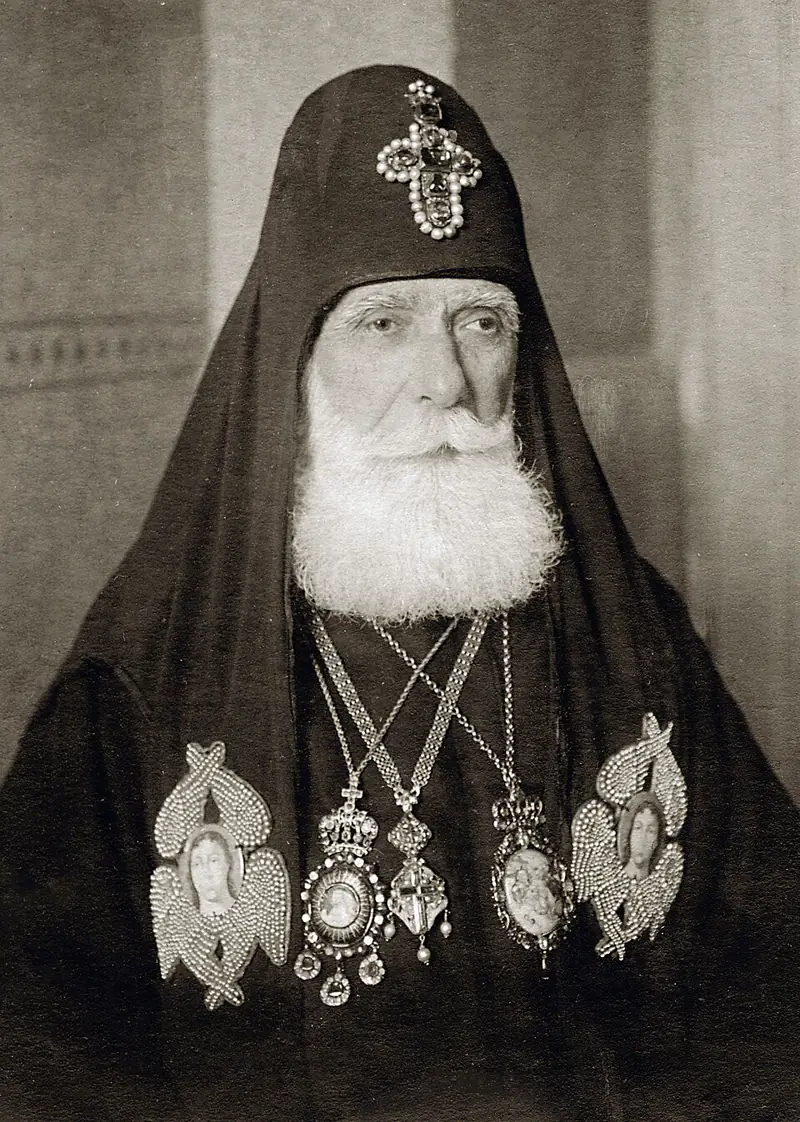
Callistratus
His Holiness and Beatitude Callistratus (in the world Kalistrate (Bichiko) Tsintsadze, son of Mikheil; born 24 April 1866, Tobanieri, now Vani Municipality — died 3 February 1952, Tbilisi) was a Georgian churchman, public figure and scholar, Catholicos-Patriarch of All Georgia and Archbishop of Mtskheta and Tbilisi from 1932 to 1952. On 22 December 2016 the Georgian Orthodox Church numbered Kalistrate Tsintsadze among the saints.
Biography
Kalistrate (Bichiko) Tsintsadze, son of Mikheil, was born on 12 April 1866 in the village of Tobanieri in Kutaisi Governorate (now Vani Municipality), into a priest's family. His parents had at first lived in the village of Mterchveuli. His parents were the priest Mikheil and Ekaterine Gogorishvili. Mikheil Tsintsadze had been educated at the Monastery of Jruchi, at the court of Metropolitan Davit Tsereteli. In 1878–82 he served in the church of the village of Gommukhaqrua. Kalistrate's brother Amfilokhe was psalm-reader in the Church of Sts Kvirike and Ivlita at Kormaghali.
His sister Matrona taught him to read and write at home, and deacons who were his father's pupils helped him learn the Horologion. In 1875 his family placed him in the Kutaisi Theological School. In 1882, having finished the Kutaisi Theological Seminary with distinction, he entered the Tbilisi Theological Seminary on the recommendation of Bishop Gabriel; there a harsh regime and an anti-Georgian spirit prevailed. In the same year, on 8 February 1882, his father died at the age of 47.
On 24 May 1886 his classmate Ioseb Laghiashvili killed the rector, Chudetsky, which was the beginning of the struggle against Russia's reactionary policy. Exarch Paul of Georgia presented the late Chudetsky as a martyr for the state and religious interests of Russia, and in the Church of St Alexander Nevsky in Tbilisi publicly cursed the Georgian nation: “It is not the victim of the evildoer who deserves mourning, but the milieu that bred the evildoer. Yes, the fathers and mothers of our land mourn that in our midst there are children left to their animal instincts. The gentleness of the family did not work on them; the kind and warm regard of the school could not influence them. They are possessed by an alien, false and harmful influence; they mourn that immoral men can even become ministers of the Church. Cursed be the people and the land that bring forth such evildoers.” These words of Exarch Paul outraged Georgian society. In an open letter to the Exarch, Dimitri Kipiani demanded that Exarch Paul leave Georgia at once. The Emperor reprimanded Dimitri Kipiani, removed him from his office as marshal of the Kutaisi nobility and exiled him to Stavropol, where he was killed in 1887. The seminarian Kalistrate Tsintsadze was in the thick of these events, and fighting for his homeland's interests became his plan of action.
In 1888 he finished the Tbilisi Theological Seminary, and from 1889 continued his studies at the Kiev Theological Academy, where he distinguished himself as a gifted student. In 1892 he returned to Georgia as a candidate of theology.
On 11 April 1893 he was ordained deacon of the Didube church, and on 18 April priest. From that time on nothing of importance happened in the political or church life of Georgia in which Kalistrate Tsintsadze did not take part. In 1903 he was transferred to Kashveti. From 1909 he was an archpriest. After the great change in the Russian Empire in February 1917 (on 25 February Emperor Nicholas II abdicated), on 12 (25) March 1917 the Georgian clergy solemnly proclaimed the restoration of the autocephaly of the Georgian Orthodox Church in the Patriarchal Cathedral of Svetitskhoveli. Archpriest Kalistrate was elected first to the Provisional Administration of the Georgian Church, and on 17 September to the highest governing body of the Georgian Orthodox Church, the Council of the Catholicate. He took part in all the negotiations over the recognition of the Georgian Church's autocephaly. In January 1923 Archpriest Kalistrate was arrested with the members of the Council of the Catholicate on a charge of anti-Soviet activity. In prison the members of the Council were not even given food, and doctors were not allowed in to the sick and exhausted. The Soviet authorities wanted to break them morally. At the trial in March 1924 he was found guilty and sentenced to three years and nine months' imprisonment and confiscation of property.
In March 1925 he was freed under an amnesty. On 1 November 1925, in the Sioni Cathedral in Tbilisi, His Holiness and Beatitude Ambrosius, Catholicos-Patriarch of All Georgia, with the bishops of the Georgian Church concelebrating, consecrated Archpriest Kalistrate bishop of Ninotsminda; the same day he raised him to the rank of metropolitan, appointed him permanent locum tenens of the Catholicos-Patriarch, and gave him the right to wear a cross on his klobuk and precedence among the bishops in divine services. This decision unsettled the leaders of the so-called “renewal and reform” group, Bishops David and Christophorus. With the help and at the instigation of the Bolshevik authorities they called a church congress in Kutaisi on 26–27 December 1926 and resolved to depose His Holiness Ambrosius and the hierarchs who supported him. On 30 December 1926 Metropolitan Callistratus declined the office of locum tenens of the Catholicos-Patriarch. From 12 January 1927 he was relieved of the see of Ninotsminda as well and left as rector of the Kashveti church. Catholicos-Patriarch Christophorus III felt that Metropolitan Callistratus had been treated undeservedly. Metropolitan David, too, apologised to Callistratus. In 1927 he became bishop of Manglisi. After the death of Christophorus III, Catholicos-Patriarch of All Georgia, the Synod of the Catholicate met in emergency session on 10 January 1932. The Synod decided unanimously to choose Metropolitan Callistratus as locum tenens of the Catholicos-Patriarch of All Georgia. On 21 June 1932, at the Sixth Council of the Georgian Orthodox Church, he was elected Catholicos-Patriarch of All Georgia. On 24 June he was enthroned in the Patriarchal Cathedral of Svetitskhoveli.
During the Second World War the Gestapo took an interest in Callistratus and tried to win him over, because his wife was German. In spite of this, Callistratus was the first among the leaders of religious organisations in the USSR to join the anti-fascist coalition. From 1948 he was a member of the Soviet Peace Committee. Catholicos-Patriarch Kalistrate Tsintsadze died on 3 February 1952, at the age of 86. The remains of His Holiness the Catholicos were buried beside his renowned predecessors — their Holinesses Kyrion II, Leonid, Ambrosius and Christophorus — in the Patriarchal Cathedral of Sioni.
Kalistrate Tsintsadze was one of those who began the building of the Church of St George at Kashveti. He wrote important studies and articles on history and literature. He fought actively for the restoration of the autocephaly of the Georgian Church. In 1894 the journal Pastyr published the priest Kalistrate's article “The Autocephaly of the Georgian Church”. In 1906 his monograph “The Autocephaly of the Georgian Church” came out in Russian, and became the scholarly proof of the Georgian autocephalists' case. His works include “Notes on the History of the Georgian Church”, “The Historical Value of The Knight in the Panther's Skin”, “The Church of St George at Kashveti”, “The Church Rule of Iveria” and “On Georgian Odes”. He compiled the calendars of the Georgian Church from 1930 to 1952. Kalistrate Tsintsadze's personal archive is kept at the National Centre of Manuscripts.
Family
In Kiev he met his future wife, Ottilia Thomas. The young Kalistrate first saw her while out walking with a friend, and the second time when visiting his own professor's family, where Ottilia worked as governess to the professor's children. Ottilia's father, a farmer named Johann Thomas, is said to have been a very strict man. He gave all his children an education, and when they came of age sent them out of the house: find your own way, he told them. That is how Ottilia came to Kiev.
Kalistrate brought his Lutheran wife home to Georgia; as soon as she arrived she was baptised Orthodox, and they were married in church. Six children were born to them: Nino, Ekaterine, Angelina, Mikheil, Marine and Melania. Three of them died young, and only three left descendants. The eldest daughter, Nino Tsintsadze-Karalashvili (born 1895 — died 1937), later worked as secretary of the Bacteriophage Institute and was shot in the Stalinist repressions.