
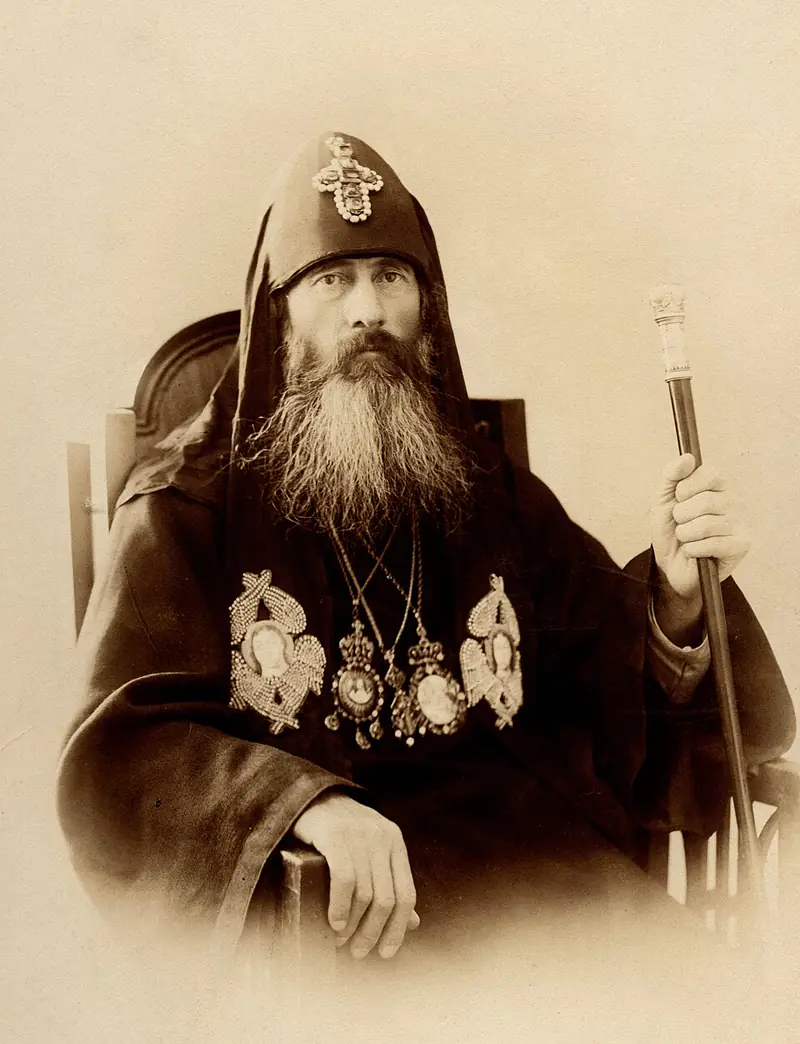
Christophorus III
His Holiness and Beatitude Christophorus III (in the world Kristepore Tsitskishvili, son of Murman; born 27 March 1873, Vertkvichala, Shorapani district — died 23 [O.S. 10] January 1932, Tbilisi) was a Georgian churchman, Catholicos-Patriarch of All Georgia and Archbishop of Mtskheta and Tbilisi from 1927 to 1932.
Biography
There were many clergy in the Tsitskishvili line. One of the future Patriarch's brothers was a priest too, so it was no surprise that he chose the Church. In 1895 he graduated from the Tbilisi Theological Seminary, and then from the higher teachers' courses of Tbilisi University; from 1895 to 1922 he was a priest, first in the Transcaspian Region and then in the villages of Georgia — Khidistavi, Itria, Nabakhtevi — and at the Church of St Nicholas at Vere in Tbilisi. He was head of the two-class school in the village of Itria and its teacher of religion (1898–1905), supervisor of the parish schools of the Gori district (1904–1905), teacher of religion at the Fifth Gymnasium in Tbilisi (1905–1918), and there too teacher of Georgian (1918–1921). In 1905 in Tbilisi he chaired an illegal assembly which drew up the demand for the restoration of the autocephaly of the Georgian Orthodox Apostolic Church.
His wife was Ana Chubinidze, a most virtuous, devout and noble woman; she died fairly early, and the upbringing of five children fell to Kristepore. On 18 March 1922 Archpriest Kristepore was consecrated by Ambrosius (Khelaia), Catholicos-Patriarch of Georgia, as bishop, first of Manglisi and then of Urbnisi. On 28 May 1922 he was appointed chorbishop to the Catholicos-Patriarch, and from 12 January 1923 to 8 March 1925 he acted as the Patriarch's locum tenens. Here began the hardest period of his life.
In the 1920s part of the Georgian clergy decided to take a course of loyalty towards the authorities. On 26–27 December 1926, on the initiative of Bishops Christophorus and David, a church congress met in Kutaisi which held the anti-government course of Catholicos-Patriarch Ambrosius and the Council of the Catholicate to be the cause of the misfortunes that had fallen on the Church, and adopted a declaration of loyalty to the authorities.
After the death of Catholicos-Patriarch Ambrosius (Khelaia), his locum tenens Callistratus declined the office in an official statement. On 26 June 1927, at the Fourth Council, Christophorus (Tsitskishvili), then Metropolitan of Tskhum-Abkhazia, was elected Catholicos. He had to lead the Church in an extremely hard and, for the Church, disastrous situation. The state oppressed the clergy severely and persecuted the faithful. Christophorus's policy was marked by a wish to cooperate with the authorities, but not even such diplomacy could halt the closing and destruction of churches. Under Christophorus, from November 1927, the Church moved from the Old Style calendar to the New. In 1930 he published a statement recognising the sovereignty of the Soviet government and criticising Pope Pius XI's call for a “crusade” against the USSR.
He died on 10 January (O.S.) 1932, at the age of 57. Before his death he was ill and was in the Red Cross hospital. As was the custom, like every patriarch after the restoration of the Georgian Church's autocephaly, he was buried in Tbilisi, in the Sioni Cathedral. The newspaper carried only one small notice, of the kind usually printed for a layman: “Kristepore Tsitskishvili has died.” Many did not even know that this name belonged to the Catholicos-Patriarch of All Georgia.
Christophorus III also did scholarly work. He wrote many articles and studies on historical and literary subjects. Notable among them are his works on the national origin of “Visramiani”, a monument of old Georgian literature. His work, first as bishop and then as Patriarch, was sharply criticised by his contemporary Nikita Talakvadze, an archpriest and later a layman.
On 20 June 2013 the secondary school in Itria was named after him, becoming Christophorus III Public School No. 4 of the town of Surami, Khashuri Municipality.