
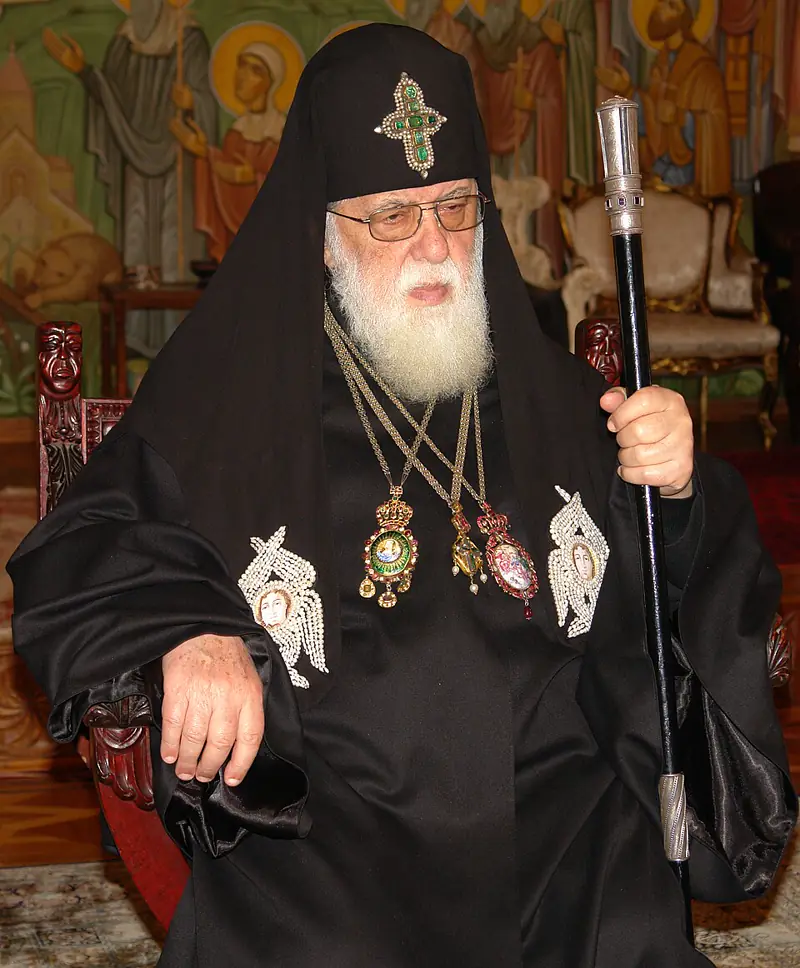
Ilia II
Ilia II (in the world Irakli Ghudushauri-Shiolashvili, son of Giorgi; born 4 January 1933, Ordzhonikidze, North Ossetia, RSFSR — died 17 March 2026, Tbilisi) was a Georgian churchman and public figure. He was His Holiness and Beatitude the Catholicos-Patriarch of All Georgia and Archbishop of Mtskheta and Tbilisi from 1977 until his death.
By decision of the session of the Synod of 21 December 2010, the title of the Catholicos-Patriarch of Georgia was set as follows: His Holiness and Beatitude Ilia II, Catholicos-Patriarch of Georgia, Archbishop of Mtskheta and Tbilisi and Metropolitan of Bichvinta and Tskhum-Abkhazia.
Ilia II graduated from the Moscow Theological Academy in 1960. In 1957 he was tonsured a monk and named Ilia; on 18 April 1957, in the Patriarchal Cathedral of Sioni, he was ordained hierodeacon; on 10 May 1959, in the Lavra of St Sergius, hieromonk; on returning home he was appointed a priest of the Batumi Cathedral; on 19 December 1960 he was raised to the rank of hegumen, and on 16 September 1961 to that of archimandrite; on 26 August 1963 he was appointed chorbishop to the Catholicos-Patriarch with the title of Bishop of Shemokmedi; from 1963 to 1972 he was the first rector of the Mtskheta Theological Seminary; in 1967 he was transferred to the Eparchy of Abkhazia; in 1969 he was raised to the rank of metropolitan; on 9 November 1977 he became locum tenens of the Patriarch.
On 23 December 1977 he was elected Catholicos-Patriarch of All Georgia. With the blessing of Ilia II the Bible was published in modern Georgian, together with theological collections, pamphlets, books, journals and three kinds of calendar; newspapers were founded; in 1988, on Ilia II's initiative, the Mtskheta Theological Seminary was moved to Tbilisi and the Tbilisi Theological Academy and Seminary was founded; theological schools opened in various parts of Georgia, with theological seminaries in Batumi, Akhaltsikhe and Kutaisi.
A theological school was set up in Khulo, with a gymnasium attached; after centuries the Gelati Theological Academy was restored, together with the Gelati Academy of Sciences under the aegis of the Church; within twenty years the number of eparchies of the Georgian Church grew from 15 to 33, of monasteries to 53, and of clergy to 1,000; new saints were canonised; and the Cathedral of the Holy Trinity was built.
In 1960, at the Moscow Theological Academy, he defended his dissertation for the degree of candidate of theology on “The History of the Iviron Monastery on Athos”. From 1978 to 1983 he was a President of the World Council of Churches, and from 1997 he was a full member of the International Informatization Academy attached to the United Nations and an honorary member of the Theological Academy of Crete. He was an honorary doctor of theology of the New York Theological Academy and a doctor of theology of St Tikhon's Theological Seminary of the Orthodox Church in America. He took part in several peace forums.
In April 1989 there were protests in Tbilisi. At dawn on 9 April 1989, on Rustaveli Avenue in Tbilisi, in front of the Government House, punitive military units of the Soviet Union broke up a peaceful protest, and 21 people were killed. Ilia II went to the protesters and spoke to them. On 9 April Ilia II served the first panikhida for the dead in the Patriarchal Cathedral of Sioni.
From 30 September to 2 October 2016 Pope Francis visited Georgia. His visit took place at the invitation of the President of Georgia and the Catholicos-Patriarch of Georgia. On 30 September Francis called on Ilia II, and both sides spoke as the occasion required. The Pope went with Ilia II to Mtskheta and visited the Cathedral of Svetitskhoveli, in which, by the tradition of the Church, the greatest Christian treasures are kept. Ilia II, Catholicos-Patriarch of Georgia, called the Pope's visit historic.
Ilia II died on 17 March 2026.
Childhood
Ilia II's parents came from Georgia, from Kazbegi Municipality: his father, Giorgi Ghudushauri-Shiolashvili, son of Simon, from the village of Sno, and his mother, Natalia Kobaidze, daughter of Ioseb, from the village of Sioni. In 1927 they also bought a house in Vladikavkaz, where the future Patriarch of Georgia was later born. When the baby was three days old, on Christmas Day, his parents had him baptised in the Georgian church and named him Irakli in honour of Erekle II. His godparents were Archimandrite Taras and the nun Zoile (Dvalishvili). Mother Zoile often took little Irakli to the Samtavro Monastery, where at the age of three he received the blessing of the Catholicos-Patriarch of the day, Kalistrate Tsintsadze.
Education
In 1952 Irakli Shiolashvili finished School No. 22 in Vladikavkaz and went on to the Moscow Theological Seminary, which is in Sergiev Posad (then Zagorsk). From 1956 to 1960 Irakli Shiolashvili was a student of the Zagorsk Theological Academy. Documents kept in the archive of the Patriarchate of Georgia give a full picture of Irakli Shiolashvili's years at the Moscow Theological Seminary and Academy. His first-year mark sheet, filled in on 11 May 1953, shows that Irakli Shiolashvili had “excellent” in every subject; in the second year he had a “4” in Greek alone; in the third year he again had top marks throughout. In his first year Irakli Shiolashvili submitted an essay to a competition, and it won first place. The winner was awarded 50 roubles from the fund of Metropolitan Philaret, and the Holy Trinity Lavra of St Sergius gave him 30 roubles. The Patriarchate's archive keeps his record book (mark sheets), signed by the inspector of the academy, V. Sarychev, and the secretary, N. Muravyov. The academy's graduate, Hieromonk Ilia, had “excellent” in every subject.
In his very first year at the academy Irakli Shiolashvili decided to renounce life in the world and become a monk. While he studied at the theological academy, his love for the mother Church and for his homeland grew keener still. At the Zagorsk Theological Academy Hieromonk Ilia chose “The History of the Iviron Monastery on Athos” as the subject of his qualifying work. After finding and working through the material in Russian, he went to the rector of the Zagorsk academy, Archpriest Konstantin Ruzhitsky, and asked leave to go to Georgia for several months to study the literature in Georgian thoroughly. The rector Konstantin Ruzhitsky's letter to the heads of the National Library of Georgia, the Central Archive and Tbilisi State University, asking them to admit Hieromonk Ilia (Irakli Shiolashvili, son of Giorgi), a fourth-year student of the theological academy, to work in the libraries, book stores and manuscript departments of their institutions, is dated 4 June 1959. Hieromonk Ilia worked for several months in the libraries of Tbilisi and took advice from Georgian scholars.
In June 1960 he publicly defended his qualifying work at the Zagorsk academy. The official examiners, Professors N. Muravyov and A. Georgievsky, rated the work highly. The rector of the Moscow (Zagorsk) Theological Academy wrote a special letter to His Holiness Alexy I, Patriarch of Moscow and All Russia, asking him to reward the candidate of theology Hieromonk Ilia for the best work. The archive of the Patriarchate of Georgia keeps the diploma with distinction issued by the Zagorsk academy to Hieromonk Ilia Shiolashvili, signed by the rector of the academy, Archpriest Konstantin Ruzhitsky, the inspector, Archimandrite Pitirim, and the secretary, A. Ostapov.
Later years
On 16 April 1957 Irakli Shiolashvili, a 24-year-old second-year student of the theological academy, was tonsured a monk in the Church of St Alexander Nevsky in Tbilisi, with the blessing of Melchizedek III, Catholicos-Patriarch of All Georgia, and named Ilia in honour of the holy Prophet Elijah. The tonsure was performed by Bishop Zinobi (Mazhuga).
Ilia II recalls the Church of St Alexander Nevsky in these words:
On 18 April 1957, in the Patriarchal Cathedral of Sioni, the monk Ilia was ordained hierodeacon, and on 10 May 1959, in the Lavra of St Sergius, the hierodeacon Ilia was ordained hieromonk by His Holiness Alexy I, Patriarch of Moscow and All Russia.
In 1960 he graduated from the Moscow Theological Academy with a first-class diploma; in his fourth year he had written his candidate's thesis, “The History of the Iviron Monastery on Athos”, for which he was given the degree of candidate of theology. After this the council of the academy offered him a place as a scholar in training for a professorship and asked him to go on with his research; he would have been able to lecture at the theological seminary and academy. But the blessing of His Holiness and Beatitude Ephraim II was otherwise: Hieromonk Ilia was to begin his ministry at home. Hieromonk Ilia turned down an honourable career, returned home, and was appointed a priest of the Batumi Cathedral.
On 19 December 1960 he was raised to the rank of hegumen, and then, on 16 September 1961, to that of archimandrite.
In 1963, under Nikita Khrushchev, when five seminaries and many churches and monasteries were closed in Russia, His Holiness and Beatitude Ephraim II managed to open a theological school in Georgia, which, to be on the safe side, was called “Theological Courses”. It was as the first rector of these “Theological Courses” that Archimandrite Ilia was appointed.
From 1963 to 1972 he was the first rector of the Mtskheta Theological Seminary — at the time the only theological school. At the same time he worked at training a new generation of clergy for the Georgian Church.
On 26 August 1963 Archimandrite Ilia was consecrated Bishop of Shemokmedi by His Holiness and Beatitude Ephraim II, Catholicos-Patriarch of All Georgia, with the bishops of the Georgian Church concelebrating, and was appointed chorbishop to the Catholicos-Patriarch.
In 1967, after seven years' ministry in Adjara, he was transferred, with the Patriarch's blessing, to be bishop of Tskhum-Abkhazia.
In 1969 he was raised to the rank of metropolitan. Metropolitan Ilia spent eleven years in Sukhumi. In 1972 he was awarded the right to wear a second panagia, and in 1975 the right to wear a cross on his skufia.
Catholicos-Patriarch
In 1977 David V, Catholicos-Patriarch of All Georgia, died. On 9 November 1977, by decision of the Holy Synod, Metropolitan Ilia (Shiolashvili) of Tskhum-Abkhazia became the Patriarch's locum tenens.
On 23 December 1977 the 12th Council of the Apostolic Church of Georgia met in the Patriarchal Cathedral of Sioni in Tbilisi, with 47 delegates attending. The Council considered the election of a new Catholicos-Patriarch of the Georgian Church, and Metropolitan Ilia was unanimously elected Catholicos-Patriarch of All Georgia, taking the name Ilia II. Ilia I had governed the Georgian Church 1,600 years before, in 390–400. Representatives of Churches abroad attended the 12th Council of the Georgian Church: Pimen, Patriarch of All Russia, Archimandrite Naum from the Bulgarian Church and Archimandrite Gregorios from Alexandria.
On 25 December 1977 a new Patriarch was raised to the patriarchal throne of the Apostolic Church of Georgia, which takes its beginning from Andrew the First-Called and Simon the Canaanite: in the Patriarchal Cathedral of Mtskheta the new Catholicos-Patriarch, His Holiness and Beatitude Ilia II, was enthroned.
In 1990 the Ecumenical Patriarchate presented Ilia II with a charter of confirmation, by which the whole Orthodox world recognised the autocephaly of the Georgian Church.
In the 39 years of his ministry as Catholicos-Patriarch the number of eparchies of the Georgian Church grew from 15 to 47 and the number of clergy to 2,000; monastic life grew stronger, new saints were canonised, and the largest church in Georgia — the Cathedral of the Holy Trinity — was built.
From 1978 to 1983 Catholicos-Patriarch Ilia II was a President of the World Council of Churches. He was awarded the highest honours of the Ecumenical Patriarchate, of the Churches of Antioch, Jerusalem, Alexandria, Russia, Georgia, Greece, Bulgaria, Romania and Poland, of the Church of the Czech Lands and Slovakia, and of almost every other Orthodox Church. The New York Theological Academy gave Catholicos-Patriarch Ilia II the honorary title of Doctor of Theology. In 1997 the Theological Academy of Crete elected His Holiness an honorary member. The same year he was elected a member of the International Informatization Academy attached to the United Nations. In 1998 St Tikhon's Theological Seminary of the Orthodox Church in America gave him the honorary title of Doctor of Theology. In 2002 Ivane Javakhishvili Tbilisi State University, Tbilisi State University and the Sulkhan-Saba Orbeliani Tbilisi State Pedagogical University gave him the titles of honorary doctor and professor.
The Cathedral of the Holy Trinity
With the blessing of Ilia II the Cathedral of the Holy Trinity was built in Tbilisi.
On 24 August 1988 Ilia II asked Irakli Andriadze, chairman of the Tbilisi executive committee, to set aside a suitable site for building the Cathedral of the Holy Trinity. Not all of those then in power supported the undertaking. They tried to allot a site that would not be too conspicuous in the city's panoramas. Several sites were named. One lay on the road to Tskneti, in the forest, from where the views of Tbilisi could hardly be seen. Then, by order of the executive commission of the city council, a site was chosen at the top of the Baratashvili rise, and there are several designs made to fit that ground. After that came the grounds of the student town in Vake, and finally Elia Hill. It was on Ilia II's initiative that the Cathedral of the Holy Trinity was built.
The canonisation of saints
With the blessing of Ilia II the lives of those who suffered for their homeland began to be studied, and on that basis the most outstanding of them were numbered among the saints. In 1987, for the 150th anniversary of Ilia Chavchavadze's birth, the Georgian Church numbered among the saints the public figure, writer and leader of the national liberation movement Ilia Chavchavadze, and named him St Ilia the Righteous.
In 1995, with the blessing of Ilia II and by decision of an extended council of the Apostolic Church of Georgia, these were added to the company of the saints: Catholicos-Patriarch Ambrosius Khelaia, Metropolitan Nazar of Kutaisi-Gaenati (and those with him), Bishop Gabriel Kikodze of Imereti, Bishop Alexander Okropiridze, Archimandrite Grigol Peradze, Hegumen Alexis Shushania, the priest Tevdore, and St Nino's parents, Zabulon and Sosana. Later the company of the saints was joined by Tsotne Dadiani, Catholicos Peter I, Catholicos Samuel I, Catholicos-Patriarch Melchizedek I, Theodore of Adjara, Abuserisdze Tbeli, the fathers and mothers of Klarjeti, Hilarion the New Georgian, Catholicos-Patriarch Kyrion II, Ekvtime Takaishvili, the Fathers of Betania, Ioane and Giorgi, the martyrs of the Battle of Krtsanisi, Pilimon Koridze the Chanter, Hegumen Ekvtime the Confessor (Kereselidze), and the Karbelashvili brothers.
In 2007 the nineteenth-century statesman and public figure Dimitri Kipiani was numbered among the saints and named the One Who Gave Himself for His Homeland, and in 2012 the monk Gabriel was numbered among the saints and named the holy and venerable Father Gabriel, Confessor and Fool for Christ.
On 22 December 2016 the Holy Synod of the Georgian Orthodox Church met at the Patriarchate of Georgia. Several people were canonised at the session. They are:
the nun Nino (Amilakhvari, 1784–1839), Abbess Nino (Amilakhvari, 1815–1904), Schema-abbess Tamar (Marjanishvili, 1869–1936), King Bagrat III of Georgia, King Solomon I of Imereti, and His Holiness and Beatitude Callistratus (Tsintsadze), Catholicos-Patriarch of All Georgia.
The international charitable foundation
On 8 February 2005, in the Cathedral of the Holy Trinity, as the holy Church and all Georgia were solemnly keeping the commemoration of St David the Builder, the International Charitable Foundation of Ilia II, Catholicos-Patriarch of All Georgia, was established.
The foundation's aim is to care for the strengthening of spiritual life, for the revival and growth of culture and science, and for the strengthening of national and civic thinking.
On the founding of the foundation Ilia II remarked in particular:
The mass baptisms
Ilia II decided on mass baptisms, to improve the demographic situation in Georgia. Ilia II first voiced the idea back in 2007: every third and later child would be baptised by the Patriarch, and the first such baptism took place on 19 January 2008, the feast of Theophany.
At the session of the Holy Synod of the Georgian Church on 21 December 2007 it was decided to apply church economy specifically to the godchildren of the Catholicos-Patriarch of Georgia, and, should such a case arise in future, to allow marriage between them.
International relations
From his enthronement to this day Ilia II has given great attention to international relations, and has met and continues to meet heads of state. Several important meetings took place during his time as chief shepherd: in 1991 he met former US President Richard Nixon in Tbilisi; in 1993, Boris Yeltsin, President of the Russian Federation, in Tbilisi; in 1995, Ion Iliescu, President of Romania; in 1995 he received Leonid Kuchma, President of Ukraine, at the Patriarchate; in 1996 he met Roman Herzog, President of the Federal Republic of Germany; in 2000, in Jerusalem, Yasser Arafat, Chairman of the Palestine Liberation Organization; in 2001, in Tehran, Mohammad Khatami, President of the Islamic Republic of Iran; in 2005, in Moscow, Vladimir Putin, President of the Russian Federation; in 2006 he received Viktor Yushchenko, President of Ukraine, at the Patriarchate; in 2008 he met Dmitry Medvedev; in 2013, in Moscow, Vladimir Putin, President of the Russian Federation. Ilia II met Heydar Aliyev, President of Azerbaijan, several times, and after him Ilham Aliyev; he also had meetings with the presidents of Armenia. At various times Ilia II had many meetings with the ambassadors of foreign states accredited in Georgia and with other representatives of states. In 2020 US Secretary of State Mike Pompeo, on a visit to Georgia, met Ilia II.
Choosing a locum tenens
On 23 November 2017, in the Church of St George at Kashveti in Tbilisi, Ilia II, Catholicos-Patriarch of All Georgia, celebrated the Divine Liturgy. Before it began, the Patriarch, to the surprise of the public and of the members of the Holy Synod, read out an order written in his own hand and attested with his personal seal, by which he appointed Metropolitan Shio (Mujiri) of Senaki and Chkhorotsku locum tenens of the Catholicos-Patriarch of All Georgia.
Forty years since the enthronement
On 25 December 2017 forty years had passed since Ilia II was enthroned as Catholicos-Patriarch of All Georgia. In the history of the Catholicate of Mtskheta this is a record, since no other Catholicos-Patriarch had been able to govern the Church for so long. Only Grigol Lortkipanidze, Catholicos-Patriarch of Abkhazia, governed his Church for 46 years.
A service of prayer for the fortieth anniversary of Ilia II's enthronement was held on 24 December in the Cathedral of the Holy Trinity, and on 25 December a festal Liturgy was celebrated in the Patriarchal Cathedral of Svetitskhoveli. Present at the Liturgy, with the faithful who had gathered, were the President of Georgia, Giorgi Margvelashvili, the Prime Minister, Giorgi Kvirikashvili, and members of the government and parliament. Of the Orthodox Churches, only representatives of the Patriarchate of the Russian Church attended for the occasion.
Letters of congratulation were sent to the Catholicos-Patriarch of Georgia by Queen Elizabeth II of the United Kingdom of Great Britain and Northern Ireland, Pope Francis I, Ecumenical Patriarch Bartholomew I of Constantinople, Patriarch Kirill I of Moscow and All Russia, and others.
Ilia II, Catholicos-Patriarch of Georgia, addressed the faithful in these words:
The Patriarch and the recognition of autocephaly
The autocephaly of the Georgian Orthodox Church, won as long ago as the reign of King Vakhtang Gorgasali, was abolished by the Russian Empire in 1811, wholly unlawfully.
At the end of the nineteenth century the struggle for autocephaly began, and it was crowned in 1917 by the restoration of the autocephaly of the Georgian Orthodox Apostolic Church and the election of Kyrion II as Catholicos-Patriarch of All Georgia at the First Council. The Russian Church did not recognise the autocephaly. The Russian Church recognised the territorial autocephaly of the Georgian Church only on 31 October 1943. Despite the autocephaly proclaimed in 1917, the Ecumenical Patriarchate of Constantinople still did not recognise it, and in official letters the Catholicos-Patriarch of Georgia was not addressed by the proper title.
From 1977 Ilia II, Catholicos-Patriarch of Georgia, set himself the goal of winning recognition of the autocephaly. In May 1979 he was in Istanbul at the invitation of the Ecumenical Patriarch, His All-Holiness Demetrios, and there raised the question of the restoration of the autocephaly of the Apostolic Church of Georgia. The negotiations went on for eleven years. Most of them were conducted by Metropolitans Chrysostomos and Damaskinos. On 7 January 1990, in the Patriarchal Cathedral of Sioni, at the end of the Divine Liturgy, Metropolitan Chrysostomos announced that by decision of the Ecumenical Patriarchate the historic autocephaly of the Apostolic Church of Georgia and the patriarchal title were recognised. On 4 March 1990, in Istanbul, Ilia II, Catholicos-Patriarch of Georgia, also received the charter signed by Ecumenical Patriarch Demetrios.
— Ilia II, April 1990.
So the whole Orthodox world recognised the autocephaly of the Georgian Church.
Church and state
On 25 December 1977, after Metropolitan Ilia was enthroned as Catholicos-Patriarch of Georgia, the question arose of how relations with the authorities were to be conducted. The 1978 Constitution of the Georgian Soviet Republic stated that citizens had the right to profess any religion, and also the right to carry on atheist propaganda. The same constitution forbade stirring up enmity and hatred over religious belief.
After independence was restored, relations between Church and state were defined by the Constitution of Georgia of 1995. The Constitution states that the state declares complete freedom of belief and religion, and recognises the special role of the Apostolic Church of Georgia in the history of Georgia and its independence from the state. Later, on 14 October 2002, in Mtskheta, in the Cathedral of Svetitskhoveli, a Constitutional Agreement was signed between the State of Georgia and the Apostolic Autocephalous Orthodox Church of Georgia. The concordat laid down: 1) the protection of confession and of the Church's sacraments; 2) the state recognises marriages performed by the Church in the manner set by law;
3) clergy are exempt from military service;
4) teaching of the Orthodox faith in educational institutions is voluntary; 5) the Church does not itself engage in business; 6) liturgical goods produced by the Church are exempt from state taxes; 7) the state recognises as the property of the Church the Orthodox churches and monasteries on the territory of Georgia, in use or not, their ruins and the land around them. In 2007 Ilia II supported the introduction of a constitutional monarchy in Georgia.
Ilia II more than once stated the Church's position on Georgia joining European structures. He supports cooperation between Georgia and Europe and the country's European course. In January 2014, meeting Nils Muižnieks, the Council of Europe's Commissioner for Human Rights, Ilia II declared:
The Georgian-Russian war of 2008 and the Georgian Church
In August 2008 heavy fire broke out between the armed forces of Georgia and of so-called South Ossetia. On 7 August Ilia II called on the opposing sides to be reconciled, but to no effect. On 8 August Georgian troops took several villages; at the same time Russian aircraft began bombing other regions of Georgia as well, among them Gori and Poti. There were a great many casualties. On 9 August Ilia II visited the wounded at the Ghudushauri National Medical Centre. He asked the world community to help settle the situation in Georgia peacefully, and said that so-called South Ossetia was the product of the forcible Sovietisation of Georgia and should not be a basis for separatism. On 13 August Russian and Ossetian military units entered Zemo Nikozi and killed several local people. On 14 August the Patriarch asked the Russian Church to arrange a peace corridor to enter Gori and Nikozi. On 15 August Ilia II was in Gori with clergy, and then went to Zemo Nikozi. He encouraged the people and urged them to stay calm. He brought four wounded out of the conflict zone and managed to bring back the bodies of six of the dead.
The Patriarch's title
In 1917, with the restoration of the autocephaly of the Apostolic Church of Georgia, the title of the head of the Georgian Church was restored as well. It was recognised by the Ecumenical Patriarchate in 1990, and the title of the head of the Church ran: “Archbishop of Mtskheta and Tbilisi and Catholicos-Patriarch of All Georgia”. The title also includes “His Holiness” and “His Beatitude”, which entered the full title of the Catholicos-Patriarch of All Georgia in their time, when the Catholicates of Abkhazia and Kartli were united.
In 2010 there was one more change in the title. By decision of the Holy Synod of 21 December, the Eparchy of Bichvinta and Tskhum-Abkhazia was given to Ilia II, Catholicos-Patriarch of Georgia, and his title was set as follows: “Catholicos-Patriarch of All Georgia, Archbishop of Mtskheta and Tbilisi, Metropolitan of Bichvinta and Tskhum-Abkhazia, His Holiness and Beatitude”.
Relations with the Orthodox Churches
As soon as he was enthroned as Catholicos-Patriarch of Georgia, Ilia II set about establishing friendly relations with the Orthodox Churches of the world.
In 1978 Ilia II took part in the celebrations of the sixtieth anniversary of the restoration of the patriarchate in Russia; in 1979 he met Ecumenical Patriarch Demetrios in Istanbul; in 1980 he was in Jerusalem at the invitation of Patriarch Benedict I of Jerusalem; in 1981 Patriarch Ignatius IV of Antioch and All the East met Ilia II in Tbilisi; in 1981 His Beatitude Patriarch Diodoros I of Jerusalem was in Georgia; in 1981 Pope and Patriarch Nicholas VI of Alexandria came to Georgia; in 1982 Pope and Patriarch Nicholas VI of Alexandria came to Georgia; in 1983 Pope and Patriarch Nicholas VI of Alexandria came to Georgia; in 1984 Pope and Patriarch Nicholas VI of Alexandria came to Georgia; in 1987 Ilia II was in Jerusalem; in 1988 Ecumenical Patriarch Demetrios met Ilia II in Tbilisi; in 1990 Ilia II attended the funeral of Patriarch Pimen; in 1990 Patriarch Alexy II of Russia was in Georgia; in 1994 Ecumenical Patriarch Bartholomew I visited Georgia for the first time and met Ilia II; in 2007 Ilia II attended the presentation of the thirteenth volume of the Orthodox Encyclopedia in Moscow; in 2008 Ilia II attended the funeral of Patriarch Alexy II of Russia; in 2008 Patriarch Theodore II of Alexandria and All Africa was in Georgia; in 2009, the first meeting with Patriarch Kirill of Russia, in Baku; in 2011 Ilia II met Ecumenical Patriarch Bartholomew I in Istanbul; in 2012 His Holiness Ilia II met Patriarch Theophilos of Jerusalem in Jerusalem; in 2013 Ilia II met His Holiness Kirill in Moscow;
in 2013 Ecumenical Patriarch Bartholomew I came to Tbilisi for the 35th anniversary of Patriarch Ilia II's enthronement; in 2016 Ilia II attended the seventieth birthday celebrations of Patriarch Kirill of Russia.
Relations with the Roman Catholic Church
From 1917 to 1977 the relations of the Georgian Orthodox Church and the Roman Catholic Church were by letter only. Ilia II did much to deepen them.
In 1978 the chairman of the Department of External Relations of the Georgian Orthodox Apostolic Church, Metropolitan Nikoloz (Makharadze) of Tskhum-Abkhazia, attended the funeral of Pope Paul VI with the blessing of Ilia II. The first official meeting of Pope John Paul II and Ilia II, Catholicos-Patriarch of Georgia, took place in the Vatican on 5–6 June 1980. At the meeting it was agreed that Georgian scholars would be able to work on Georgian documents in the Vatican archives. A Vatican embassy opened in Tbilisi, and in the Caucasus a Catholic bishopric of Tbilisi.
Pope John Paul II made an official visit to Georgia on 8 November 1999, at the invitation of the Catholicos-Patriarch of Georgia and the President of Georgia. The official invitation was sent to the Pope only after the matter had been agreed with the head of the Georgian Church, and it was sent jointly. This was the first visit of the head of the Roman Catholic Church to Georgia; among the countries of the former Soviet Union, the Baltic states apart, Georgia was the first the Pope visited.
John Paul II was met at Tbilisi airport by Ilia II, Catholicos-Patriarch of Georgia, and Eduard Shevardnadze, President of Georgia. On 9 November the Pope met representatives of Georgian science and culture at the government residence in Krtsanisi, and also visited the Cathedral of Svetitskhoveli; addresses were exchanged. The Catholicos-Patriarch of Georgia, His Holiness and Beatitude Ilia II:
In 1989 the Catholic nun and Nobel laureate Mother Teresa of Calcutta, canonised by the Catholic Church in 2016, was in Tbilisi, and Ilia II met her. Mother Teresa went with the Patriarch to the Patriarchal Cathedral of Sioni as well.
Pope Francis I and Ilia II, Catholicos-Patriarch of Georgia, met in Tbilisi during the Pope's visit to Georgia from 30 September to 2 October 2016. His visit took place at the invitation of the President of Georgia and the Catholicos-Patriarch of Georgia.
On 30 September Pope Francis was the guest of His Holiness Ilia II at the patriarchal residence. The Pope went with the Catholicos-Patriarch of Georgia to Mtskheta and visited the Cathedral of Svetitskhoveli. In Svetitskhoveli Ilia II spoke these words:
Relations with the Anglican Church
In February 2011 the Catholicos-Patriarch made an official visit to Great Britain, where he met the Archbishop of Canterbury and Queen Elizabeth II of the United Kingdom of Great Britain and Northern Ireland.
Relations with the Armenian Church
Eucharistic communion between the Georgian and Armenian Churches has been broken since the seventh century. Even so, the Georgian and Armenian Churches kept up close relations through the centuries, the twentieth among them. In 1961 the head of the Armenian Church, Vazgen I, first met Ilia Shiolashvili, then an archimandrite. On 25 December 1977 Vazgen I also attended the enthronement of His Holiness Ilia II. And in May 1978 Ilia II went himself to Etchmiadzin to meet Vazgen I. Since then there have been many official visits to Etchmiadzin and to Georgia. Vazgen I died in 1994, and in Etchmiadzin His Holiness and Beatitude Ilia II paid due honour to the memory of the late Catholicos. Friendly relations continued with the new Catholicos, Garegin I, who visited Georgia in 1997. In 2011 Garegin II, Supreme Patriarch and Catholicos of All Armenians, visited Georgia.
Relations with other Churches
On 15 January 1979, in Kingston, the capital of Jamaica, Catholicos-Patriarch Ilia II was elected a President of the World Council of Churches, which raised the Patriarch's standing internationally and gave the Georgian Church the chance to have relations with the churches and religious confessions of many countries. At various times Ilia II met Shenouda III, Patriarch of the Copts of Egypt; Abuna Tekle Haymanot, the Monophysite patriarch of the Indians of Malabar; Mar Jacob III, patriarch of the Syrian Jacobites; and Maximos V, the Monophysite patriarch of the East.
Relations with Islamic countries
Ilia II, Catholicos-Patriarch of All Georgia, has had close and friendly relations with Muslim religious leaders from his enthronement to this day.
In 2001 Ilia II made an official visit to Iran at the invitation of Mohammad Khatami, President of the Islamic Republic of Iran, and there met President Khatami and the Supreme Leader of the Islamic Republic of Iran, Ali Khamenei. The meeting discussed the prospects for friendship and cooperation.
His Holiness has close relations with the chairman of the Council of the Muslims of Transcaucasia, Allahshukur Pashazade, who on 25 December 2013 awarded the Patriarch the Order of Sheikh ul-Islam for his contribution to relations between religions and nations.
Many other Muslim leaders have visited the Patriarchate, and the Orthodox Church has in turn visited Islamic countries. In 2007 Ayatollah Taskhiri, head of Iran's Organisation for Relations between Religions, was in Georgia for the celebrations of the thirtieth anniversary of Ilia II's enthronement.
The Patriarch and education
Within the Georgian Orthodox Church there were many centres of learning over the centuries. From 1811, after the Russian Empire unlawfully abolished the autocephaly of the Georgian Church, a policy of Russification was pursued in Georgian education. The same went on from 1921 under aggressive Soviet atheism.
After autocephaly was restored, it was only under His Holiness Ephraim II that a theological school could be opened in Mtskheta. While it was led by Bishop Ilia of Shemokmedi, the school was made into a seminary, and Bishop Ilia became its first rector.
On 14 October 1988, as a result of many years of Ilia II's work, a theological academy was also founded in Tbilisi, at the Patriarchal Cathedral of Sioni. The Mtskheta Theological Seminary moved there too. From 5 March 2003 to 4 April 2004, and from 25 January 2005 to 30 September 2009, Ilia II was rector of the Tbilisi Theological Academy and Seminary.
In 1995, with the blessing of Ilia II, the St Bishop Gabriel Theological Seminary was founded in Kutaisi, and the Gelati Theological Academy was restored.
On 12 October 2008, with the blessing of Ilia II, the St Andrew the First-Called Georgian University was founded.
During Ilia II's ministry theological schools opened in various parts of Georgia: in Batumi, Akhaltsikhe and Kutaisi, and in Khulo a theological school with a gymnasium attached; gymnasiums were founded in Tbilisi and a number of other Georgian towns.
With the blessing of Ilia II the Bible was published in modern Georgian, together with theological collections, pamphlets and books, journals and three kinds of calendar, and newspapers were founded. On his initiative there were set up at the Patriarchate a centre for architecture, a department of folk crafts, a department of mission and evangelisation, a publishing centre, a centre for finding and protecting holy objects, a department for relations with the armed forces and law-enforcement bodies, as well as departments of external relations and of finance and economics and an information service; youth centres, a humanitarian service, a pilgrimage service and others were formed.
From the day of his enthronement Ilia II gave a large place in his work to relations with the creative intelligentsia and with scholars. One fruit of these relations was bringing to Georgia microfilms of the Georgian manuscripts kept in the monastery on Athos, which the Patriarchate handed to the Institute of Manuscripts of the Georgian Academy of Sciences. The Patriarchate regularly hosts Georgian philosophers, historians, linguists and historians of art.
The Patriarch's creative work
Of Ilia II one must also mention his work in music, in church chant and in icon painting. He is the author of many musical works and chants. On 2 April 2015, World Autism Awareness Day, a charity gala concert was held in the Grand Concert Hall in Tbilisi at which only the Catholicos-Patriarch's works were performed.
Ilia II is the author of some twenty icons. They are quite varied in subject and technique. Among them are “The All-holy Trinity”, “God Is with Us”, “The Ancient of Days”, “The Iveron Mother of God”, “Platytera”, “The Archangel Michael”, “The Archangel Gabriel”, “The Holy Prophet David”, “God-protected Georgia”, “The Holy Kings Solomon”, “Vakhtang and Tamar”.
Most of the icons painted by the Patriarch are in the Cathedral of the Holy Trinity and in the patriarchal residence. Two belong to the Church of the Mother of God at Manglisi and to the Church of St Vakhtang Gorgasali in Rustavi.
Notably, two of the icons listed are frescoes: “God-protected Georgia” is in the old patriarchal residence, and the image of the holy Queen Tamar is part of the wall paintings of the Didube Church of the Mother of God. The Patriarch is also the author of the sketch for the image of the Saviour to be painted in the dome of the Cathedral of the Holy Trinity, and of one sculpted portrait (of Shiola Ghudushauri).
One of His Holiness's outstanding works is the icon of the All-holy Trinity. It is classical in direction both in its iconography and as art.
Death
After a fall in his oxygen saturation, Catholicos-Patriarch Ilia II was taken from the Patriarchate to the Chapidze Heart Clinic in the afternoon of 16 March 2026. When hidden bleeding in his stomach was found, he was moved at two in the morning of 17 March to the Caucasus Medical Centre. Throughout the day he was kept intubated in the clinic, “in a state of sleep”. News of his death was confirmed outside the clinic the same day at 10.47 pm by the locum tenens of the patriarchal throne, Metropolitan Shio Mujiri. By order of the Government of Georgia, mourning was declared in Georgia on the death of Ilia II.
On 18 March 2026, by order of the Government of Georgia, a state commission was set up “in connection with the burial of His Holiness and Beatitude Ilia II, Catholicos-Patriarch of All Georgia”.
On 21 March 2026 the panikhida for Ilia II was attended by the religious leaders of various religious organisations in Georgia — clergy representing the Apostolic Administration of the Caucasus for Latin Catholics, the Georgian Diocese of the Armenian Apostolic Church, the Union of the Jews of Georgia, the Administration of the Muslims of Georgia, the Tbilisi International Baptist Church, the Union of Christian Baptist Churches of Georgia, the Evangelical Lutheran Church of Georgia, the Evangelical Protestant Church of Georgia, the Church of the Gospel Faith of Georgia, the Yazidi Spiritual Council of Georgia and the Salvation Army in Georgia. Letters of condolence were issued by the ambassadors accredited in Georgia, the President of Azerbaijan, Ilham Aliyev, the President of the United Arab Emirates, Mohamed bin Zayed Al Nahyan, the US Secretary of State, Marco Rubio, the President of Belarus, Alexander Lukashenko, the President of Turkey, Recep Tayyip Erdoğan, the Foreign Minister of Israel, Gideon Sa'ar, the Foreign Minister of Latvia, Baiba Braže, the Foreign Minister of the Kingdom of the Netherlands, Tom Berendsen, the Prime Minister of Armenia, Nikol Pashinyan, the Slovak State Secretary Ratislav Chovanec, the Foreign Minister of Serbia, Marko Đurić, and the President of Hungary, Tamás Sulyok. The Foreign Minister of Bulgaria, Nadezhda Neynsky, also wrote to the Foreign Minister of Georgia on the death of Ilia II. The President of Uzbekistan, Shavkat Mirziyoyev, sent the Prime Minister of Georgia a letter of condolence on the death of Ilia II.
The heads of five Orthodox Churches attended the burial of Ilia II. Among them were the Archbishop of Constantinople – New Rome and Ecumenical Patriarch Bartholomew I, Patriarch Daniil of Bulgaria, Archbishop Ioannis of All Albania, Metropolitan Rostislav of the Czech Lands and Slovakia, and Metropolitan Tikhon of America. Delegations of other Orthodox Churches also came to Georgia to honour the late Patriarch.
The Patriarch was buried on Sunday, 22 March 2026, in the Sioni Cathedral. He is thus the ninth patriarch of the Georgian Orthodox Church to be buried in the Sioni Cathedral.
Awards
Ilia II held many awards. In 1972 he was awarded the Order of St Nino, Equal to the Apostles; in 1977 the Order of the Victory of St George the Martyr; in 1977 the Order of St John, First Class; in 1997 the Order of David the Builder; in 2000 the Order of the Holy Cross of the Knights of the Holy Sepulchre (Jerusalem, Israel). On 22 January 2001, an award of the Georgian Church, the Order of St George, First Class;
in 2002 Ivane Javakhishvili Tbilisi State University and the Sulkhan-Saba Orbeliani Tbilisi State Pedagogical University gave him the titles of honorary doctor and professor; in 2007 he was given the Church's highest award, the Order of the Lord's Robe; in 2010, the Presidential Order of Excellence; on 29 December 2010, the Shota Rustaveli State Prize and gold medal; in January 2013, by decision of the Caucasus Muslims' Board, the Order of Sheikh ul-Islam for his contribution to relations between religions and nations; on 23 January 2013, the prize of the Foundation for the Unity of Orthodox Peoples, “for outstanding service in strengthening brotherly relations between Orthodox peoples and Churches”; on 19 June 2013, by decision of the academic council of Batumi Shota Rustaveli State University, the title of honorary doctor; on 21 November 2013, the highest Order of Justice.
Ilia II, Catholicos-Patriarch of Georgia, was also awarded the highest honours of the Ecumenical Patriarchate and of the Patriarchates of Antioch, Jerusalem, Alexandria, Russia, Georgia, Greece, Bulgaria and Romania; of the Churches of Poland and Czechoslovakia, and of almost every other Orthodox Church.
From 1978 to 1983 Ilia II, Catholicos-Patriarch of Georgia, was a President of the World Council of Churches. The New York Theological Academy gave Ilia II the honorary title of Doctor of Theology. In 1997 he was elected an honorary member of the Theological Academy of Crete. The same year he was elected a full member of the International Informatization Academy attached to the United Nations; and in 1998 St Tikhon's Theological Seminary of the Orthodox Church in America gave him the honorary title of Doctor of Theology.
In 2016 the Public Council of the Saratov Region under the Russian Ministry of Education, in the name of the region's teaching community, awarded Ilia II, Catholicos-Patriarch of All Georgia, the medal “For Work in Education” for his many years of educational and public work.
Other facts
The Christian world celebrated the two thousandth year since the birth of Christ with special solemnity. At the invitation of the Patriarchate of Jerusalem, the heads of state and of the Churches of the Orthodox countries came to Israel. The Catholicos-Patriarch of Georgia was in Jerusalem too. On 6 January the President of Georgia and the Patriarch visited the Tomb of the Saviour together. They entered the niche of the Tomb as a Georgian choir sang, and lit candles. In the throne room of the Patriarchate of Jerusalem, Patriarch Diodoros I of Jerusalem presented the heads of the Orthodox states and Churches with the Order of the Holy Cross of the Knights of the Holy Sepulchre.
In January 2010 Montserrat Caballé, a diva of the world's opera stage, sent Ilia II, Catholicos-Patriarch of All Georgia, her congratulations from Spain on his 77th birthday in these words:
In October 2016 Pope Francis visited Georgia, and after returning to the Vatican he shared his impressions of Georgia with the media, speaking of the Catholicos-Patriarch of Georgia with special respect as “a man of God”: