
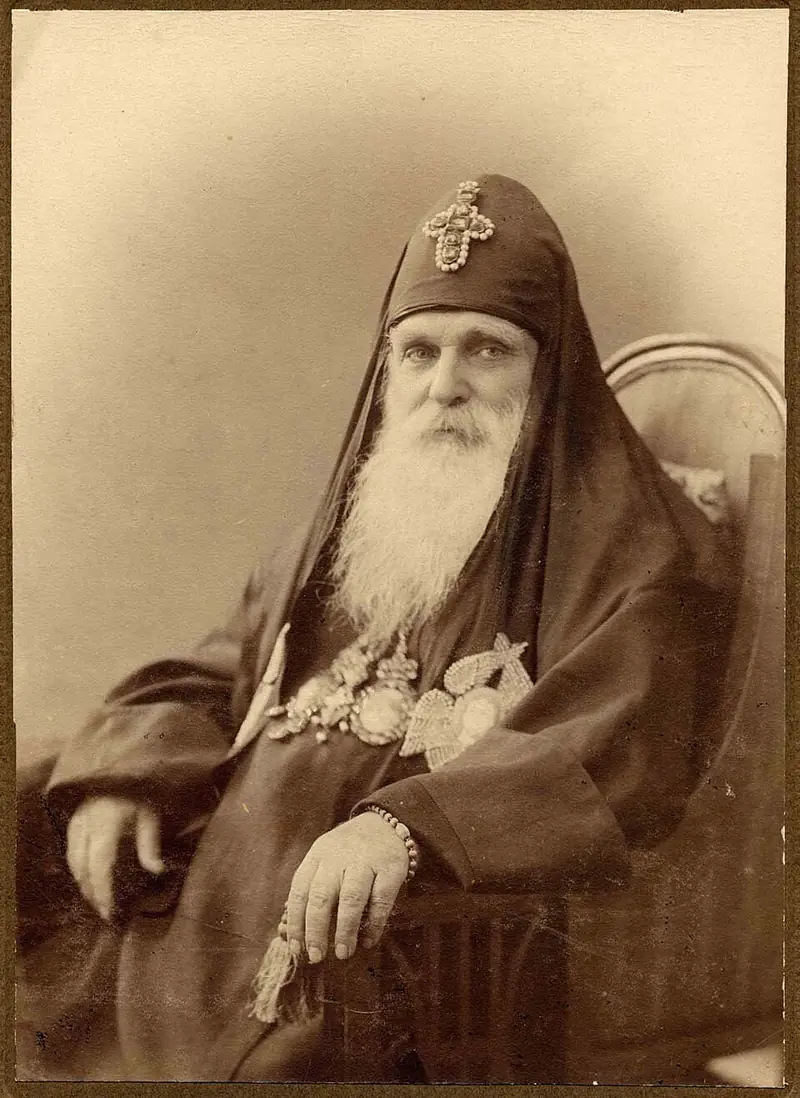
Ambrosius
Ambrosius (in the world Besarion Khelaia, son of Zosime; born 7 September 1861, Samurzakano — died 29 [O.S. 16] March 1927, Tbilisi) was a Georgian churchman, public figure and scholar, Catholicos-Patriarch of All Georgia and Archbishop of Mtskheta and Tbilisi from 1921 to 1927, and a National Hero of Georgia.
Biography
He was born into the family of Zosime Khelaia, priest of the church at Ilori. Besarion Khelaia is registered in the parish book of the Church of St George in the village of Inchkhuri, though his grandfather had already moved from Inchkhuri to Samurzakano at the turn of the 1830s and 1840s. In 1872 he finished the parish school in Ochamchire and, with his younger brother Giorgi, went on to the Martvili Theological School. In 1879 the brothers entered the Tbilisi Theological Seminary. Giorgi died in April 1881; Besarion finished his studies in 1885. He wanted a university education, but the dream was never fulfilled. At the beginning of 1887 he married Elizaveta (Kesaria) Merchule.
On 25 March 1887 he was ordained deacon of the Sukhumi Cathedral. On 19 April of the same year he was ordained priest of the Church of the Archangel Michael in Sochi. In Sochi three children were born to him: Andria (in 1889; he died at a few months old), Nina and Aleksandre. On 29 September 1892 he was transferred to the Sukhumi Cathedral as a priest. On 11 October he was appointed treasurer of the Eparchy of Sukhumi. From 20 October 1892 to 17 June 1893 he was dean of the Gudauta district. From there he was transferred to be sacristan of the Sukhumi Cathedral. From 26 April 1894 he taught religion at the Sukhumi Mountain School. On 26 August of the same year he was appointed supervisor of the parish schools of Sukhumi, New Athos and Lykhny. He fought the Russifying and chauvinist policy of tsarism in Abkhazia, and wrote in the press against Bishop Arseny (Izotov).
In 1896 his wife died. From 1897 he continued his studies at the Kazan Theological Academy. On 11 February 1900 he was tonsured a monk with the name Ambrosius. He finished the academy in June 1901 and moved to Tbilisi. On 15 October he was assigned to the Monastery of the Transfiguration in Tbilisi, and on 11 December appointed its temporary administrator.
On 29 January 1902 he was appointed abbot of the Monastery of Chelishi, and on 3 March raised to the rank of archimandrite. In the Chelishi monastery he discovered a previously unknown manuscript of “The Conversion of Kartli”, longer than the Shatberdi version. On the basis of material found in Racha-Lechkhumi he later, in 1915–1917, published a series of articles, “A Journey through Racha-Lechkhumi”, which appeared in the journals Gantiadi and Tskhovreba.
Exiles
Ambrosius went often to Abkhazia and kept up the struggle against Russification, for which on 6 September 1903 he was exiled to the Eparchy of the Don. The revolution of 1905 gave him the chance to return to Georgia. On 24 November 1905 he was appointed a member of the Georgian-Imeretian Synodal Office and abbot of the Monastery of St John the Baptist. In 1906 he published the article “По поводу статьи "Голосъ изъ Сухума"” (“On the article ‘A Voice from Sukhumi’”), in which he supported the appointment of Kyrion II as bishop of Sukhumi and opposed Russian chauvinism in Abkhazia. From 1906 Ambrosius was deputy chairman of the Tbilisi Church Museum. In 1907, on his initiative, the Georgian-Imeretian Synodal Office decided that church records should be kept in Georgian. He was also charged with publishing theological books in Georgian.
In 1908, in connection with the murder of Exarch Nikon, a new charge was brought against him, and he was exiled again, this time to a monastery in Ryazan. At the end of 1909 he was rehabilitated, but without the right to return to his homeland. On 4 February 1910 he was appointed abbot of the Monastery of the Transfiguration in the Eparchy of Novgorod, and on 24 December of the same year dean of the monasteries of the eparchy. His many attempts to return to Georgia came to nothing. In 1912–1917 he published many articles on Abkhazia, on questions of theological education in the Exarchate of Georgia, and on the case for the autocephaly of the Georgian Church.
The restoration of autocephaly
In 1917 the February Revolution gave Ambrosius the chance to return to Georgia. In April and May 1917 he was in Tbilisi on leave and joined the work of the provisional administration of the Church, which had restored its autocephaly. In the summer, with Bishop Anton and Callistratus, he took part in negotiations with the Provisional Government of Russia and its Synod. In August he returned to Tbilisi for good.
On 17 September, at the First Local Council of the Georgian Orthodox Church, Ambrosius was named as a candidate for Catholicos-Patriarch of Georgia, but withdrew. At the same Council Ambrosius was raised to the rank of metropolitan and confirmed as bishop of Chqondidi. The Eparchy of Tskhum-Bedia was temporarily attached to him as well. Ambrosius worked hard to extend the jurisdiction of the Georgian Church to Abkhazia. In 1918 he published the article “The Historic Border of Georgia on the Black Sea”. On 28 October 1919 he was elected bishop of Tskhum-Abkhazia. In 1920 he published a scholarly work, “Bedia and the Church of Bedia”. While Ambrosius was bishop in Abkhazia, Soviet Russia occupied Georgia. The bishop's house was taken from him.
Catholicos-Patriarch and resistance to the Soviets
On 11 July 1921 Catholicos-Patriarch Leonid died. At the Third Church Council, held at Gelati on 1–5 September, Ambrosius was elected to succeed him. He celebrated his first Liturgy as Catholicos-Patriarch on 18 September in the Military Cathedral in Tbilisi. He was enthroned on 14 October 1921, the day of Svetitskhovloba.
On the question of Georgia's form of state, Ambrosius stood for independence and was actively involved in the national liberation movement. On 7 February 1922 he sent his famous appeal to the Genoa Peace Conference. He demanded the restoration of Georgia's lawful rights, which had been trampled on. The appeal, translated and published in several languages, drew a wide response: “... 1) that the Russian occupying army be withdrawn at once from the borders of Georgia, and her land and waters be secured from the raids, violence and seizures of foreigners; 2) that the Georgian nation be given the means to order itself as it wishes, without force or dictation from others, and to work out such forms of social and political life as suit its mind, its spirit, its customs and its national culture.”
The memorandum angered the authorities of the Georgian SSR. On 2 June Ambrosius was forcibly evicted from the patriarchal residence. On 13 June the Cheka arrested him, questioned him and let him go. On 17 November his palace was confiscated. On 12 January 1923 the Cheka arrested Ambrosius and the members of the Council of the Catholicate. The investigation went on until September 1923. At the same time the authorities had a plan to remove Ambrosius through Bishops Christophorus and David, but it failed.
On 1 November Ambrosius's house arrest was replaced by imprisonment in the Metekhi prison. His are the famous words spoken at his arrest: “My soul belongs to God, my heart to my homeland, and my body I yield to you, tormentors!” Besides the appeal to the Genoa Conference, he was charged with hiding church treasures. The trial was held on 10–19 March 1924 in the hall of the People's Theatre in Nadzaladevi. In court Ambrosius was defended by Kirile Ninidze and Ioseb Baratashvili. The court found Ambrosius guilty and sentenced him to seven years and nine months' imprisonment with confiscation of property. In October 1924 Bishops Christophorus and David demanded that Ambrosius condemn the memorandum sent to the Genoa Conference. Ambrosius did not repent of having sent it.
In March 1925 an amnesty was declared in the Transcaucasian SFSR. Ambrosius was released on 10 March. In the autumn of 1925 he blessed Bishop Callistratus of Ninotsminda as his co-locum tenens. A group of bishops loyal to the authorities, led by Christophorus and David, held a church council in Kutaisi in December 1926, which abolished the Council of the Catholicate and introduced a provisional administration. Ambrosius gave way: he took the head of the provisional administration himself and removed Callistratus. Because of Ambrosius's illness, power in the provisional administration passed to the bishops loyal to the authorities.
Ambrosius died on 29 March 1927. He was buried on 3 April in the Sioni Cathedral.
Remembrance
Ambrosius Khelaia's personal archive, recording his sermons, his correspondence and his writing, is kept in the archival collection of the National Centre of Manuscripts. On 17 September 1995 the Holy Synod of the Georgian Orthodox Church numbered him among the saints. On 26 September 2013 he was awarded the title of National Hero of Georgia.