
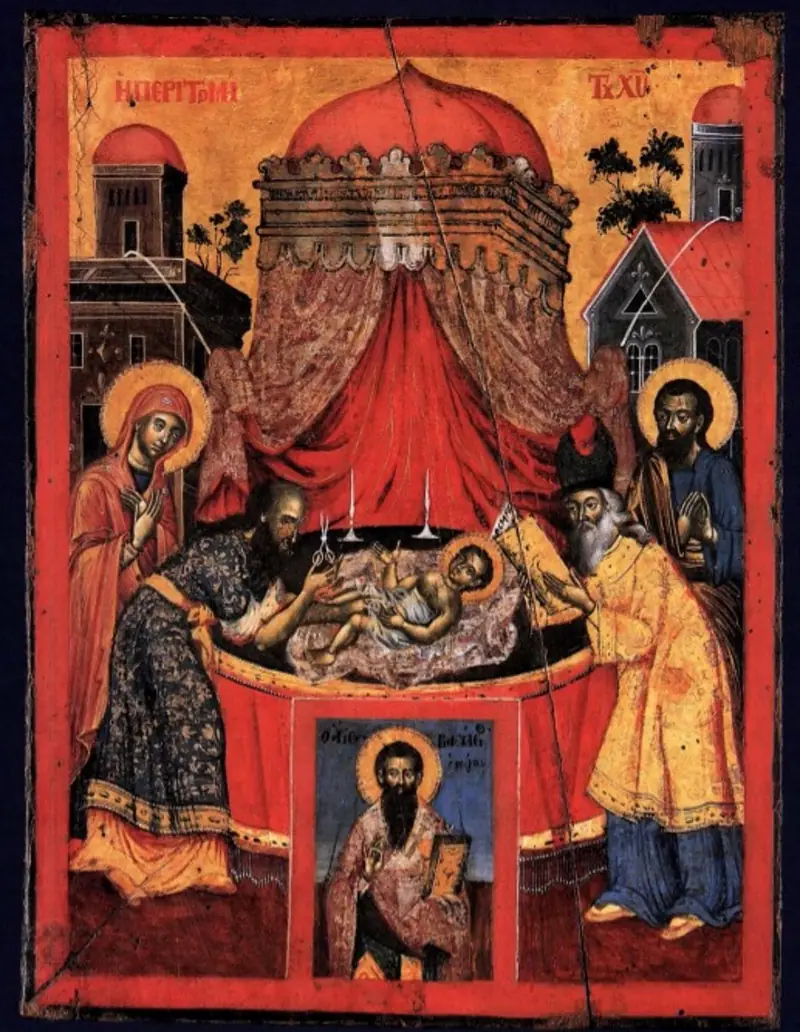
The Circumcision of our Lord Jesus Christ
The earthly life of Jesus Christ and the events bound up with it — the Nativity, the Meeting in the Temple, the Baptism, the Transfiguration, the entry into Jerusalem in glory and the rest — are of the highest importance for Christianity, since besides their historical or political content they have a deep mystical side as well. Studying these events closely helps us to walk the way the Son of God walked, to follow Him, to take up our own cross, to overcome our sins and passions and to grow up in Christ.
Someone may ask: why did the incarnate Lord need to pass through infancy, childhood and youth? Could He not have taken the body of a grown man at once and saved mankind so? God, of course, can do all things; but soon after the Saviour's crucifixion a multitude of sects arose, claiming that Jesus, the Son of Man and the Son of God, clothed Himself in a human body only in appearance, and so accomplished His work. In other words, that human nature had no part in our salvation. This is a great error, for the meaning of salvation is precisely this: man sinned, and man had to redeem the sin. Many sects spread this false teaching to this day — and that although Christ was born and grew as an ordinary man does. What would they have said had the Saviour clothed Himself at once in the body of a full-grown man?
This is why the Circumcision of our Lord Jesus Christ matters. It shows us that the eight-day-old child was circumcised in real flesh and not in appearance, in remembrance of the covenant given by the Lord to the patriarch Abraham and his seed: “And he that is eight days old shall be circumcised among you, every man child in your generations” (Gen. 17:12). From that time every Jewish man keeps this rule. More than that: because of Abraham's first son Ishmael, whom his father circumcised at thirteen along with Isaac, his descendants — the Arabs — are circumcised too, though, unlike the Jews, at thirteen years old.
The Jews kept this rule so strictly that for circumcision they would even break the rest of the Sabbath. On the eighth day from His birth our Lord Jesus Christ was also circumcised: the Maker of the Law Himself fulfilled the Law's demand, to show us an example of obedience to the divine will. The Lord was circumcised, and by this He confirmed that He had truly taken flesh. At that rite He was given the name Jesus — the name the Archangel announced to the All-holy Virgin before His conception (“Jesus” means precisely “Saviour”, and shows us that Christ became man to save the world): “And when eight days were accomplished for the circumcising of the child, his name was called Jesus, which was so named of the angel before he was conceived in the womb” (Lk. 1:21). Not one of the apocryphal gospels says anything of the circumcision — not one except the “Arabic Gospel” of the childhood of Jesus, where the story is told with horrifying details. It was not the kind of event that interested those who wished to weave their own inventions into sacred history; but for Christians the Lord's circumcision had a particular meaning — it confirmed that Christ came not to abolish the old Law but to fulfil it: “for thus it becometh us to fulfil all righteousness” (Mt. 3:15). The Lord received circumcision as the first ordinance of the Law of Moses. This is what the Apostle Paul writes: “But when the fulness of the time was come, God sent forth his Son, made of a woman, made under the law, to redeem them that were under the law, that we might receive the adoption of sons” (Gal. 4:4). Thus, had the Saviour not received circumcision, no one would have acknowledged Him as the Messiah, the descendant of Abraham. Jesus Christ bore pain in His infancy in order to teach us the circumcision of the spirit. As the east reflects the light of the west at the setting of the sun, so Bethlehem foretold Golgotha, and even the child's cradle carried the seed of the Saviour's passion on the cross. Circumcision was moreover an image of baptism: as circumcision cuts from the body not a part that is needed but a useless excess, so through holy baptism sin is cut away from us — and that sin is plainly an excess of desire and not desire itself as it is needed (for it is impossible that a man should desire nothing at all or take no pleasure at all), since sin is the same as the uselessness of pleasure, that is, useless desire and pleasure, which holy baptism cuts through and cuts off — “circumcises” — granting us as a sign the precious cross on the forehead: not to set us apart from other peoples (for every people is brought near to baptism and sealed with the sign of the cross), but to distinguish, within every people, the believer from the unbeliever.
Thus, when the truth was made manifest, the image and the shadow — that is, circumcision — became useless. So circumcision now is superfluous, and even contrary to holy baptism, for one who is circumcised is bound to keep the Law of Moses, whereas the Lord was circumcised precisely so that the Law should come to an end. He kept the whole Law and the Sabbath as well, so as to finish the Law and bring it to a stop; but when He was baptized and the Holy Spirit appeared to men in the form of a dove, descending upon Him, from then on He preached the service and labour of the spirit and the Kingdom of Heaven.
Records of the feast of the Circumcision being kept in the Church of the East go back to the fourth century. The canon for the feast was composed by St Stephen the Sabbaite.



