
Svetitskhovloba: the Story of the Lord's Robe
The feast of the Lord's Robe and of the God-radiant, myrrh-streaming Pillar
Mtskhetoba — Svetitskhovloba
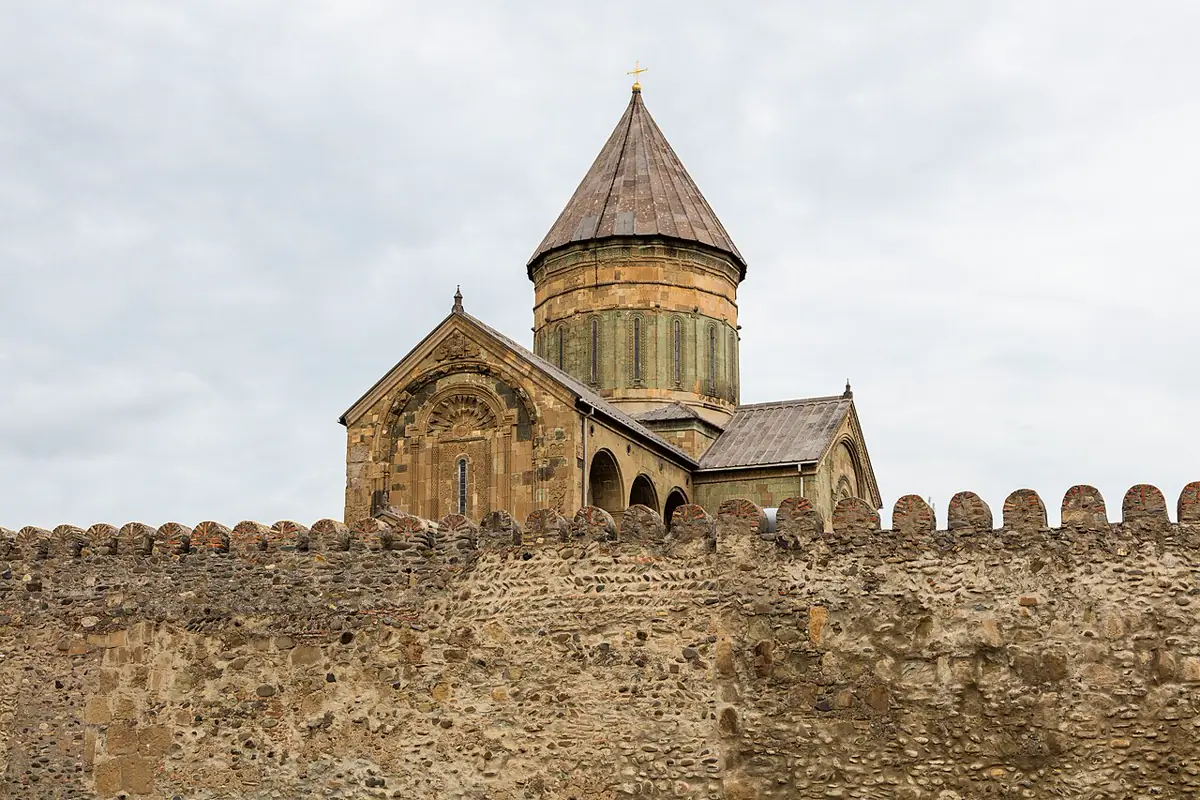
The patriarchal cathedral of Svetitskhoveli (11th century). Photo by Paata Vardanashvili (www.paata.ge)
Troparion: The feast of the catholic Church, of the holy Pillar and of the Lord's Robe, gathers in light to the ends of the world, and for our nourishment pours forth holy myrrh upon us who worship the holy Mother of God and Christ born of her, that we may find life for our souls.
Paraklesis of the Living Pillar and of the Lord's Robe
Akathist of the Living Pillar and of the Lord's Robe
Nikoloz Gulaberisdze — The Reading of Svetitskhoveli
● His Holiness and Beatitude Ilia II, Catholicos-Patriarch of All Georgia, sermons on the feast of Svetitskhovloba (2001 · 2005 · 2006 · 2007 · 2008 · 2009 · 2010)
● Catholicos-Patriarch Leonid (Okropiridze), a word on the day of Svetitskhovloba
● On the Lord's Robe and Svetitskhoveli: an interview with Archpriest Archil Mindiashvili, rector of the church of the Holy Chief Apostles Peter and Paul
In the year when Aderki came to the throne of Kartli, a rumour spread in Mtskheta that the Persians had conquered Jerusalem. Mourning and grief seized the Jews of Georgia, but after a little while all were calmed: they learned that “the Persians had not come to Jerusalem to conquer it, but instead of weapons were bringing royal gold, healing myrrh and fragrant frankincense, and were seeking a child of the tribe of David. And they found one, a poor stranger, born of a poor stranger woman at no fit time and in no fit place. To that child they bowed down and offered gifts.”
Thirty years passed. The high priest Annas sent a messenger to the Jews of Mtskheta: “He for whose sake the magi came and offered gifts has grown up, and calls himself the Son of God, and preaches to us some other new law; and now we have sent messengers to all the Jews, that those learned in the law may come. Come, then, all who are bound by the law of Moses, and let us take counsel concerning him.”
Elioz of Mtskheta obtains the Robe
From Kartli, Elioz of Mtskheta and Longinoz of Karsani went to the council of the Sanhedrin. Elioz's mother was of a priestly tribe. Before he left she begged her son to have no share in the shedding of the Messiah's blood, “for He is the word of the prophets and the parable spoken by the wise”.
When the Saviour was crucified on Golgotha, Elioz's mother in Mtskheta heard the sound of the hammer, cried out “with a terrible shriek”: “Farewell, kingdom of the Jews, for you have killed your own Saviour and Redeemer, and from henceforth you have become enemies of the Creator!” — and at once she died.
When the Jews cast lots for the Lord's Robe, by God's providence it fell to the men of Mtskheta. Elioz and Longinoz brought the Robe to Kartli. When Elioz came to Mtskheta, “his sister” Sidonia came out to meet him. She pressed the Robe of our Saviour to her heart, heard with weeping and lament her brother's account of the Crucifixion, and gave up her spirit. This wonder quickly became known throughout Kartli. King Aderki wished to put on the Robe himself, but no one could take it from Sidonia's cold arms, and Elioz buried his sister together with the holy Robe. A cypress tree grew up on Sidonia's grave.
St Sidonia
After Pentecost the apostles cast lots. The conversion of Kartli fell by lot to the All-holy Mother of God, but the Saviour appeared to her and said: “O My Mother, I will not neglect that people, chosen above all nations, at thine intercession for them. But do thou send Andrew the First-called to that portion allotted to thee, and send with him thine icon, which shall be imprinted by laying it upon thy face; and in thy stead that icon of thine shall abide as their guardian unto the ages of ages.” By God's providence and with the blessing of the Mother of God, St Andrew the First-called (commemorated 30 November) came to Georgia to preach.
St Andrew preached in Didachara; by the grace of the wonder-working icon of the All-holy Mother of God he converted the pagans, ordained priests and deacons, and built a church dedicated to the Mother of God. Then he crossed the mountain called the Iron Cross, went through the gorge of Odzrkhe, reached the border of Samtskhe and stayed in a village called Zaden-gora. Here by the grace and power of prayer he shattered the idols. In Atskuri ruled a widow of the Samdzivari family, whose only son had died. The holy Apostle Andrew, by the power of the cross and the grace of the icon of the All-holy Mother of God, raised the dead man to life. Samdzivari was baptised with her son and all her household. The holy apostle appointed a bishop, priests and deacons in Meskheti; after this he preached in Klarjeti, in Artanuji, in Armenia, and returned to Jerusalem to keep the Passover.
King Aderki turned the baptised Georgians and Megrelians back to paganism and punished the eristavi of Klarjeti, who had let St Andrew go in peace. The apostle returned to Kartli once more. This time Matthias and Simon the Canaanite were with him. St Matthias (commemorated 9 August) went to preach in Svaneti; St Andrew and St Simon (commemorated 30 June) went to Ossetia and converted many, and then turned to Abkhazia. St Simon the Canaanite remained in Tskhumi, while St Andrew went on to Jiketi. The Jiks would not receive the apostle's preaching and wished to kill him, but by God's grace he was saved.
Time passed. Under the rule of the lawless and in fear of the pagans the Georgians forgot their Creator and the crucified Saviour.
The Equals-to-the-Apostles King Mirian and Queen Nana
At the time of the martyrdom of St George of Cappadocia (commemorated 23 April and 10 November) there lived in Cappadocia a devout husband and wife, Zabulon and Sosana (commemorated 20 May). They had a daughter, Nino (commemorated 14 January and 19 May). Sosana was the sister of Juvenal, Patriarch of Jerusalem. The couple resolved to give themselves to the Lord; they distributed their property to the poor, gave their little daughter to a nurse to bring up, and themselves took up the hermit's life. Nino's teacher told her of the Lord's Passion, Crucifixion, burial and Resurrection, and also of His linen and grave-cloth. When she learned that the Lord's seamless Robe was buried in a pagan city, she resolved to convert the Georgians to the faith of Christ. She became the friend of the king's daughter Rhipsime and of her nurse Gaiane (commemorated 30 September), who with fifty virgins were fleeing the lawless emperor Diocletian, and with them she went to Armenia. After the holy virgin-martyrs were put to death by Tiridates, king of Armenia, Nino, miraculously saved from death, crossed into Kartli over the mountains of Javakheti.
At that time Mirian reigned in Kartli. His wife was Nana, the daughter of a Pontic commander. Mirian was known for his tolerance in matters of faith: he worshipped fire and the Georgian idols, but through his long dealings with the Greeks he had also heard of the Christian teaching, and word had reached him of the miraculous victory over the enemy won by St Constantine the Great (commemorated 21 May).
The Lord's visitation and the deliverance of our nation from the idols of the demons
Coming into Kartli, Nino went down to Urbnisi and settled in the Jewish quarter. Some twenty days later all Kartli set out for the feast of the pagan deity Armazi. The whole royal court was present at the feast. St Nino lifted up a prayer to God, and the idols of Armazi, Gatsi and Gaim were miraculously shattered. Nino settled in Mtskheta. She asked everyone about the Robe, but no one remembered where it lay. In this search Nino came to know Abiatar, the priest of the Jews of Mtskheta, a descendant of Elioz, his daughter Sidonia, and six other women. St Nino converted them to the faith of Christ, but since she was not a priest, they were not given the sacrament of Baptism.
St Nino received from the Lord the gift of healing. In the name of the crucified Saviour and by the grace of the cross of vine she healed the sick.
Queen Nana fiercely opposed Nino's preaching and reviled the new teaching and its preacher. But King Mirian “had a desire for the faith of Christ and did not hinder the preaching of Nino and her disciples”. Once he secretly rescued the priest Abiatar, his daughter Sidonia and other Christians from persecution by the Jews.
Time passed. Once Queen Nana fell ill, and St Nino's prayer saved her from certain death. After the queen's healing King Mirian took an interest in the faith of Christ and often questioned Abiatar, formerly a Jew, about the books of the Old and New Testaments. Abiatar had him read the Book of Nebroth. The king came to desire to turn to the faith of Christ.
The baptism of holy King Mirian, Queen Nana and Revi
One day Mirian went hunting on Mount Tkhoti. The invisible enemy came upon him and again put into his heart love for the idols and for fire, and a wish to put the Christians to the sword. He resolved that as soon as he returned to Mtskheta he would drive out the Christians and put Nino to death. When the king had climbed the mountain, the sun was darkened for him and pitch-black night came down. The frightened Mirian begged the idols for help, but they were deaf to their suppliant. Then the king commended himself to the crucified God, and a miracle came to pass: it grew light and the sun shone out. Mirian stretched out his hands towards the east and said: “Thou art God above all gods, Lord above all lords, the God of whom Nino speaks.” On returning to Mtskheta the king went to Nino, and on her advice the very next day he sent envoys to Greece to King Constantine, asking him to send priests to baptise them.
Before the priests sent from Constantinople arrived, King Mirian resolved to build a church in the royal garden. The builders made seven pillars of cedar. Six they set up, but the seventh, the largest, they could not move from its place. St Nino with her disciples stood in prayer. At dawn a youth clothed in light, “all girded about with fire”, came down from heaven, took hold of the pillar and raised it up. The pillar shone with divine light and stood still in the air at a height of twelve cubits. All Mtskheta came to venerate the pillar of light; as they drew near it the sick were healed, the blind received their sight, the crippled rose up.
The raising of the Living Pillar
Meanwhile the envoys returned from Constantinople. With them came Bishop John, priests and deacons. To the king and people who had turned to the faith of Christ, St Constantine the Great sent a cross and an icon of the Saviour, and a portion of the Life-giving Cross — the footrest — and the nails of our Lord Jesus Christ. At the confluence of the Mtkvari and the Aragvi the king, the queen, the royal court and all Kartli were baptised. After the solemn baptism Bishop John and those with him went to Erusheti, built a church and left there the nails of the Lord; then they began to build a church at Manglisi, and here they laid the portion of the Life-giving Wood.
King Mirian was grieved. He wanted holy things to rest in the royal city as well. St Nino told the king that a great holy thing, the Lord's Robe, was kept in Mtskheta. The king summoned the priest Abiatar, questioned him about the Robe and was filled with joy.
In Mtskheta, on top of a rock, stood a beautiful, fragrant, wonder-working tree. Wild beasts struck by arrows and dying were healed by its leaves. When Bishop John was told of it, he said: “Truly that tree has sprung up from God and been kept for this time, and now the grace of God has spread over Kartli; and from that tree it is fitting to make a precious cross, which all the multitude of Kartli shall worship.”
King Mirian's son Revi, with the bishop's blessing and accompanied by the people, cut down the tree, brought it with its branches and set it up to the south of the church. For thirty-seven days the tree neither changed its colour nor shed its leaves. Afterwards three crosses were made from this tree.
The raising of the Precious Cross
After this, for many days, the people saw one and the same vision: at night a fiery cross surrounded by stars stood over the church; at dawn two stars parted from the others, one going towards the east and the other towards the west, while the fiery cross itself came to rest beyond the Aragvi, on top of a rocky hill, and from there vanished into heaven. Because of this wonder, on St Nino's advice, the king had one cross set up to the west on Mount Tkhoti, and the second in the town of Ujarma, but for the third cross they could not choose a place.
King Mirian prayed to the Lord to show the place where the cross should be raised. God heard the right-believing king's entreaty and made known to him through an angel that the cross should be raised on the rocky hill beyond the Aragvi.
When this precious cross was raised at Mtskheta, all the idols in Kartli were at once shattered.
Before his death the king blessed his son Bakar, charged him to be faithful to the Holy Trinity and to fight against the idols, and reposed in God. The holy right-believing king was buried, at his own wish, in the upper church (the church of the Samtavro convent). He did not wish to be buried in the lower church (Svetitskhoveli), which was called “the Holy of Holies”, because of the reverence and awe he had before the glorious pillar of light. Two years later Queen Nana also died and was buried in the same place, beside King Mirian.
Lives of the Saints, vol. IV, Tbilisi, 2001
The story of the Lord's Robe · St David the Builder and Svetitskhoveli · No one could lay hands on the Robe · The holy things of Svetitskhoveli · The Lord's Robe is undivided · And in conclusion
An Old Testament priest had to wear, together with the ephod, the mantle and his other vestments, a woven robe as well. The All-holy Mother of God knew this, and therefore she wove a robe for the child Jesus, the future “high priest after the order of Melchizedek”. “Now the coat was without seam, woven from the top throughout.” Time went on, Jesus “increased in wisdom and stature, and in favour”, and the robe woven by the Mother of God miraculously grew as well — the robe in which “the all-light-ruling body of that holy fire of the Godhead was blessedly clothed”. According to Theodore Zigabenus, the robe had sleeves. A robe with short sleeves is also depicted on the coat of arms of the Bagrationi. And according to a tradition current in Jerusalem in the seventeenth century, the Lord's Robe was azure, like a mantle, sleeveless, wide and long (the conversation of Ioannikios the Greek with Iv. Gramotin); but what it was woven from is unknown. One thing is certain: this blessed garment, like a sponge, soaked up the sweat, blood and tears that the Saviour shed for the salvation of mankind.
At the time of Jesus' Crucifixion, Jews from Georgia also went to Jerusalem — Elioz of Mtskheta and Longinoz of Karsani. Elioz's mother was of the tribe of the high priest Eli. It was she who warned her sons to take no part in the shedding of the Lord's blood. Elioz's sister Sidonia begged the same of him. At the Saviour's Crucifixion, they say, Elioz's mother in Mtskheta heard the sound of the nails being driven in. She cried out: “Farewell, kingship of Israel, for in your folly you have killed the Lord and Saviour of all!” — and there and then gave up her spirit from grief.
Elioz, it seems, took an active part at the Saviour's Crucifixion. When they divided the Lord's garments and cast lots for the Robe, it fell to him. Elioz brought the Lord's Robe to Mtskheta. Sidonia met him weeping at the gate of Mtskheta, pressed “the Redeemer's Robe, desired by all” to her breast, and fell asleep “with the sleep of her mother”. The story spread through all Mtskheta. King Aderki saw the dead woman and took a liking to the Robe. Many tried to take the Robe from the dead woman, but in vain, and at last she was buried in the Robe beside the cedars of Lebanon.
Some years later Aderki's grandson, King Armazeli, wished to dig up Sidonia's grave and find the Robe, but for this he received punishment from God — he was suddenly struck blind.
That is how the Lord's Robe came to Georgia. The good Lord had ordained beforehand the “preparation of our land as a chosen people”, and since we were also the lot of the Mother of God, Iberia was made all the more worthy of “this awesome grace”. As St Nikoloz Gulaberisdze says, “for this He sent forth beforehand the grace of His Godhead, that it might first be betrothed by that Robe and by the grace of His Godhead”.
St Nino came to Iberia, and the time came for the wedding, the union with Christ, of the “chosen people” betrothed by the Lord's Robe… King Mirian, converted by God's miracle and by the saint's prayer, resolved to build a church in his royal garden. They cut down the beautiful cedars of Lebanon that grew in the garden and hewed seven pillars from them. They raised the walls with great effort and set up six posts, each in its place, but the seventh pillar, meant to stand in the middle of the church, they could not move for all their toil. Evening came. The king and his attendants went back to the palace. Only St Nino remained by the pillar with her disciples. The devil in despair tried to frighten them, but St Nino's prayer overthrew his machinations.
Dawn broke. Worn out with all they had lived through, they fell asleep. Only Sidonia, the daughter of the priest Abiatar, kept watch. St Nino was praying with outstretched hands. Suddenly a youth clothed in light came to her and spoke three words to her. The virgin fell on her face before him, and the youth took hold of the pillar and raised it up to heaven. Some time later the pillar, changed into the likeness of fire, slowly came down, drew near the place where the tree had been cut, and stopped two cubits above the ground, “wondrously suspended in the air”. So The Reading of Svetitskhoveli tells it; according to The Life of Kartli, the pillar of fire came down, stood in that same place and was fixed there untouched by human hands.
This astonishing event shook all Kartli. People came to the pillar and could not tear themselves away from the wondrous sight. Countless miracles took place by the power of the pillar. First a Jew blind from birth was healed by drawing near the Living Pillar; then the young prince Amazaspan, bound to his bed, was set on his feet. At that time the only son of a certain Jew died. Everyone had gone to see the Living Pillar; only the parents stayed with the dead boy, weeping bitterly, they say, and pleading with their son: “Arise, our only-begotten, that we may go to that pillar of light” and rejoice with the others. And suddenly, as though he had woken, the dead boy rose and asked to be taken to the Living Pillar. He told how he had fallen into the abyss of hell; suddenly a pillar of light came down from heaven, on top of which the Saviour sat in glory. All at once a voice came from the pillar: “I pity your parents; my heart aches at their pain” — and then He commanded the angels to return the boy's soul to his body.
This miracle stirred the people still more. Everyone tried to get near the Living Pillar. In their excitement they trampled one another. Then King Mirian surrounded the pillar with a casing of planks. The casing could not hold back the grace of the Living Pillar…
Soon the first church was built here. St Constantine the Great sent to King Mirian, by the hand of Bishop John, a portion of the Life-giving Wood, the nails and the board to which the Saviour's feet had been nailed. The bishop left the precious gifts at Erusheti and Manglisi and came back to King Mirian empty-handed. St Nino comforted the disheartened king: she told him that he possessed the greatest holy thing — the Lord's Robe and the mantle of the Prophet Elijah were buried in his garden. The king questioned the Jews about everything in detail. They too confirmed what the holy virgin had said. Then the king was filled with joy and glorified the Lord.
Mirian's son Revi, in his reign, feared that the Living Pillar might be stripped of its casing and stolen, and built a wall of stone and mortar around it. Later Vakhtang Gorgasali built a large stone basilica dedicated to the Twelve Apostles on the site of the wooden church. Abul-Qasim burned this church in the tenth century, but it was soon restored. In the reign of Giorgi I, Catholicos Melkisedek had a great domed cathedral built in its place. The cathedral was damaged during Timur's invasion, and Alexander the Great restored it anew. The cathedral was damaged again during the invasions of Shah Tahmasp and his grandson Shah Abbas. Queen Mariam, wife of King Rostom, restored the dome of Svetitskhoveli in 1656, and for this she was depicted in the cathedral together with her son. The tower built around the Living Pillar was also damaged by the invasions, and it was restored in 1675 by order of Catholicos Nikoloz. Grigol Gurjvarishvili painted the tower with scenes from The Conversion of Kartli.
From time immemorial myrrh flowed from the foot of the Living Pillar, and by it the Georgian nation was nourished and grew in the faith of Christ. Platon Ioseliani supposed that this life-giving spring must have ceased during Shah Abbas's invasions in 1614–1617, for the shah, it is said, greatly desecrated the cathedral; but in 1624 Ioannikios the Greek, a contemporary of Shah Abbas summoned to the Ambassadorial Office, told Ivan Gramotin this: when Shah Abbas's grandfather, Shah Tahmasp, invaded Iberia (this was in 1541–1553), the shah turned the cathedral of Svetitskhoveli into a stable for horses and cattle; and it was from then on that the myrrh ceased to flow from the pillar.
Though no one ever saw the Lord's Robe again after its burial, the Georgians firmly believed that it was buried precisely where the pillar was raised, and if anyone came to doubt this, he was corrected by God. They say that the great David the Builder himself “wavered somewhat in mind” about Svetitskhoveli and said: what do we know of what lies beneath this tower, what are we worshipping — has the devil not led us astray?.. Once the king prayed before the Living Pillar with his mind so troubled. That same night, in his sleep, an old man appeared to him sitting on top of the pillar, from whom came a blinding light. “David, David,” he said to the crowned one, “you do not know who I am; know that neither you nor anyone else who has hope in me will ever be put to shame. Do not disbelieve in me, for whoever disbelieves will be punished.”
The king woke, leapt in fear onto his horse, galloped all night, and reached Svetitskhoveli at the time of the morning service. He fell on his face, watered the floor with his tears, and begged God's forgiveness “for his former errors and unbelief”.
In the eleventh century, during the Turkish invasions, the sultan's wife Shahri-Khatun wished to dig up the holy thing, but fire burst from the foot of the pillar and turned the blasphemer to ash… Neither Timur nor Shah Tahmasp dared to lay hands on the holy thing. Only Shah Abbas ventured to order the foundations of the Living Pillar to be dug up, but fire bursting from the ground again burned those who committed this sacrilege. The shah took fright, dismounted, walked reverently around the cathedral, prayed before the pillar and gave the Catholicos a guarantee that it would not be touched.
As for the gift the shah sent to the Russian sovereign in 1625, supposedly the Lord's Robe, this was a reddish piece of linen, a span long and a span wide, on which, they say, scenes of the Lord's Passion and Crucifixion were depicted in the Latin manner. A robe “woven from the top throughout” would of course have fallen apart if cut up. So the shah's gift cannot have been the Lord's Robe.
What, then, was this holy thing that worked so many miracles in Russia?
After the fall of Constantinople many holy things came to Georgia. In the cathedral of Alaverdi a part of Christ's shirt was kept, and in the church of the Transfiguration at Rustavi the girdle of the Mother of God. The shah's gift may have been one of these. Teimuraz I voiced such a supposition in a letter sent to the Russian sovereign in 1639.
The cathedral of Svetitskhoveli possessed many holy things: the Lord's Robe, the wonder-working Pillar, the mantle of the holy Prophet Elijah. At the beginning of the twentieth century (and now too) there rested there one of the four crosses that St Nino had made from the wonder-working tree. Earlier, before Timur's invasion, it was kept in the Jvari monastery at Mtskheta. On 16 February 2004 myrrh flowed from the wonder-working cross (the childless especially set their hope on it). With the Patriarch's blessing it was adorned with enamel icons. Portions of the Life-giving Wood and of St Nino's cross are set within it.
One of the chief holy things of Svetitskhoveli was the processional icon of the Living Pillar. This is a chased image of the Living Pillar, 36×17 cm, set in a triptych. St Nino and St Mirian are depicted on the wings of the triptych. The upper part of the triptych is gilded. On it Sidonia is depicted lying in her coffin, and on her breast rises the pillar, held by angels. At Sidonia's feet St Nino is depicted in prayer, and above, the Saviour blessing with both hands. The icon held 44 holy relics. It is now kept in the Museum of Art.
These holy things are that very covering which veiled “not only the body of the Godhead, but still more the nakedness of our souls through sin”.
As St Cyprian of Carthage says, “by the sacrament of His garment the Lord declared the unity of the Church”, and “he cannot possess the garment of Christ who rends and divides the Church of Christ”. That is why the Georgians guarded the unity of the Church so carefully, and why a bishop had to be consecrated in Svetitskhoveli without fail.
Once the holy Patriarch Nikoloz Gulaberisdze, because of “the harshness of winter” and the queen's illness, consecrated Timote as Bishop Mroveli in the church of Ruisi. That same night the Living Pillar appeared to the preacher of the cathedral “in the likeness of an old monk” and commanded him to warn the Patriarch never again to consecrate a bishop anywhere other than the cathedral of Svetitskhoveli. He did this in ignorance, so I forgive him, but another time I will not pardon “the affront to my throne”, the Lord said.
The atabegs of Samtskhe cared nothing for the unity of the Church, and by trying to break their bond with the throne of Mtskheta they brought it about that this blessed land was emptied and wasted both spiritually and physically. Wishing to rend the Lord's Robe, they rent their own souls and left the generations to come so great a burden that I do not know whether anyone will ever be born who can lift it…
Mtskheta, called a second Jerusalem for its place-names and for the holy things it possesses; Svetitskhoveli, built on seven pillars and in this likened to Solomon's temple; the Lord's Robe and the holy Pillar stir Georgians to read them as signs. We too shall draw one parallel: fire bursting from the ruins of Solomon's temple burned the workmen whom Julian the Apostate had sent, against God's will, to build the temple. From the place where myrrh once flowed, the Lord made fire burst forth. Therefore let us fear to draw near the Living Pillar without reverence, especially on the feast of the Robe; let us fear, and become that “chosen people” for whom the Lord, as a sign of His great mercy, will make myrrh spring up and flow from the foot of the Living Pillar, “as deifying and illuminating”.
Prepared by Kakhaber Kenkishvili, the journal Karibche, no. 9, 2004
A holy thing kept at Svetitskhoveli — the Precious Cross
Svetitskhoveli — a divine creation of talent
I had no guards upon the walls, / I never asked for more than was my due — / I made only Svetitskhoveli!
Wrestling with eternity, / let no one take me for a great man's son: / I had no ancient, praised lineage.
I myself refused the peaceful life / and ease's treacherous abode; / I stood: I shaped, I cut and… I undid.
I shut the door on sweetness, / now I hungered, now I fasted, / and in God's name I served the people.
To do good, it seems, is a crucifixion… / How many stones has one man broken! / How often have I felt the evening come!
In stone I kindled every colour. / I have left you Svetitskhoveli.



