
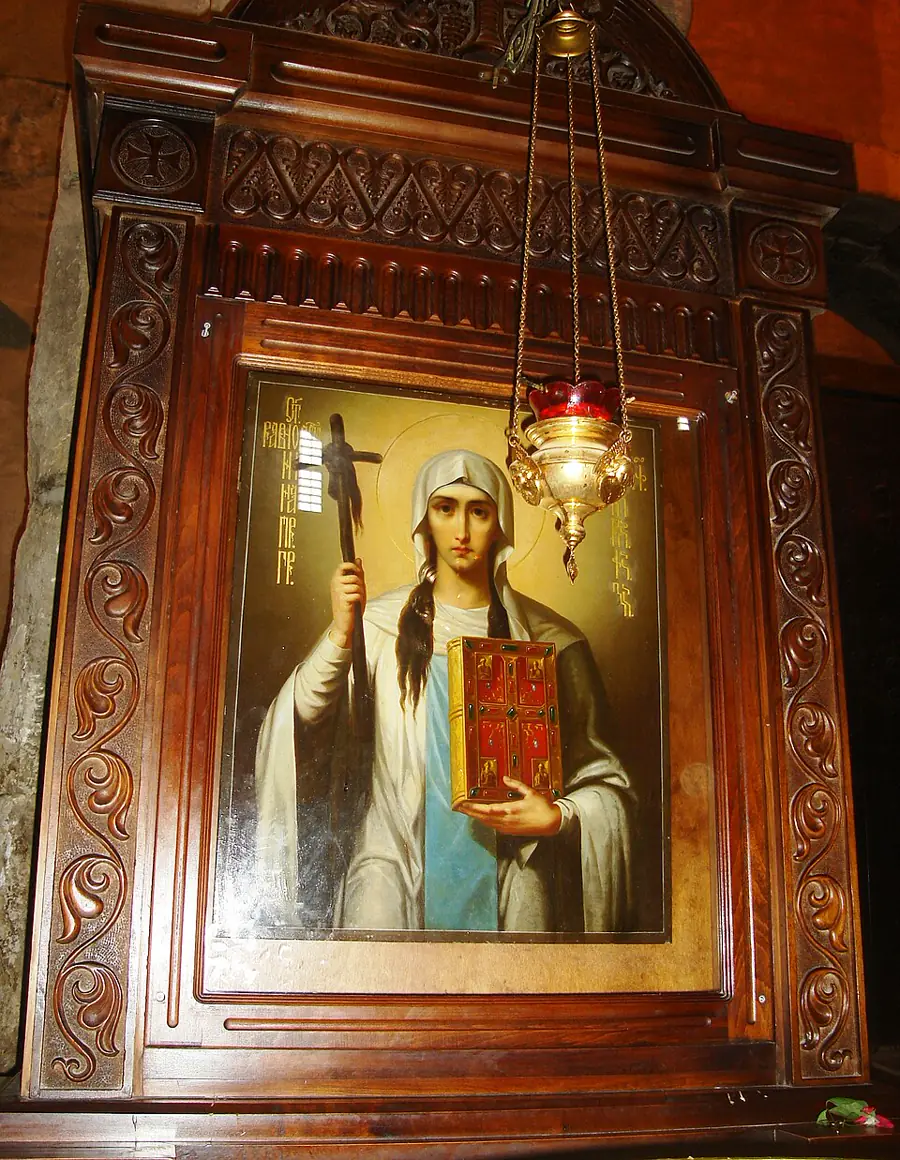
Ninooba — the feast of St Nino
Troparion: Fellow-labourer with the servants of the Word of God, who didst bring the preaching of Andrew to its fulfilment, enlightener of the Georgians and lyre of the Holy Spirit, O mother Nino, entreat Christ God to have mercy on our souls.
Kontakion: The apostle chosen by Christ, the herald of the Word of God, the learned evangelist of life, the guide of the Georgian people on the paths of righteousness, the own disciple of the Mother of God, Nino, let us adorn today with all divine songs — our fervent intercessor and unsleeping guardian.
The Life of St Nino
Akathist to our holy mother Nino, Equal to the Apostles
Supplicatory canon to our holy mother Nino, Equal to the Apostles
The Monastery of Bodbe holds a place of its own in the spiritual life of Georgia. The reason, of course, is that here rests the enlightener of the Georgians, St Nino, Equal to the Apostles. Even in St Nino's lifetime the Lord glorified the village of Bodbisi as the future resting place of His well-pleasing servant. And from that time St Nino's grave has become a living spring of grace and healing for the Georgian people.
St Nino was fourteen when, at the command of the Mother of God, she set out for the land of her lot. Here, with many tears, with prayer and with strict ascetic labour, she accomplished her apostolic work and brought a nation covered with the mist of paganism into the light of truth.
The Church of St George, where St Nino is buried
From St Nino's time onwards the Monastery of Bodbe was the first object of care of the Georgian kings and nobles.
In the fifth century Vakhtang Gorgasali adorned and enlarged the church, and it took the form of a three-aisled basilica in the eighth and ninth centuries.
In the twelfth century, in the reign of Demetre I, son of David the Builder, St Nino's resting place was adorned once again.
The grave of the Equal-to-the-Apostles was so revered that the Mongols, who razed the whole country to the ground, left only the church of Bodbe unruined and unsacked — though not unharmed.
In the Middle Ages the kings of Kakheti were anointed in this church. Incidentally, even Shah Abbas himself was present at the enthronement of Teimuraz I in the church of Bodbe; but this did not keep him from sacking the monastery a few years later, and King Teimuraz I himself afterwards laboured greatly to restore it.
John of Bodbe. Fresco (1823)
From of old the Monastery of Bodbe was a centre not only of spiritual life but of culture and learning as well. From the seventeenth century a theological school worked here, in which secular sciences were taught besides the theological subjects. Here too was one of the richest libraries in Georgia. From the second half of the eighteenth century there was a fairly large monastery of monks at Bodbe.
Before the exarchs abolished the eparchy of Bodbe, its last bishop was the well-known churchman Ioane Maqashvili. Through the labours of Ioane of Bolnisi the house was adorned and beautified once again in 1823: the church was painted, a new iconostasis made (both the painting and the iconostasis survive to this day), and a bishop's palace built with a house chapel. With the death of Ioane Maqashvili (1837) the eparchy of Bodbe was abolished as well, and both the monastery and the seminary came to an end. From that time Bodbe was governed by archimandrites. Among them Archimandrite Makari held a place of his own. He paid particular attention to the revival of Georgian chant. For this work he is said to have invited the priest Grigol Karbelashvili especially and set up a school of chant. What this school was like is shown clearly by a letter of Dimitri Kipiani to Archimandrite Makari: “My soul was sweetened when I heard our ancient chant, renewed by your care and effort.” In his time too, in 1862, the building of a three-storey bell tower began, which was finished in 1885 under the hieromonk Nikoloz Mikeladze as superior.
The Monastery of Bodbe at the beginning of the twentieth century · The modern revival of the monastery · The holy things of the monastery · The address and bank details of the St Nino Convent of Bodbe: Bodbe Convent, 383210, Sighnaghi district, tel. (8 255) 32 752; JSC Bank Respublika, code 220101757, current account 136084271, currency account 136184271 · The protector of the Georgian liturgy
In the 1880s the renowned hagiographer and icon painter Mikheil Sabinin did great service to the house, which the exarchs had undeservedly forgotten and left unprotected. He replaced the old stone over St Nino's grave with a marble shrine. By his untiring labour too the ground was prepared for opening a convent here.
Tamar Marjanishvili, abbess of the Monastery of Bodbe (1902–1907)
At the end of the same century the Russian emperor Alexander III visited the place, and by his order a convent was opened at Bodbe in 1889; a school for girls worked here too. In 1902–1906 the superior of the convent was Iuvenalia II (in the world Tamar Marjanishvili, in the great schema Tamar, sister of Kote Marjanishvili; the question of her canonisation is now being considered by the Russian Church). In this hardest of periods for the Georgian Church, when the policy of Russification was pursued with full force, through the efforts of Tamar Marjanishvili the teaching of Georgian became compulsory at the Bodbe girls' school from the first class to the last. Through her too, while she was superior, the services in the church of Bodbe and the chant, which Abbess Iuvenalia herself taught the girls at the school, were in Georgian.
In 1906, by order of the emperor Nicholas II, Bodbe was given the rank of a first-class monastery.
Nino Vachnadze, the last abbess of the Monastery of Bodbe (1917–1924)
A letter of Oliver Wardrop gives a living picture of what the Monastery of Bodbe was like at the beginning of the twentieth century. He visited the monastery in 1919 and wrote about the visit with delight to his wife: “As we approached the monastery, a triumphal arch decorated with leaves and plants rose before us. We were received by the abbess (Princess Vachnadze). Everyone had gathered round the monastery: the nuns in black mantles and handsome headdresses, the girls of the monastery school dressed in white, and the people who live nearby. The priest invited me into the church, which was first built in the fourth century, and held a service of a few minutes, praying and beseeching the Lord, while those around him and the nuns sang.
The abbess showed me the girls' dormitory, the classrooms, the kitchen and the workrooms, where carpets, church vestments and icons are made, and also the embroidery room. We visited the garden too, which adorns the monastery. The girls presented us with flowers, and the people and children saw us off with cheers, and we set off on the road to Sighnaghi” (it is worth noting that this letter was given to the present superior of the Monastery of Bodbe, Abbess Teodora, by Oliver Wardrop's daughter. She bears the name of the enlightener of the Georgians, lives in England and, like her father and her aunt, loves Georgia very much. Mrs Nino takes a lively interest in the house of her patron saint, as her correspondence with the mothers of Bodbe bears witness).
In 1924 the communists closed the monastery. The last abbess of Bodbe, Nino Vachnadze, would not leave the monastery despite many threats, but in the end she was forced to abandon Bodbe and settle in Tbilisi, by the church of Anchiskhati, where she died. In the sixties the last superior of Bodbe was brought back, as she had willed, to her own monastery.
The monastery garden
The Monastery of Bodbe, with its most ancient traditions, sacked by the communists, was restored in 1991. Some thirty nuns and novices now labour in the monastery. The sisters are mostly young. Under the guidance of their superior, Abbess Teodora, they carry on many kinds of work, and hope that the monastery will soon regain its former glory and that a spiritual life adorned with many labours will come alive here again as of old.
Abbess Teodora, superior of the Monastery of Bodbe
And truly the house is regaining its first form, slowly but surely. With the help of devout people the monastery is being revived: St Nino's grave has been adorned and beautified; a bathing place and a small church of Sts Zebulon and Sosana have been built at the spring that came forth through St Nino's prayer. What is very important, the church has been restored, and as a result a later (seventeenth-century) addition half a metre thick was removed from its walls, which had quite destroyed its original proportions. Besides this, restoration work has uncovered the remains of the building of Ioane of Bolnisi's time, which are now being restored.
At the same time a detailed plan of the whole monastery complex is being drawn up, by which restoration and building work in the monastery will be carried on in future. The monastery has its own farm, and there are workshops for icon painting and handicraft. Besides this, the sisters carry on the work with books that is traditional in Georgian monasteries: on the basis of ancient manuscripts they are preparing service books for publication. In future, besides building work, it is intended to enlarge the publishing work and to restore the girls' school. And most important of all, the Liturgy is celebrated daily at the grave of the enlightener of the Georgians for the good of all Georgia.
St Nino's grave still brings forth healing of soul and body today, and her house tries, as far as it can, to give people the means of drawing near to her.
The sisters' cells
Photographs provided by Luarsab Togonidze
Much has been written about St Nino in our country, and more will be written in future. Her life, her labours and her person have many times been described, studied and adorned by art. One could speak of her without end.
But many may not know how St Nino protected the Apostolic Church of Georgia in one of the hardest periods for our country — under the rule of the exarchs, when services and chant in Russian were being imposed in the Georgian churches and monasteries. Catholicos-Patriarch Kalistrate Tsintsadze writes in his memoirs: “On 14 January 1905 (Ninooba) the Liturgy in the church of the school (meaning the Tbilisi diocesan school for girls) was served in Georgian (once only in the year).”
This is what we read in the private diary, dated 1883, of the well-known public figure and choirmaster Zakaria Chkhikvadze, who was then himself a seminary student: “13 January — today I appeared in class. Then, after we had eaten dinner, I gathered the pupils, had them sing in Georgian and taught them the order of the Liturgy. Since they did not know the Cherubic Hymn, I had a great deal of trouble preparing them. I taught them the new monastic ‘Holy God’.” The next day, on Ninooba, he writes: “This morning too I held a rehearsal and somehow taught them the Cherubic Hymn. At the Liturgy we sang well. They nearly spoiled the Cherubic Hymn for me, but we soon set it right. After the Liturgy I went to Sioni, and there too the Liturgy was in Georgian and the school pupils sang. They sang well, and there were a great many people…” (the style has been kept — N. Gh.).
Like David the Psalmist, the wise heart of the Georgians bound St Nino to the lyre — an instrument that echoes the sources of church chant. “Nino, lyre of the Holy Spirit”, who in the prayer of the Georgians is pictured as a musical instrument, stood as protector and guardian of the Georgian language, the Georgian liturgy and Georgian chant in the time of the exarchate.
So 27 January, Ninooba, may also be understood as the day of the saving and revival of the Georgian language, liturgy and chant — and St Nino as one of their intercessors before God. “Nino, lyre of the Holy Spirit, entreat God to have mercy on our souls.”



