
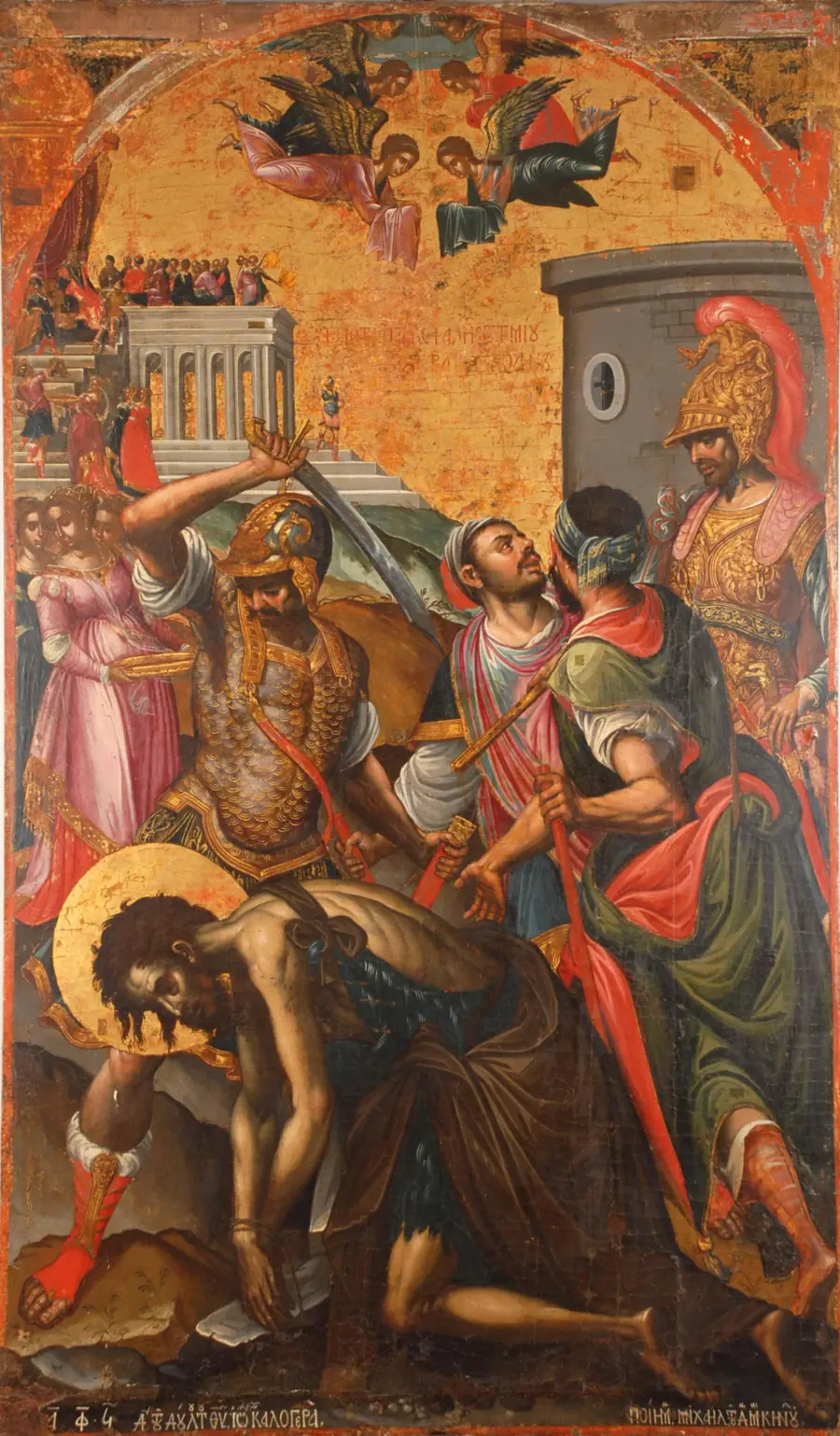
The Beheading of St John the Baptist
A fast day
And king Herod heard of him (for his name was spread abroad), and he said that John the Baptist was risen from the dead, and therefore mighty works do shew forth themselves in him. Others said that it is Elias, or as one of the prophets of old. But when Herod heard thereof, he said: It is John, whom I beheaded: he is risen from the dead. For Herod himself had sent forth and laid hold upon John, and bound him in prison for Herodias' sake, his brother Philip's wife: for he had married her. For John had said unto Herod: It is not lawful for thee to have thy brother's wife. Therefore Herodias had a quarrel against him, and would have killed him; but she could not. For Herod feared John, knowing that he was a just man and an holy, and observed him; and when he heard him, he did many things, and heard him gladly. And when a convenient day was come, that Herod on his birthday made a supper to his lords, high captains, and chief estates of Galilee, the daughter of the said Herodias came in, and danced, and pleased Herod and them that sat with him. And the king said unto the damsel: Ask of me whatsoever thou wilt, and I will give it thee. And he sware unto her: Whatsoever thou shalt ask of me, I will give it thee, unto the half of my kingdom. And she went forth, and said unto her mother: What shall I ask? And she said: The head of John the Baptist. And she came in straightway with haste unto the king, and asked, saying: I will that thou give me by and by in a charger the head of John the Baptist. And the king was exceeding sorry; yet for his oath's sake, and for their sakes which sat with him, he would not reject her. And immediately the king sent an executioner, and commanded his head to be brought: and he went and beheaded him in the prison, and brought his head in a charger, and gave it to the damsel: and the damsel gave it to her mother. And when his disciples heard of it, they came and took up his corpse, and laid it in a tomb.
● St Gabriel (Kikodze) the Hierarch, a teaching on 29 August, on the Beheading of the Baptist
He was the Forerunner of the Lord, who prepared the field of the Saviour's labours, and the greatest prophet among those born on earth. The words of Jesus Christ Himself bear witness to this. The whole life of the Lord's kinsman after the flesh was a single breath offered to God. He stood on the border between the Old Testament and the New. He began; but when the Light of the world came, John was ready to depart from this world.
The death of John the Baptist is bound for ever to the names of Herod Antipas, Herodias and Salome. It was by their hands that one of the greatest men in the history of mankind met his end.
Herod Antipas was the son of Herod, called the Great, who ordered the slaughter of the children in Bethlehem. The Saviour says only one sentence about him, but that one phrase throws light on his two-faced nature: “Go ye, and tell that fox” (Luke 13:32). Herod Antipas became notorious above all after he gave way to a storm of unbridled passion and married the daughter of his half-brother Aristobulus, Herodias, famous for her lust — one of the few descendants of the Maccabees, a granddaughter of Herod the Great and of Mariamne the Maccabee, and a granddaughter too of Herod the Great's sister Salome and of the sheikh Costobarus. So the blood of many wicked and ambitious ancestors ran in this woman's veins.
Herodias was married to her uncle Herod Philip (not to be confused with Philip the Tetrarch). The woman became convinced that her ambitious designs were not destined to be fulfilled. Herod the Great had left her husband without an inheritance (though until then he had meant to leave him the whole kingdom). Besides, Philip lived for the most part in Rome, without pretensions and in quiet, while Herodias dreamed of a queen's crown (and no wonder — the blood of the legendary Maccabees ran in her veins). So once, when Herod Antipas came to visit his brother, Herodias entered into a criminal liaison with him and persuaded him to divorce his wife and marry her.
The Law plainly forbade such a marriage and held it “unclean”, and so the union of Herod Antipas and Herodias deeply outraged the Jews; but the lustful and ambitious woman listened to no one. She moved with her daughter into the palace of her new husband, became his evil genius and his curse, and in the end ruined him.
Antipas moved his residence to the fortress-palace of Machaerus on the eastern shore of the Dead Sea. There the tetrarch and his courtiers “clothed in soft raiment” were near Aenon and the other places where the Forerunner preached and baptized. John the Baptist was more than once invited to the palace (so Josephus tells us in his Antiquities of the Jews, though whether this is true no one can say). Be that as it may, Antipas became interested in the Forerunner's preaching, and for a while even listened to him with pleasure. As the Gospel tells us, “he did many things, and heard him gladly” (Mark 6:29) — until John rebuked him without mercy and said to him: “It is not lawful for thee to have thy brother's wife” (Mark 6:17). Probably it was at the insistent demand of Herodias that Antipas threw John into the dungeon of Machaerus, whose ruins make a terrifying impression on those who see them even today.
Antipas's feelings towards John the Baptist were, it seems, not very steadfast. His consort, on the other hand, was unshakeable, and she resolved on the Forerunner's death. In the depths of his heart Herod Antipas knew that John was a just and holy man. Moreover, the Baptist had great influence over the people, and Antipas evidently feared that his execution might be followed by a rising: “he feared the multitude, because they counted him as a prophet” (Matthew 14:5). So he wavered — he did not know what to do — and for a while he protected the prophet as best he could from his enraged wife. Plainly he preferred to keep him shut up in prison: from there the Forerunner could do him no harm, and besides, he thought Machaerus an impregnable fortress.
But Herodias had something quite different in mind. She carried out her cunning plan at one of those dissolute feasts for which the house of Herod was so notorious.
Herod Antipas was celebrating the day of his accession to the throne, or his birthday. By all logic the feast should have been held in the capital, Tiberias, rather than at Machaerus; the Evangelists say nothing of this, but according to Josephus it was precisely at Machaerus that John the Baptist was beheaded. How it happened everyone knows: the revel at which Salome was promised the fulfilment of any wish in return for her dance was crowned by the sending of the executioner to the prison and the beheading of John the Baptist.
From that day joy vanished for ever from the life of Herod Antipas. The crowned man was given no rest by fear and the pangs of conscience. That is why, when he heard of the work of Jesus Christ, he said: this is John the Baptist, whom I beheaded; “he is risen from the dead; and therefore mighty works do shew forth themselves in him” (Matthew 14:2).
Very soon after this, at Jesus Christ's last Passover, Antipas was given once more a splendid opportunity to do the greatest good — an opportunity given to no other mortal save Pontius Pilate: he could have saved Jesus from crucifixion. But Herod did nothing of the kind — he could not part with his own political interests and ambitions. With a single word the tetrarch of Galilee could have changed the history of mankind and atoned for the blood of John the Baptist; but he did not. The Messiah was crucified.
After this Herod's reign went downhill. In 37 the emperor Tiberius died. His successor, Gaius Caligula, was on good terms with Agrippa, Herodias's brother. He rewarded him with the diadem — the royal insignia — and made him not a mere tetrarch, as Antipas was, but a true king over the territory of Philip the Tetrarch (Philip had died just at that time). In 40 Agrippa came to Palestine with the royal insignia. Herod Antipas and his wife felt deeply insulted. They had married Salome to the aged Philip in the hope that after his death the tetrarchy would pass to them, but their hope was disappointed. Agrippa's unexpected success, which overshadowed her husband's glory, filled Herodias with envy.
The embittered couple travelled to Rome “to have justice done”, but Agrippa was not caught off guard either: he sent a man to the emperor and accused Antipas of treason against Rome. Caesar took from Herod all his estates and his tetrarchy and exiled him to Gaul, to Lyon.
To Herodias's credit it must be said that she did not abandon her husband even in adversity. When Caligula learned that the consort of Antipas was Agrippa's own sister, he at once restored her property and her honour; but Herodias refused the luxury and followed her husband to Gaul.
According to Dio Cassius, Caligula had Antipas put to death. It is known in general that the emperor dealt this way with exiles (those driven from their kingdoms), but the death of Antipas is wrapped in mist. In one place Josephus says that Herod died in Spain, and in another he names as the place of his death Lugdunum — in Gaul, a province on the border of Spain (today's Saint-Bertrand-de-Comminges). This version must stand nearer the truth — according to the tradition of the Church too, it was there that the couple received their just reward: in winter, as Salome was crossing a frozen river, the ice broke under her, and she fell into the water in such a way that the ice cut off her head… The body sank in the river, and the head was brought to Antipas and Herodias; and the tetrarch himself and his wife, tradition says, were swallowed alive by the earth.



