
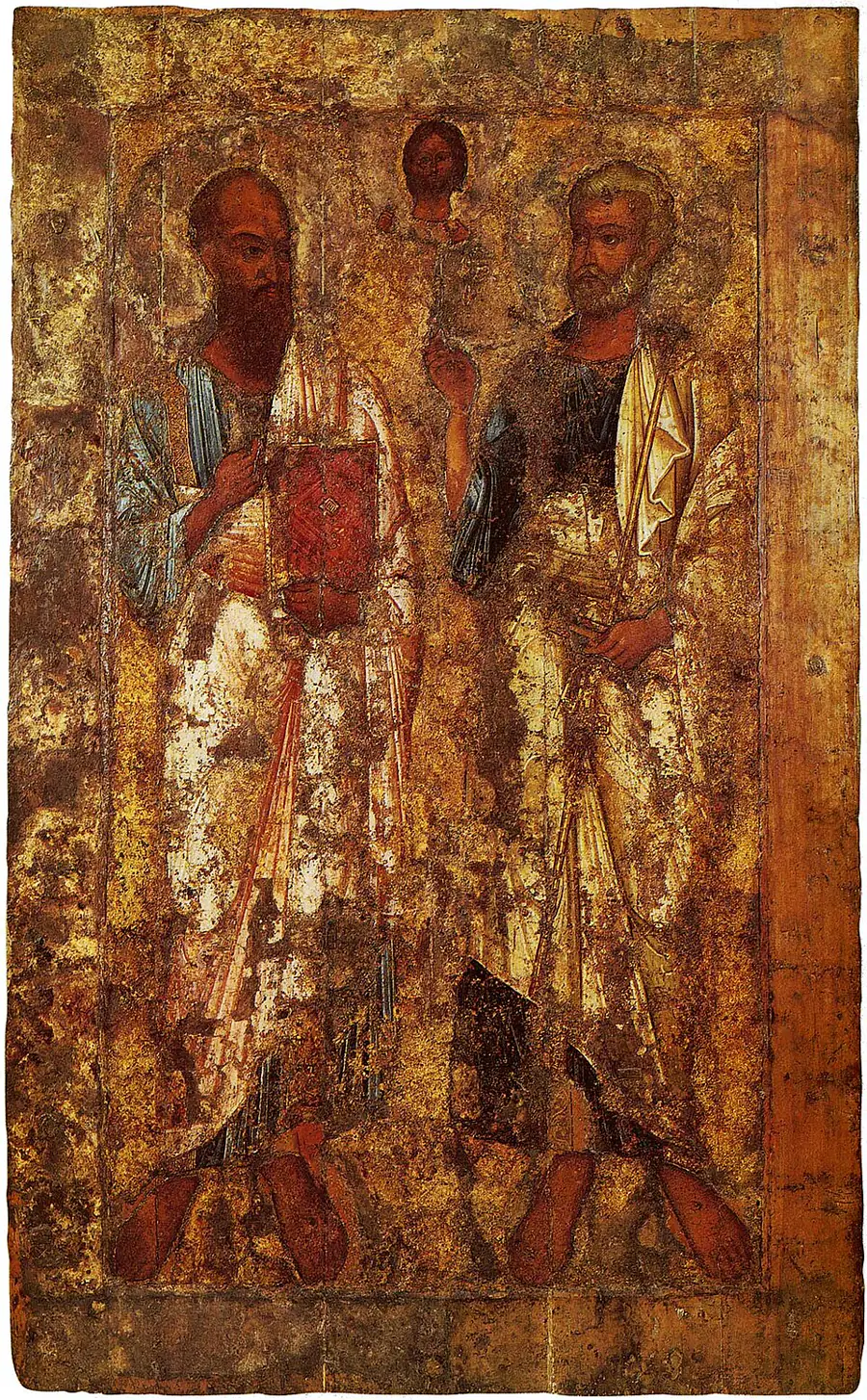
The feast of Sts Peter and Paul
The chief Apostles Sts Peter and Paul. Icon painter: Magda Sologhashvili
Ilia II, Catholicos-Patriarch of All Georgia ● sermons for the feast of Sts Peter and Paul (1987, 2004, 2006, 2008, 2009, 2010)
St Gabriel (Kikodze) the Hierarch ● a word on 29 June, on the day of Peter and Paul ● a word for the feast of Peter and Paul ● a word on the day of Peter and Paul ● a word on the day of Peter and Paul ● a short teaching on Peter and Paul ● a word upon the day of Peter and Paul
Among Christ's disciples, the Apostles, the Orthodox Church gives particular honour to two and names them the chief Apostles. These are Sts Peter and Paul, who in the words of St John Chrysostom the Hierarch “surpassed every nature, earthly and heavenly. They, while in the flesh, surpassed the angels… Peter, the beginning of Orthodoxy, the glorious minister of the Church… Paul, the illustrious preacher of the truth, the watchful helmsman of the Church of Christ”.
The holy Apostle Peter, the elder brother of the Apostle Andrew, was before the Lord's call a fisherman of Bethsaida, a small town by the Sea of Galilee. His name before was Simon. “Thou art Simon the son of Jona: thou shalt be called Cephas, which is by interpretation, A stone” — so Jesus Christ said to him (John 1:42) when He beheld him. Some time later, as Christ walked by the shore of the Sea of Galilee, He saw Peter and Andrew again, casting a net into the sea. “Follow me, and I will make you fishers of men” (Matthew 4:19) (kontakion 2) — these words, spoken to simple fishermen, decided their lot. The ardent Peter, who loved the Lord Jesus fervently, followed Him at once. Soon the Lord Himself visited Peter's house and healed his mother-in-law of a fever (Mark 1:29–31).
Having the greatest faith and devotion, Peter — alone of Christ's disciples — makes bold to ask the Lord: “Lord… bid me come unto thee on the water.” At the Lord's word he stepped out of the boat onto the water and hastened towards Him as on dry land. But when he doubted the divine help he began to sink. “Lord, save me!” cried Peter. And the divine Teacher did not delay: at once He stretched out His hand and took him back into the boat (Matthew 14:28–32) (ikos 3). But the Lord saved him not only from the storm and the wind but from little faith too, saying to him: “I have prayed to My Father for thee, that thy faith fail not” (Luke 22:32) (kontakion 4).
On Mount Tabor Peter, with James and John, became a witness of the Lord's divine glory. When he saw the Lord Jesus Christ transfigured and heard the voice of God the Father, “This is my beloved Son: hear him”, Peter rejoiced and cried out: “It is good for us to be here” (Mark 9:2–7) (ikos 5). A remembrance of this has come down in one of his Epistles (2 Peter 1:17–19).
When the time of the Saviour's saving Passion drew near, on the way to Jerusalem He asked His disciples: “But whom say ye that I am?” Peter, first among the Apostles, said: “Thou art the Christ, the Son of the living God”, for which he earned the Lord's highest praise: “Blessed art thou, Simon Bar-jona” (“Jona” means dove in Georgian and “bar” means “son”, and the dove is an image of the Holy Spirit; that is, because of Peter's grace He called him the son, the adopted son, of the Holy Spirit)… “thou art the rock, and upon this rock I will build my church; and the gates of hell shall not prevail against it” (Matthew 16:15–18) (ikos 1, 7). Peter's confession has found its echo in the festal readings of the Apostles: “Christ showed thee forth first, O Peter, and crowned thee as the foundation of the faith.” Before the Mystical Supper, in the upper room on Zion, the Saviour “took a towel, and girded himself… and began to wash the disciples' feet”. “Lord, dost thou wash my feet?” Peter protested. “If I wash thee not, thou hast no part with me,” the Lord explained to him. And then Peter, overcome with fear and love, cried out: “Lord, not my feet only, but also my hands and my head” (John 13:3–9) (ikos 9).
Of the disciples only one, Peter, stood up for the Lord in the garden of Gethsemane. He drew his sword and cut off the ear of one of those who had come; but even before His own death the Saviour took care and healed the man whose ear was cut off. Peter followed the Lord as far as the house of the high priest Caiaphas, went into the courtyard with Him, and stood there by the fire warming himself. But three times he denied his divine Teacher, when they laid hold on him too as a disciple of Christ: “I know not this man” (Mark 14:71); and when he denied Him the third time he saw that the Lord was looking at him, and “went out, and wept bitterly” (Luke 22:62) (kontakion 10). By one holy tradition, ever after, whenever he heard a cock crow, Peter would weep bitterly, remembering this sin of his, so that from his constant weeping bloody furrows appeared at the corners of his eyes.
But there is no sin that the merciful Lord does not forgive. Peter's repentance was so strong and so deep that after the Resurrection the Lord appeared first, among the disciples, to Peter. Three times He asked Peter: lovest thou me? And three times He received the answer: Yea, Lord; thou knowest that I love thee (John 21:15–16). Jesus Christ restored him to the dignity of an Apostle and entrusted him with the shepherding of His rational sheep (ikos 11).
After the Lord's Ascension, on Peter's counsel, Matthias was numbered among the twelve Apostles (Acts 1:15–26). After this, at Pentecost, Peter became the leader of the first Christian community. His preaching, inspired by fervent love for the Lord risen from the dead, worked with such life-giving power that it turned thousands of people to the faith of Christ (Acts 2:41; 4:4). Wondrous signs accompanied the faith in Christ of Peter's confession. The dead were raised (Acts 9:40), the lame and the palsied were healed (Acts 3:1–8; 9:32–34), those caught in wrongdoing gave up the ghost (Acts 5:5–10).
Two catholic Epistles of the holy Apostle Peter are known (about 63 and 67). In the second Epistle he writes: “Knowing that shortly I must put off this my tabernacle, even as our Lord Jesus Christ hath shewed me” (2 Peter 1:14) — that is, according to the Lord's word, he foretells his approaching end. By order of the emperor Nero the Apostle Peter was seized and sentenced to crucifixion. Counting himself unworthy to receive the same martyr's death as his Teacher, he asked the executioners to crucify him head downwards, wishing even in death to bow his head before the Lord.
The holy Apostle Paul was by descent of the tribe of Benjamin, and before his apostolic ministry was called Saul. Born in Tarsus in Cilicia, he was “taught according to the perfect manner of the law of the fathers, and was zealous toward God”, as he himself said of himself; “and I persecuted this way unto the death, binding and delivering into prisons both men and women” (Acts 22:3–4). He approved the martyrdom of the Archdeacon Stephen, and even kept the garments of those who stoned him (Acts 7:58). In 34, on the commission of the high priests, he set out for the city of Damascus to hand over to torment the Christians who had taken refuge there. On the way something happened to him that changed Saul's lot from the root.
As he drew near Damascus, a divine light shone round him. All the horsemen with him fell from their horses, and Saul heard a voice saying: “Saul, Saul, why persecutest thou me? it is hard for thee to kick against the pricks.” Saul asked: Who art thou, Lord? The voice answered: I am Jesus whom thou persecutest. But rise, and stand upon thy feet: for I have appeared unto thee for this purpose, to make thee a minister and a witness both of these things which thou hast seen, and of those things in the which I will appear unto thee (Acts 26:13–16).
Those with Saul heard the voice but could not make out the words. Saul was blinded by the divine light, and at the Lord's direction he hastened to Damascus, where Ananias, one of the seventy apostles, lived. It was made known to Ananias in a revelation: Arise, and go into the street which is called Straight, and enquire in the house of Judas for one called Saul, of Tarsus (Acts 9:11). Ananias was to lay hands on him, and his eyes would be opened. When he had done as he was commanded, at once Saul's eyes were opened; he was baptized and was named Paul (ikos 2).
Having received the Lord's command to announce the Kingdom, Paul began to preach among Jews and pagans, among slaves and the free, and for this he undertook long journeys and sent out Epistles. In Palestine and Asia Minor, in Greece and Italy, on the islands of the Mediterranean the Apostle's fiery word was heard (kontakion 3, ikos 4, kontakion 5). On his journey on the island of Cyprus, St Paul, filled with the Holy Spirit, restrains the sorcerer Elymas from “perverting the right ways of the Lord” before the proconsul Sergius Paulus. At the word of the Apostle Paul the sorcerer was struck blind and “went about seeking some to lead him by the hand” (Acts 13:8–11) (ikos 6). In about 51 Paul took part in the council of the Apostles at Jerusalem. Paul told those gathered “what miracles and wonders God had wrought among the Gentiles by them” (Acts 15:12). The council resolved not to force the Gentiles to keep the Law of Moses, but “ye shall do well” (Acts 15:29).
In his unceasing labour St Paul had to endure many afflictions. “Of the Jews five times received I forty stripes save one. Thrice was I beaten with rods, once was I stoned, thrice I suffered shipwreck, a night and a day I have been in the deep” (2 Corinthians 11:24–25) (ikos 10). While preaching in Philippi and Macedonia he was seized and thrown into prison. But even in chains he went on praying and glorifying God, and at midnight there was a great earthquake, the doors were opened and the chains fell off (Acts 16:22–26) (ikos 8).
In Athens he preached Christ: “For in him we live, and move, and have our being” (Acts 17:28). This preaching in the Areopagus gained Christianity new converts, among them the future great theologian Dionysius the Areopagite. As the Apostle Paul was returning from his third missionary journey he met in Caesarea the prophet Agabus, who took Paul's girdle, “bound his own hands and feet, and said: Thus saith the Holy Ghost: So shall they bind at Jerusalem the man that owneth this girdle” (Acts 21:11) (kontakion 11). By this Agabus foretold the chains he was to bear to the end of his life. When he returned to Jerusalem the Apostle Paul was seized and, as a Roman citizen, sent to the judgment of Caesar.
Here in Rome St Paul helped the Apostle Peter in the Christian enlightening of the citizens. By one tradition he converted the emperor's chief cupbearer, for which he was sentenced to death. The holy Apostle ended his life by beheading.
By some testimonies the Apostles Peter and Paul suffered martyrdom on the same day; by another tradition, Paul was beheaded with the sword a full year after Peter's crucifixion. The feast of their commemoration was established from the first, and the place of their burial was holy to the first Christians. In the fourth century St Constantine the Great, Equal to the Apostles, raised churches in Rome and Constantinople in the name of the holy chief Apostles Peter and Paul.
Translated from Russian by Archpriest Archil Mindiashvili



