
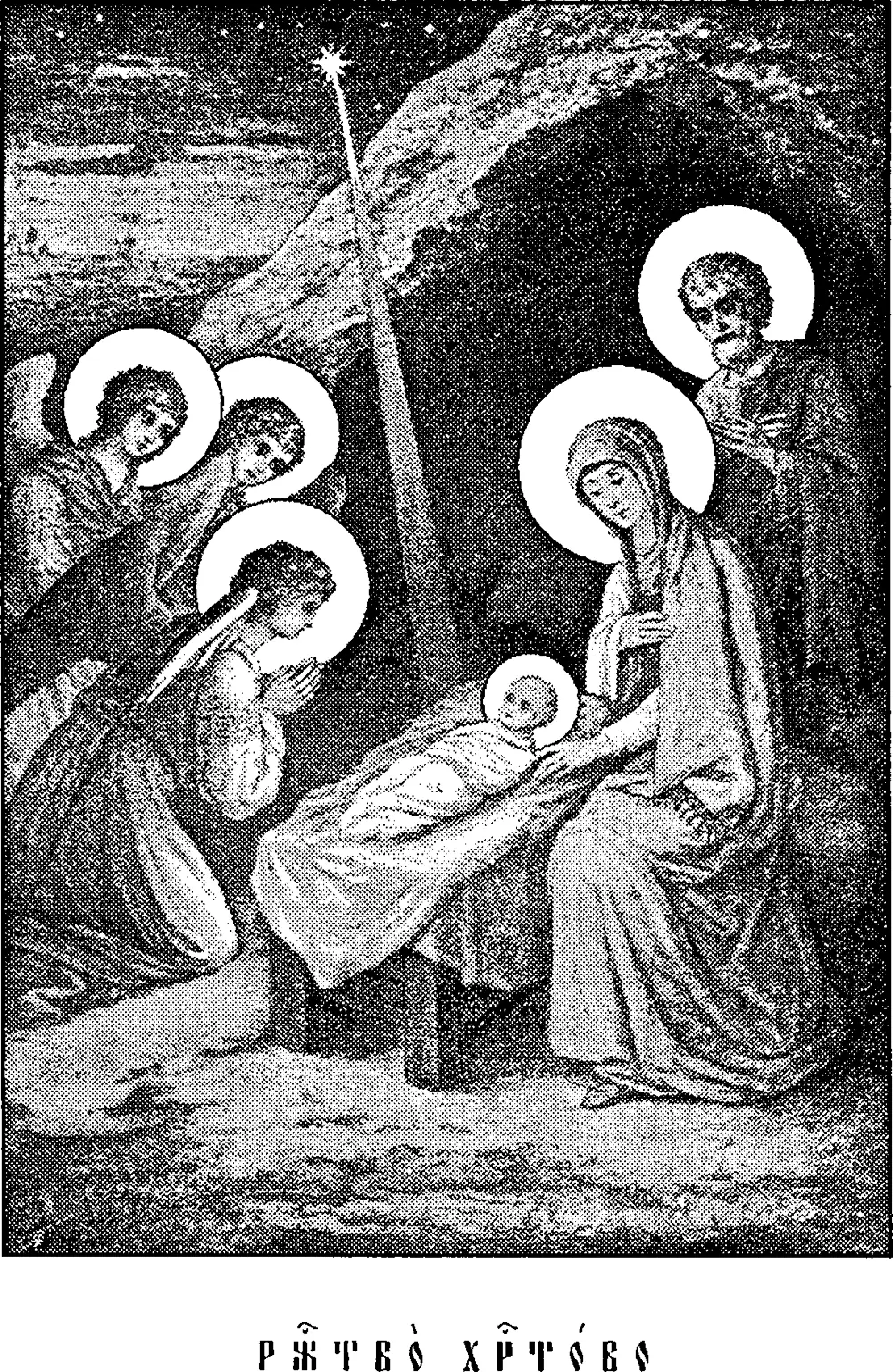
The Nativity of Christ
The Nativity of Christ
Thy Nativity, O Christ our God, has shone upon the world the light of knowledge; for by it those who served the stars were taught by a star to worship Thee, the Sun of righteousness, who didst dawn from on high, from the east. O Lord, glory to Thee.
Today the Virgin gives birth to Him who is above all being, and the earth offers a cave to the Unapproachable; angels with shepherds give glory, and the wise men journey with a star; for unto us is born a young Child, God before the ages.
Long did man await the coming of the Saviour. He awaited it from the day when God sent them out of paradise with this hope to go with them:
“I will send you a Redeemer, and He will crush the serpent's head.”
Parted from the home they had known, they waited in sorrow and in hope. But weighed down day by day with sins, they sank lower and lower towards the underworld.
Again the Creator stretched out His hand. He turned the right way round the wheel of life that the devil had set turning backwards, and a new reckoning of the years began, from earth towards heaven. And the Nativity of Christ was laid as the foundation of this reckoning.
Quietly, of itself, an uncommonly bright star shone out in the sky. But those for whom it shone did not understand. They did not even lift their heads to the sky. They were sunk in the whirl of this world. But far away in the east the wise men noticed it at once and hastened towards it.
All around, life seethed and bubbled. In splendid halls and palaces the rulers of this world trod on soft, deep carpets. But He, the Saviour, the Word made flesh, Jesus Christ our Lord, lay like an ordinary infant in a manger meant for animals, and from His very birth revealed to men the greatest mystery: that man's glory is in humility; that it is not his earthly lot and his luxury that determine a person, but what is within him — by his inner world is he shown for what he is. So He taught that man is saved by obedience and humility. But men stood far from this wisdom. And that is why not even one simple, poor hut was found to shelter the Lord — the Lord whose birth the angels hymned thus:
“Glory to God in the highest, and on earth peace, good will toward men.”
And Jesus was born in Bethlehem, in a cave where in bad weather the shepherds sheltered their flocks.
“Today the Virgin gives birth to the Saviour,” the holy Church sings, and for unbelievers this perhaps becomes a cause for mockery too:
“How, today?! Was He not born two thousand years ago?!”
In general, the feasts of the Church differ from worldly ones precisely in this: every year they shine with the same brightness as the first time. With worldly feasts it is quite otherwise. How many memorable dates the history of mankind has kept that with the passing of time have faded and changed their colour. But the experience of the feasts of the Church keeps its first radiance in the hearts of the faithful.
This year too the Nativity of Christ has come. Like the shepherds, let us hasten towards Him. Let us renounce Herod's enmity towards Him. What does it matter that we are weighed down with sins, defiled? Did God disdain the manger of the beasts?! Let us not be afraid. Let us have hope. God will not abandon us. Let us let Christ into our hearts, and He will cleanse our minds and open our ears, and again we shall hear the singing of the angels: Glory to God in the highest, and on earth peace, good will toward men. Amen!
I greet you all on the Nativity of Christ!
Archbishop Sergi (Chekurishvili)
Christ is born: glorify Him! Christ from heaven: go out to meet Him! Christ on earth: be exalted! Sing to the Lord, all the earth! And I will say both together: Let the heavens rejoice and let the earth be glad — first for the heavenly, then for the earthly!.. Christ of the Virgin…
Melchizedek comes: born without a mother, He is born without a father — first without a mother, then without a father. The law of nature is broken. Christ commands it; let us not resist. The bodiless takes flesh, the Word is made solid, the invisible is seen, the untouchable is touched, the Ancient of Days (that is, He who is without beginning) takes a beginning. The Son of God becomes the Son of Man. Jesus Christ is the same yesterday and today.
Let the Jews be scandalised, the pagans laugh, the heretics wag their tongues! They will believe when they see Him going up into heaven; and if not then, then surely when they see Him coming down from heaven and seated to judge the living and the dead. But that will be hereafter; now it is the feast of the Theophany, or the Nativity — and this day has these two names, for through the birth, and so this day is called, God appeared to men… that He who gave us being might give us well-being also.
St Gregory the Theologian
The events of the Nativity are described by two Evangelists — the Apostle Matthew (who was one of the Twelve) and Luke (who was one of the Seventy). Since the Evangelist Matthew wrote his Gospel for the Jews, he stresses in the Messiah's descent the patriarch Abraham and King David, as the prophets had foretold. That is why the Evangelist Matthew begins his Gospel thus: “The book of the generation of Jesus Christ, the son of David, the son of Abraham” (Matthew 1:1–17).
The Evangelist knew that Jesus was not the son of Joseph (the husband of the Virgin Mary); so he does not say that Joseph begat Jesus, but, in setting out the line of descent, says that “Jacob begat Joseph the husband of Mary, of whom was born Jesus, who is called Christ”. But why then does he give the descent of Joseph and not of Mary? The reason is that the Jews did not record their descent through the mother (through the female line, one might say). Moreover, the Law required them to take a wife from the same branch of descent to which the husband belonged; and so the Evangelist did not depart from custom, and by setting out Joseph's descent he showed that Mary, the wife of Joseph, and so Jesus who was born of her, came from the line of David.
The holy Evangelist Luke notes that the Nativity of Christ coincided with the census proclaimed in the Roman Empire; and, as has been said, the Jews kept their descent by branches and lines. This custom was so strong that, as soon as they learned of the emperor Augustus's decree, each of them set out for the town from which his family came. Joseph and the Virgin Mary lived in Galilee, in the town of Nazareth, but, as is known, they were by descent of the line of David; so they went to be registered in Bethlehem, which is called the city of David, where David the Psalmist was born and anointed king. Bethlehem is a small town near Jerusalem, to the south of it. The journey from Nazareth to Bethlehem took a little over three days. To the east of Bethlehem was David's well, and on the opposite side a cave. As Joseph and Mary drew near the town, the time came for Mary to give birth. Joseph began to look for a place to lodge, but found none, for because of the census a great many people had gathered in Bethlehem. Since night was already falling and no place was found in the town for the mother of the Messiah to come, Joseph and Mary were forced to take shelter outside the town, in that very cave where in bad weather the shepherds housed their flocks.
Jesus Christ was born at night, when everyone in Bethlehem and round about it was sunk in deep sleep.
On the night of the Nativity great wonders came to pass in all the world. As soon as the Saviour was born, a spring suddenly gushed out of the very rock in the cave; far from there, in Rome, fragrant oil began to flow from the earth and mingled with the water of the river; a pagan temple that was called eternal fell down, the idols in it were shattered, and three suns appeared in the sky; in Spain that night a blindingly bright cloud appeared in the sky; in Israel, though it was winter, the vine blossomed. But the greatest wonder was the appearing of the angels, who appeared to the shepherds, and this is described in the Gospel as well:
Opposite the cave in which the Saviour was born stood a tall tower. Shepherds lived in the tower. Three of them were not asleep that night, for they were keeping watch over the flock. It was to them that the Archangel Gabriel appeared in heavenly radiance. At the sight of him the shepherds were sore afraid, but Gabriel said to them: “Fear not: for, behold, I bring you good tidings of great joy, which shall be to all people. For unto you is born this day in the city of David a Saviour, which is Christ the Lord.” With these words the Archangel pointed to the true purpose of the Messiah, who came not for the Jews alone but for all peoples; for there would be joy for all who receive Him as Redeemer. Gabriel also told the shepherds where they would find the newborn child.
As Gabriel was telling the shepherds of this, the singing of a multitude of angels was heard from heaven, glorifying God thus: “Glory to God in the highest, and on earth peace, good will toward men.”
Why did the angel choose simple shepherds, and not announce the coming of the Messiah into the world to the Jewish elders, scribes and Pharisees? Because “the blind leaders of the blind” had forgotten the true meaning of the prophecies about the Messiah.
After taking counsel together, the shepherds decided to go to the place where the newborn was, and see whether what the Archangel had told them was true. When they came they saw the child lying in the manger, and everything was just as they had been told. The shepherds believed that He was the Messiah they had so long awaited, and that He had come to save mankind.
They told everything to St Joseph and the Mother of God. Salome (a kinswoman of the Mother of God and of Joseph) and all who were there, who had come to see the newborn, marvelled at the shepherds' story. But the Mother of God “listened to them in silence and kept every word in her heart”.
Some months before the Nativity of Christ an unusual star appeared in the sky. The wise men of the east (wise men was the name for learned men who observed and studied the heavenly lights) and the philosophers noticed it, and began to ponder what the appearing of this wondrous star might mean. As the holy Fathers say, the star of the Nativity was lit in the sky from the moment the Archangel Gabriel told the Virgin Mary that the Redeemer of the world would be born of her.
In that age people believed that at the birth of a great man a new star would appear in the sky. Many pagans, mostly in Persia, knew from the Jews of the Messiah to come, the great king of the Jews. The Persian wise men expected that when the promised king was born, a new star would appear in the sky. It is true that the prophecy of the Messiah's star was given in a spiritual sense; but God in His mercy, to awaken faith in the pagans, gave them the news in a form they could understand better — by the appearing of an unusual star in the sky.
When little time remained before the Nativity of Christ, three wise men, each from his own country, set out for Palestine.
Joseph and the All-holy Mother of God were still in Bethlehem with the newborn child when the wise men, who had come from the far east, arrived in Jerusalem. As they went from Jerusalem towards Bethlehem, the same unusual star showed them the way; the star came down almost to the ground and at last stood still over the cave where the newborn Saviour lay in the manger. When they saw the child lying in the manger of the beasts, the wise men of the east understood that the kingship of the newborn was not in luxury and in splendid halls, but in poverty, in obedience and in the hatred of earthly glory. The sight, unexpected as it was for them, did not work upon these learned pagans nor shake the faith for which they had travelled so long a road. On the contrary, they went into the stable, drew near the child lying in the manger, and worshipped Him not only as King but as God too, and offered Him gifts: gold, frankincense and myrrh. Gold as to a King, frankincense as to God, and myrrh as to a man, since myrrh was used to honour the body of one who had died, that it might be preserved.
In the story of the Saviour's Nativity this too is remarkable: the first to worship the newborn Redeemer were the shepherds, true children of nature, who could offer the Saviour only the treasure of their hearts — a treasure full of simplicity, faith and obedience. Only later did the wise men, furnished with wisdom, come from the east. This perhaps tells us that simplicity of heart and deep, conscientious learning both lead a man to Christ. Only the first way is direct, shorter and surer than the second. The shepherds were told by the angels themselves, while the wise men, from the appearing of a silent star onwards, travelled a hard and not unperilous road before they reached their longed-for goal.
The journal Samreklo, no. 4, 2006
“The angels are singing: Glory in the highest”
“When the shepherds heard it, they went and worshipped Him”
“A bird sat on the fence, crying out: Christ is born”
“A star appeared in the sky, the herald of the Nativity”
“Alatasa, balatasa — I put my hand into the basket,
and found nothing in it at all; God will give you plenty”
“On the twenty-fifth of December Christ was born in Bethlehem”
“And there were in the same country shepherds abiding in the field, keeping watch over their flock by night. And, lo, the angel of the Lord came upon them, and the glory of the Lord shone round about them: and they were sore afraid. And the angel said unto them: Fear not: for, behold, I bring you good tidings of great joy, which shall be to all people. For unto you is born this day in the city of David a Saviour, which is Christ the Lord. And this shall be a sign unto you: Ye shall find the babe wrapped in swaddling clothes, lying in a manger. And suddenly there was with the angel a multitude of the heavenly host praising God, and saying: Glory to God in the highest, and on earth peace, good will toward men. And it came to pass, as the angels were gone away from them into heaven, the shepherds said one to another: Let us now go even unto Bethlehem, and see this thing which is come to pass, which the Lord hath made known unto us. And they came with haste, and found Mary, and Joseph, and the babe lying in a manger. And when they had seen it, they made known abroad the saying which was told them concerning this child. And all they that heard it wondered at those things which were told them by the shepherds. But Mary kept all these things, and pondered them in her heart. And the shepherds returned, glorifying and praising God for all the things that they had heard and seen, as it was told unto them” (Luke 2:8–20).
Every Nativity night — probably after the star appeared and the service had ended — the shepherds, forerunners of the Apostles and heralds of Christ, have from the far past until now announced to the whole nation the fulfilment of that greatest mystery which is called the Incarnation of Jesus Christ. Dressed as shepherds, grown men in our forefathers' day or young lads in ours, singing the alilo, as the people called this folk song, would go round the yard of every villager, and to the hosts waiting impatiently they would sing aloud, for the whole land to hear, the praise of God — the alilo (alleluia, “let us praise God”):
“Alilo, and here is alilo; alilo, and here is the Nativity; God grant you many a dawn of Christmas and New Year. On the twenty-fifth of this month Christ was born in Bethlehem; a bird sat on the fence and cries out the Nativity. We are not beggars, we are the heralds of Christ; alilo, and here is the Nativity, here is alilo” (Meskheti)
“On the twenty-fifth of this month Christ was born in Bethlehem; give us some pennies, and may your children be blessed” (Samegrelo)
“On the twenty-fifth and more, the Nativity has dawned; may the grace of the Nativity help you, Christ is born. Who built this house, who roofed it with the heart of oak? May the builder's mother be saved, and the soul of the roofer's father. I looked down from the ‘tower’: you have butter standing in jars; alatasa, balatasa, an egg should go in the basket; here a pig has been slaughtered — the neck is ours, the rest is yours. Our bride, our feast, the cellar door creaks for you; open the cellar jar for us and wet our throats with wine” (Kakheti)
Who can count for how many centuries a Georgian, on this night lit by this wondrous story, by joy and by a star, has rewarded the alilo-singers generously — with money, flour, butter, nuts and walnuts, pork from the pig slaughtered for Christmas, everything he had, and of course with eggs: the symbol of the Nativity, which very soon, at Pascha, would be dyed red as a sign of Christ's crucifixion and given to the singers who brought the news of Christ's resurrection. With eggs, which from of old were counted a splendid gift. And woe to him who begrudged a gift (to send the alilo-singers away without a gift was held among the people to bring ill luck and harm upon the house) to those shepherds who stood for the forefathers of the Gospel, taught by God and the angels, to whom by the will of God and the angels the great mystery was to be entrusted for all the world — the pledge of the salvation to come, eternal, everlasting. Besides this, a Christian Georgian saw God in every comer, in every guest, the alilo-singers among them; and the gift offered to them was both an offering and a present, both glory and worship.
On this night the church could no more contain the joy of the Nativity than the cave of Bethlehem could; it went out with the shepherds, through the shepherds reached every mortal, and this joy, felt through the coming of Christ in the flesh, made of all one flock, the earthly body of Christ, the Church.
According to a medieval tradition, at the Nativity roses bloomed in Jericho in December; at Shiomghvime, the buds of a red rose growing by the wall of the church seem, like the alilo-singing shepherds, to await the Nativity, that they may blossom in token of joy and glory.
Nino Ghambashidze, the newspaper Sapatriarkos Utskebani, No. 1 (103), 2001. The symbols of the Nativity: Expectation · Light · The star of the Nativity · The census · Bethlehem · The cave · The shepherds · The worship of the wise men · The gifts of the wise men. The incarnation of the Son of God changed the world fundamentally for the better: it gave men the means of a new way of thinking, ennobled their moral side, turned the events of the world into a new channel. The incarnation of the Word of God gave men the strength to fight sin and reconciled them with God; a stream of divine life entered the corruptible human body and made man a partaker of eternal life. For these reasons the Saviour's Nativity came to stand at the centre of the world's events, and the years are counted from it — before the Nativity of Christ and after the Nativity of Christ. Why did God become man? The first to worship the newborn Redeemer were the shepherds, true children of nature, who could offer the Saviour only the treasure of their hearts — a treasure full of simplicity, faith and obedience. Only later did the wise men, furnished with wisdom, come from the east. This perhaps tells us that simplicity of heart and deep, conscientious learning both lead a man to Christ. Only the first way is direct, shorter and surer than the second. The shepherds were told by the angels themselves, while the wise men, from the appearing of a silent star onwards, travelled a hard and not unperilous road before they reached their longed-for goal.
The fall into sin disfigured and changed man's spiritual powers and nature. Mankind, having exhausted its strength and its means, came to a kind of tragic edge; it saw that it could not save itself. Not Palestine only but the pagan world too was awaiting the Messiah, their Redeemer.
The history of mankind is a tragedy not only of the earth but of the cosmos, and Christ's coming into this world is a light that pervades the whole universe. In the Nativity hymn the Church repeats these words like a hymn of victory: “God is with us.” God came to us, that we might receive eternal life and joy.
According to tradition, the star of the Nativity was lit over Babylon when the Archangel Gabriel announced to the Virgin Mary that the Redeemer of the world would be born of her. It was this very star that the wise men followed — the keepers of secret knowledge (in the ancient world astronomy and mathematics were held to be sacred sciences). The wise men knew the prophecy of Daniel, who had lived in Babylon long before the Nativity of Christ.
To set in order the tribute and the taxes, the Roman emperor Augustine proclaimed a general census of the people in the empire. The Roman authorities took account of local customs, and in Judaea the census was conducted according to the custom of the Jews. Joseph and the Virgin Mary belonged to the line of King David, and so had to be registered in the town from which their forefather came — that is, in Bethlehem, the town named in prophecy as the place of the Messiah's birth.
Christ's coming took place without noise and in secret: Bethlehem (here an image of the world) did not know its Redeemer. And the world awaiting a redeemer made for itself another image of a redeemer, unlike the true one. For the true Christ, who brought divine light into the world, no place was found in this world — Bethlehem shut its door on Him, Jerusalem made ready a cross for Him, and the world hates Him to this day.
Christ came into the world. But Bethlehem was sleeping a deep sleep. The doors of the inns and the houses were shut fast against the newborn God. The world received its King in a cave, where the shepherds kept their flocks for the night.
In the Holy Land four great rocks stand to this day, just as they stood when Christ came into the world. In one of them is the cave in which the Saviour was born. By being born in so simple a place and not in royal halls, the Saviour gave us an example of the humility He preached to the people. The Lord was content with only what was most needful, that we might do the same. He showed us that it is not the place that gives a man worth, but the man who makes a place blessed. Man is the greatest treasure among all that exists in the world. Luxury and outward splendour do not raise a man up, and poverty does not lessen his dignity.
The country round about was sunk in silence. Israel, God's chosen people, slept. Only a few shepherds, keeping sheep in the field, were not asleep. An angel appeared to them and announced the Redeemer's coming. The shepherds received the Saviour with pure faith, since God was in their hearts. Their pure souls were like a mirror reflecting heavenly light.
And in the morning, when God's chosen people woke, they did not even notice how they had missed the most important thing of all.
As the Gospel tells us, the first after the shepherds to worship the newborn Saviour were the wise men of the east. The faith of the wise men was the faith of sages and philosophers who came to know God through the visible world and through holy books; the faith of the wise men is the hard and long road that leads to God — from Babylon to Bethlehem. The wise men were servants of false gods, but true wisdom brought them to the true God.
According to tradition one of the wise men was a Persian, the second an Arab, and the third an Ethiopian. Their names were Gaspar, Melchior and Balthazar. A little more than three decades after they worshipped the newborn Saviour, the wise men were baptized (by the Apostle Thomas) and themselves became preachers of Christianity. Their holy relics were found in the third century and are now kept in Germany, in the cathedral of Cologne.
The wise men who came from the far east to worship the newborn Redeemer offered Jesus gold, frankincense and myrrh as gifts. Gold as to a King, frankincense as to God, and myrrh as to a man.
According to tradition, a little before her falling asleep the Mother of God gave these gifts, offered by the wise men at the Saviour's birth, to the Church of Jerusalem. The relics were handed down from generation to generation, and ended up in Byzantium. In 400 the Byzantine emperor Arcadius moved them to Constantinople, the new capital. Until the conquest of Constantinople the relics were kept in the private treasury of the Byzantine emperors.
In 1433 the Serbian prince George Branković was forced to give his young daughter Mara (Mary) in marriage to Murad II, the Turkish sultan. It was this sultan's son, Mehmed II, who conquered Constantinople. And Mara, who had the right to pray to her own God, saved many relics in the conquered Orthodox city.
Some twenty years after the fall of Constantinople, Mara travelled to Mount Athos to give the gifts of the wise men to the Monastery of St Paul. These relics are kept in that monastery to this day. The gold has come down to us as 28 plates, 7 × 5 centimetres in size, square and triangular in shape. The plates are alike and differ only in their ornament. The frankincense and myrrh are kneaded together and kept in the form of about seventy dark beads. The gold is used for the blessing of water. Sometimes, very rarely, the gifts of the wise men are taken out of Athos, and with these relics demons are driven out.
The journal Samreklo, no. 4, 2006
Christianity is God's becoming man, Christ's Cross and Resurrection, through which mankind was born anew and received the means of rising up and of restoring the likeness of God, which we men had lost through the fall into sin. Since, because of our sinfulness, we can no longer be at one with God — for nothing damaged or disfigured can be in communion with God — then for union with the Lord, for man's deification, a fitting nature must be made for man. Christ gave mankind, each man, the means of restoring such a nature in himself. God's becoming man is the fruit of His boundless love shown to man. The highest formula of theology says: “God is love itself.” To love means to take another's joy and misfortune as your own. True love drives you to become one with the one you love. The highest formula of love declares: “Greater love hath no man than this, that a man lay down his life for his friends.” God's love not only created the world, not only gave man freedom, not only gave us commandments, prophecies and wisdom; love made Him not only take a human form but become Himself a complete man. God has already done what is most unimaginable to the human mind: He crossed the threshold of His eternity and entered the stream of time; He who Himself created man, for love of him, consented to receive from him the slap, the scourge and a thousand humiliations. Of His own will, out of boundless love for us, He came into this world and gave Himself as a sacrifice.



