
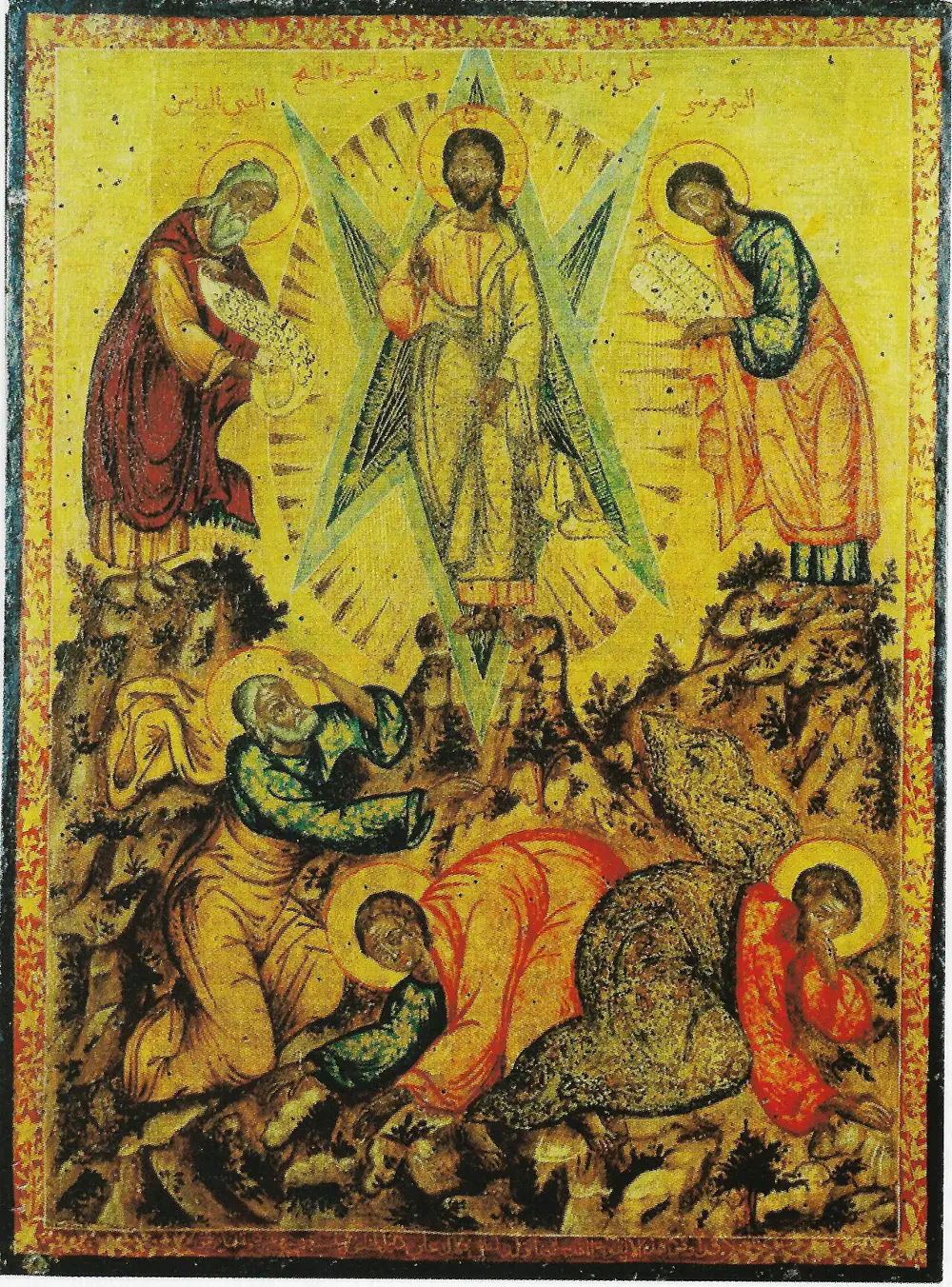
The Transfiguration
Thou wast transfigured on the mountain, O Christ God, and didst show Thy disciples Thy glory as far as they could bear it; let Thine everlasting light shine forth upon us sinners also, through the intercessions of the Theotokos, O Lord, Giver of light, glory to Thee.
On the mountain Thou wast transfigured, O Christ God, and Thou didst show Thy glory to Thy disciples as far as they could bear it; so that when they should see Thee crucified they would understand that Thy passion was voluntary, and would proclaim to the world that Thou art truly the Radiance of the Father.
On 6 (19) August the Orthodox Church keeps the feast of the Transfiguration of the Saviour, which is numbered among the twelve great feasts and is bound up with one of the best-known episodes of the earthly life of the Lord Jesus Christ. The Evangelists Matthew (17:1–13), Mark (6:2–13) and Luke (9:28–36) tell of the Transfiguration.
The Lord chose Peter, James and John from among His disciples and went up with them onto Mount Tabor to pray. While the Saviour was praying, the tired disciples fell asleep. When they woke they saw that Jesus Christ had been transfigured: “And was transfigured before them: and his face did shine as the sun, and his raiment was white as the light” (Matthew 17:2). At this time Moses and the Prophet Elijah stood beside the Saviour, clothed in heavenly glory, and spoke with Him of the passion and suffering that awaited Him in Jerusalem. The disciples who saw this were filled with inexpressible blessedness, and Peter cried out: “Master, it is good for us to be here: and let us make three tabernacles; one for thee, and one for Moses, and one for Elias” (Luke 9:33). When he had said these words a bright cloud overshadowed them, and from the cloud came the voice of God: “This is my beloved Son, in whom I am well pleased; hear ye him” (Matthew 17:5). The frightened disciples fell on their faces; Jesus came to them, touched them and said: “Arise, and be not afraid” (Matthew 17:7). When they looked about them, Moses and Elijah were nowhere to be seen.
As they came down from the mountain the Saviour charged the disciples to tell no one of this until He had risen from the dead.
By the Transfiguration on Mount Tabor the Lord showed the disciples in visible form His divine glory — the divine, uncreated, eternal light, brighter and holier than the rays of the sun, a light that filled their souls with wondrous joy, heavenly peace and blessedness. Before the disciples was revealed the mystery of eternal life, that is, the mystery of the life that is forever made radiant by the divine light, and such a revelation St Dionysius the Areopagite called “eternity in time”. In the fourteenth century there was a great dispute about the light of Tabor. Catholic thought, and in particular its originator, the Calabrian monk Barlaam, denied that this light was eternal and uncreated, and held it to be a creature, made in time. Against him the renowned holy father Gregory Palamas maintained that the light of Tabor is the divine power, the energy — in other words, God — who is wholly beyond the visible world and at the same time, by His energies, by His grace, creates, preserves and pervades the whole of this world; and that on Tabor the Saviour made the disciples worthy to behold precisely this divine power, and not some supernatural light made as it were especially for the miracle of the Transfiguration, as Barlaam maintained. The monks of Athos, too, answered in this dispute — men who through the greatest ascetic labour had themselves been made worthy to have their hearts enlightened by the divine light. They sent a “Tome” to Constantinople in which they affirmed that the light of Tabor was eternal and divine; the Local Council of Constantinople in 1351 condemned Barlaam's false teaching and recognised the views of Gregory Palamas as Orthodox. Theodore of Harran, telling of the Lord's Transfiguration in his sermon, draws a parallel between the Saviour and Moses. As we know, when Moses came down from Mount Sinai his face too shone so that the Israelites dared not come near him (Exod. 34:30).
St Theophanes writes: “Yet the radiance of Moses fell short of fulness in every way, for only his face shone, and he had no radiance within; but the radiance of Christ was perfect in every way — as without, so within. It was from Him and it was with Him, for He did not receive it from another.” It was by the power of God, whereas the Saviour's “inward” radiance is a reality inseparable from Him, which accompanies Him eternally. On Mount Tabor the Lord opened the eyes of the disciples' spirit, and they saw His glory as far as they were able to contain it — or, as Theodore of Harran says: “He was shown to them as far as they were able.” We read the same in the troparion and kontakion of the feast of the Transfiguration: “Thou wast transfigured on the mountain, O Christ God, and didst show Thy disciples Thy glory as far as they could bear it.” All this echoes the words of St Dionysius the Areopagite, who says that “the divine is revealed to each according to his capacity to receive it, according to his capacity to understand the divine”. The capacity to understand and to receive answers to each person's spiritual growth and religious experience. This explains the fact that the Saviour took only three disciples up Tabor, and not the twelve. For among the twelve was Judas, the betrayer and blasphemer against God, who was not worthy to behold the divine light, because hell had taken up its abode in his heart: he had already agreed to betray the Saviour for thirty pieces of silver. And so those who beheld the Lord's glory are Peter, James and John, who afterwards were in their turn to confirm and strengthen the other apostles in the time of trial to come.
The disciples saw the two greatest prophets of the Old Testament, Moses and Elijah, speaking with the Saviour. As St Maximus the Confessor writes: “At the Lord's Transfiguration on Mount Tabor three ways of salvation were shown: of virtue, of knowledge and of theology; the first two ways were shown in the persons of Elijah and Moses, and theology the Saviour Himself represented.”
Peter's words, “It is good for us to be here”, express the disciples' great desire that the time of the Transfiguration, as the joy of the Kingdom of Heaven, should go on without end; but it is not so. For to inherit the Kingdom there was needed the sacrifice of a whole life, the labour of an apostle and a martyr's death. For the Saviour, Tabor comes before Golgotha; for a Christian, Golgotha comes before Tabor.
On icons the light of the Transfiguration is shown as the halo above the heads of the saints. It is the precious crown with which the Lord rewards those who have conquered in the spiritual struggle.
Zurab Ekaladze, the newspaper Sapatriarkos Utskebani, no. 32 (83), 2000
On the day of the Lord's Transfiguration by the old Orthodox calendar, even in a completely clear sky a cloud always appears and rests on Mount Tabor for the whole of the feast. As is known, a cloud overshadowed the transfigured Lord, who shone here with divine light, for that holy light blinded the eyes of the Apostles Peter, James and John.
Fathers and brothers beloved in Christ!
By the grace of God we celebrate again today the glorious feast of the Transfiguration of our Lord Jesus Christ, whose content is this: some while before His passion the Saviour took three of His disciples — Peter, James and John. With them He withdrew onto a high mountain and began to pray. The tired Apostles fell asleep. When they woke, they saw that their Master and Teacher, Jesus Christ, had been transfigured: His face shone like the sun, and His raiment was white as snow. Moses and the Prophet Elijah had appeared with Him and were speaking of the terrible passion and earthly death that awaited Christ at the hands of the Jews. As Moses and Elijah were parting from Christ, suddenly a bright cloud shone upon them and they heard a heavenly voice: “This is my beloved Son… hear ye him.” The disciples fell to the ground in fear. Jesus came to them, touched them and said: “Arise, be not afraid.” Heartened, the disciples rose and saw their Master in His ordinary form. It is this glorious event that the holy Church remembers today.
Naturally, each of us will wish to know the reason for the Saviour's Transfiguration. How was it that Jesus Christ Himself showed forth His divine glory before His disciples, when He always fled from glory and honour from men? The feast of the Transfiguration is indeed exceptional among the Saviour's miracles. It concerns not the mystery of the Son of Man's descent from heaven and becoming man, nor the Saviour's earthly labours, but eternal life, the eternal blessedness of the righteous. The Saviour willed the Transfiguration in order to show plainly to the Apostles and to all believers the mystery of the life to come, the state of the justified man. As we said above, at the Transfiguration Christ's face shone as the sun. The holy Apostle Paul says the same of the justified: the righteous will shine as the sun in the Kingdom of Heaven. It seems that the salvation and justification of men in the Kingdom consists in their being transfigured and made radiant, each according to his worth, as our Lord Jesus Christ was on Mount Tabor.
But, dear brothers, such radiance and brightness — the transfiguration of a man — does not come without preparation; it is possible only as the fruit of great patience and toil. The whole earthly life of a Christian should be nothing other than an unceasing, gradual transfiguration, that is, a passing from an earthly, sinful state into a spiritual, holy one. A Christian's spiritual life must little by little, day by day, be changed, renewed, bettered, raised up and grow. The holy Apostle Paul speaks of this: “And be not conformed to this world: but be ye transformed by the renewing of your mind, that ye may prove what is that good, and acceptable, and perfect, will of God” (Rom. 12:2). That is: do not become like this world, but be changed, be renewed in mind, that you may know the will of God. And truly, brothers, if a man's mind is not enriched little by little by learning the word of God, it cannot grasp the will of God, which must raise up and perfect him. And a man who has turned away from the will of God is enslaved to worldly vanity, to the desires and passions of the flesh — which, in the words of the holy Apostle James, “is enmity with God” (James 4:4). Therefore a man must always examine his actions carefully: whether they are of God or not, whether God's will and blessing are upon them — so that by doing God's will he may draw near to the Lord God, the light of righteousness and holiness, and by this light and this purity be himself enlightened and made pure.
It is plain, brothers, that if we do not begin to prepare here, while we are alive — if we do not set about our spiritual transfiguration from here — we shall not be made worthy to inherit the Kingdom of God and to behold the divine light. What a man acquires in this world he takes with him to that one too. The colour a man's soul takes on here in its earthly life is the colour in which it passes into the dwelling of the life to come and stands before its Creator.
Therefore, brothers beloved in Christ, on this glorious day of the Saviour's Transfiguration, come, let us also go up Mount Tabor in soul, in heart and in mind, and with the Apostles let us behold the Transfiguration of Jesus Christ. Let us behold the glorious light and be enlightened ourselves; let us behold our King made radiant and be made radiant ourselves. Let us go up Mount Tabor, brothers, and hear the longed-for voice of the Most High: “This is my beloved Son… hear ye him”. Let us hear, beloved, Jesus Christ, who became man for us, suffered for us, was buried and rose again, and let us keep His commandments in our hearts. Let us leave the ways and the colour of the earth, let us change our character, put off the colour of the earth and put on the radiant heavenly light, that clothed in divine light we may serve the Lord God — the Father and the Son and the Holy Spirit, to whom is due all glory and worship unto ages of ages. Amen.
Samtavro, 1983



