
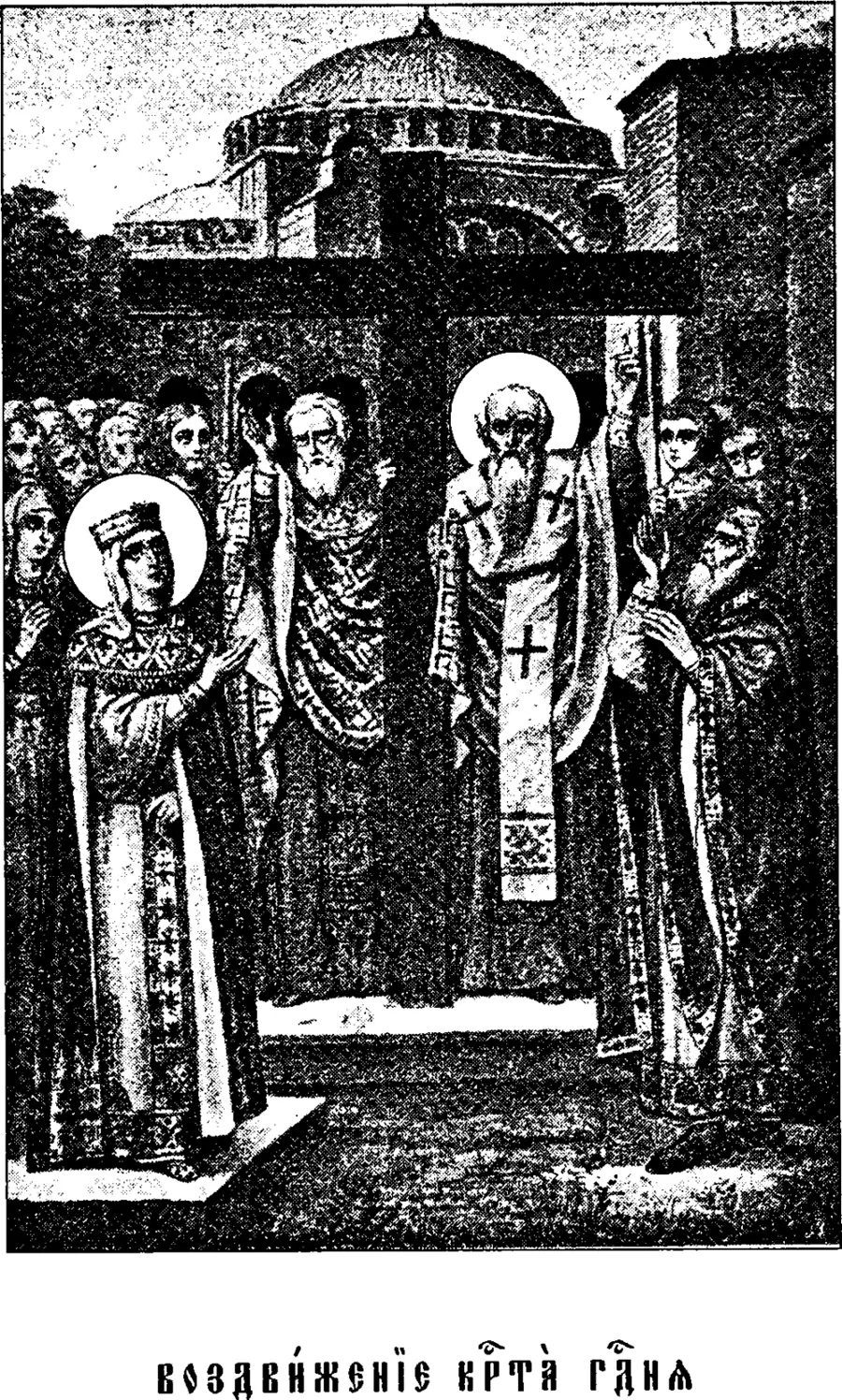
The Universal Exaltation of the Precious Cross
A fast day
Supplicatory canon to the life-giving and precious Cross
An explanation of the Gospel read on the feast of the Exaltation of the Cross, after the priest Grigory Dyachenko
● Sermons of Ilia II, Catholicos-Patriarch of All Georgia, for the feast of the Exaltation of the Cross: 1986 · 2001 · 2005 · 2006 · 2007 · 2008 · 2009 · 2010
● St Gabriel (Kikodze) the Hierarch, a word on 14 September, on the Exaltation of the Cross
Sts Constantine and Helena
By the providence of God, three hundred years after the Saviour's crucifixion, Christians found again the greatest Christian relic, which had been lost until then — the life-giving Cross of the Lord — and were given the means to venerate it. This came to pass in 326, in the time of the emperor Constantine the Great, Equal to the Apostles (306–337).
The pagan emperors of Rome tried to root out of men's minds the memory of the holy places where the Saviour suffered and rose in glory. The emperor Hadrian (117–138) had Golgotha and the tomb of Christ covered with earth, and then had a temple of the pagan goddess Venus and an idol of Jupiter set up on the man-made mound. Constantine the Great came to believe in Christ miraculously after he saw in the sky, before a battle decisive for the empire, the sign of the cross with the words: “By this conquer!” By the power of the cross the Lord's chosen one did indeed inflict a crushing defeat on his opponents, after which the desire gave him no rest to find the wood “on which the Saviour stretched out His hands”. He sent his mother, the pious empress Helena, to ruined Jerusalem, and gave her a letter to the Patriarch Macarius asking him to help in the holy work. The blessed Helena was already quite old, but, moved by the love of God, she laboured hard in the search for the great relic. For a long time she tried in vain to learn from the people of Jerusalem where the Cross was. At last the Lord revealed what was hidden through an aged Jew named Judas. They found the Saviour's tomb, and near it three crosses, the board with its inscription in three languages made at Pilate's order, and the four nails with which Christ was fastened to the wood. To learn which was the life-giving wood of the Lord, they touched a dead man with each of the three crosses in turn. At the touch of the Messiah's Cross the dead man came to life. A countless multitude of Christians gathered to venerate the relic. They asked the Patriarch Macarius to raise the Cross up, so that all might see it. Then the high priest, with the other clergy, began to lift the relic high, and the people reverently bowed down before it, crying: “Lord, have mercy.” The finding of the holy Cross was accompanied by yet another miracle: a gravely sick woman was healed when it was brought over her. The old man Judas and other Jews believed in Christ and were baptized. At his baptism Judas was named Cyriacus. He later became bishop of Jerusalem, and ended his life as a martyr in the reign of Julian the Apostate (361–363) (commemorated on 28 October). The holy empress Helena adorned the places bound up with the Saviour's earthly life with churches: more than eighty churches were built. By order of Constantine the Great the building of the Church of the Resurrection of Christ was begun, to enclose Golgotha and the Lord's tomb. The church was some ten years in building and was consecrated on 13 September 335. On the day after, 14 September, the feast of the Exaltation of the Precious and Life-giving Cross was established.
On this day another event connected with the Messiah's Cross is remembered — its return from Persia to Jerusalem after fourteen years of captivity. In the reign of the emperor Phocas (602–610), the Persian king Chosroes II defeated the Byzantine army, sacked Jerusalem, carried off the Lord's life-giving Cross and took captive the holy Patriarch Zacharias (609–633) as well. The relic remained in Persia fourteen years, and was handed back to the Christians only after the emperor Heraclius (610–641), with God's help, defeated Chosroes and made a peace treaty with his son Siroes. The life-giving wood was brought into Jerusalem with great solemnity. The emperor Heraclius, adorned with the royal crown and the purple, was carrying the relic towards the Church of the Resurrection. Beside him walked the Patriarch Zacharias. At the gate through which those going up to Golgotha had to pass, the king suddenly stopped and could not go on. St Zacharias explained to him: it is an angel of the Lord who bars your way, for He who carried the Cross up Golgotha for the redemption of mankind walked this road in humility. Then Heraclius took off his crown and put off his royal mantle too, and in simple clothes carried the relic into the church without hindrance.
In his homily on the feast of the Exaltation of the Cross, Andrew of Crete writes: “The Cross is exalted, and the fulness of the Church gathers together. The Cross is exalted, and the cities keep festival and the peoples hasten to rejoicing; for the very remembrance of the Cross becomes a cause of joy and the putting away of sorrow.”
Lives of the Saints, vol. III, Tbilisi, 2001
Sukhumi fell much earlier. All of us were preparing that fall. Men's sins gather drop by drop and break upon a nation in waves like a storm. Our own sins disarmed us; the wrong done before God bound our hands and feet. So we found ourselves powerless before a cruel enemy. An invading enemy, a natural disaster or poverty is only a tool in the hand of God. A believer must look for the cause elsewhere. If we do not find the true cause, we can do nothing about the effect. We cannot stop the trials unless we stop our sins.
The Chronicler describes the terrible sight of Tbilisi sacked by Jalal ad-Din, the corpses of the slain scattered through the whole city. The reader of The Hundred Years' Chronicle will look in vain for a word of judgment on the bloodthirsty enemy. The chronicler does not speak of that. Instead he speaks of the sins of the Georgians that went before this tragedy. He spares no one — neither peasant nor prince, neither clergy nor king; he exposes the nation's sins and lays its wounds bare. But he does so not in arrogance, with a passion for judging, but in humility and in the spirit. For a deeply believing historian the true source of calamity is the sins of the nation.
Is Jalal ad-Din not guilty, then? Is what he did against the Georgians not counted as sin? Of course he sins, and so does Georgia's present enemy, and they sin gravely — they have their own share of guilt. But why did the Lord allow the enemy to prevail over us? — that is the question a believer must ask himself.
The pain of Abkhazia has other sides too. In the Gospel the Saviour reminds the Jews of the fall of the tower in Siloam and the death of eighteen men, and says to them: “Or those eighteen, upon whom the tower in Siloam fell, and slew them, think ye that they were sinners above all men that dwelt in Jerusalem?” This question is addressed to each of us. The Lord Himself answers it: “I tell you, Nay: but, except ye repent, ye shall all likewise perish.”
But we believe that we shall repent, draw mercy from the Lord, and that the wholeness of Georgia will be restored. Such is the will of God, the Patriarch once declared; the monk Gabriel foretold the same, and we too believe that it will truly be so.
Archpriest Zurab Tskhovrebadze, the journal Karibche, no. 19 (158), 2010
● “Quiet singing, full of light” — Hieromonk Andria Qurashvili and Hypodeacon Iuri Anua
● A man is known in adversity — a conversation with Archbishop Daniel of Tskhum-Abkhazia
● O God, awaken the Georgian soul (the writer Mikho Morchiladze remembers the war in Abkhazia)
● “The Pass of the Exiles” — Guram Odisharia
● O Lord, give strength to our people… — Tsiala Ardashelia, writer and journalist
● Who are the Abkhaz? — Teimuraz Mibchuani, Doctor of Historical Sciences, Professor, head of the history department of the Sukhumi branch of Tbilisi State University
● At the map of Abkhazia (Professor Zurab Chumburidze)



