
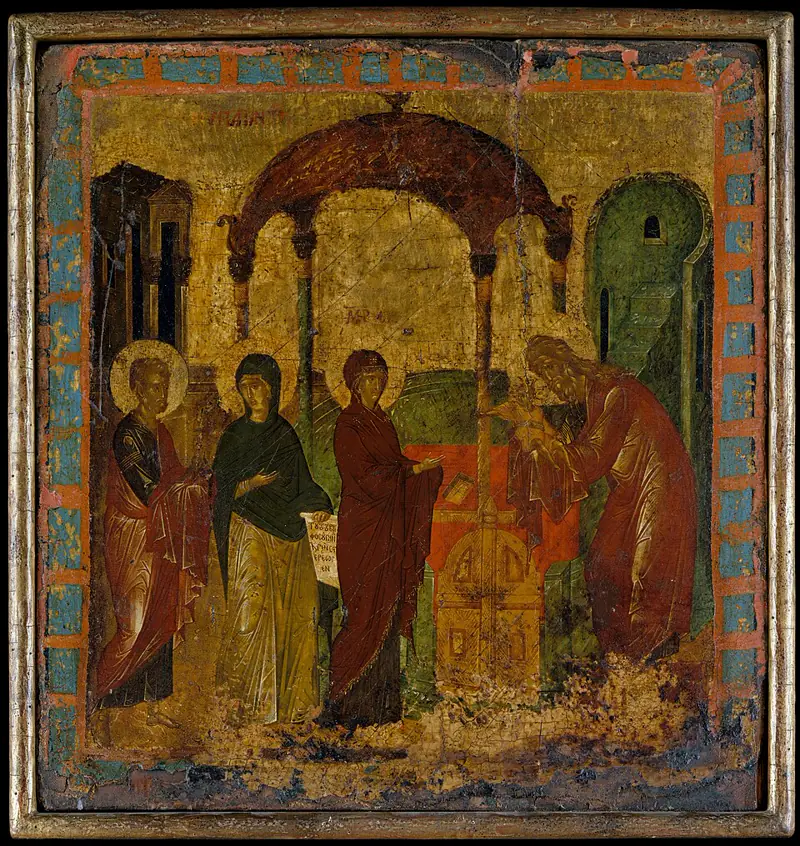
The Meeting of the Lord
● St Gabriel (Kikodze) the Hierarch, a teaching spoken on 2 February, on the Meeting and at the blessing of the church of the village of Partskhanaqanevi ● Archbishop Zosime (Shioshvili), The Meeting
Troparion: Rejoice, O Virgin Theotokos full of grace, for from thee was made flesh the Saviour of the world, Christ our God; rejoice thou also, O righteous elder Simeon, for thou didst receive in thine arms the Deliverer of our souls, who grants us great mercy.
Kontakion: By Thy birth Thou didst sanctify the Virgin's womb and didst bless the hands of Simeon, as was meet; Thou hast come now also and saved us, O Christ God. Give peace to Thy commonwealth in time of war, and strengthen the rulers whom Thou lovest, O Thou who alone lovest mankind.
● St Gabriel (Kikodze) the Hierarch, a word on the feast of the Presentation, or the Meeting
● St Gabriel (Kikodze) the Hierarch, a word on the Presentation of Jesus Christ
● St Gabriel (Kikodze) the Hierarch, a word spoken in Kutaisi on the day of the Meeting of the Lord, or the Presentation
● Ilia II, Catholicos-Patriarch of All Georgia, “Lord, now lettest Thou Thy servant depart” (1991)
● Ilia II, Catholicos-Patriarch of All Georgia, a sermon for the feast of the Meeting (2008)
● Ilia II, Catholicos-Patriarch of All Georgia, a Sunday sermon for the feast of the Meeting (2010)
● Metropolitan Anthony of Sourozh, a word spoken on the feast of the Meeting of the Lord
Ptolemy Philadelphus, who ruled Egypt from 287 to 247 before the birth of Christ, founded the famous library of Alexandria. Once he learned that the Jews, whom he had brought under his rule, possessed many sacred books full of wisdom and holiness, and he resolved to have them translated into Greek. By this he would both enrich his celebrated library and win the goodwill of the Jews living in Alexandria — by that time the Hebrews exiled in Egypt had all but forgotten their mother tongue.
Ptolemy sent an embassy to Jerusalem, with great gifts and a letter to the high priest Eleazar. He asked him to send the sacred books, and men learned in the Law who could translate them into Greek.
From the twelve tribes of Israel Eleazar chose six elders from each, men who knew the Greek language thoroughly; he entrusted the holy books to them and sent them to Ptolemy.
The ruler of Egypt received them with great honour, gave them gifts and settled them on the island of Pharos.
In seventy-two days the seventy-two venerable fathers translated Holy Scripture (this translation was afterwards called the Septuagint — the translation of the Seventy).
Among the venerable fathers was a priest of the Lord of Sabaoth, St Simeon (he appeared to Peter the Athonite clad in a priest's ephod, with a golden staff in his hand). The translation of the book of the Prophet Isaiah fell to St Simeon. The venerable father set about the work with great reverence and the fear of God. When he came to the place where Isaiah foretells the birth of the Saviour — “Behold, a virgin shall conceive, and bear a son, and shall call his name Immanuel” — Simeon was confused and as astonished as if he were reading these words for the first time. “How can a virgin bear a child without a husband?” he thought, and he took a knife to scrape away the word “virgin” and write “woman” in its place. At that moment an angel of the Lord appeared to him and stopped him: “Simeon, believe what is written, and with your own eyes you shall see how these words are fulfilled; for you shall not die until you have seen the Saviour born of a virgin.”
The angel of the Lord departed, and for St Simeon time seemed to stand still. His soul passed over into the world of God, beyond time and space.
Years went by, decades, centuries; before Simeon's eyes generations were born, grew up and died, the high priests and the rulers of Israel. Before his eyes passed those terrible days when a lawless enemy defiled the Holy of Holies — when the Syrian king Antiochus Epiphanes had an idol of Jupiter set up in the temple at Jerusalem and forced the Jews to worship it; when Ptolemy Philopator loosed a herd of elephants upon the Jews; when Solomonia and her seven sons were cut to pieces for refusing to sacrifice to idols. He lived to see the happy days too, when Judas Maccabeus defeated the enemy, cleansed the temple at Jerusalem and offered sacrifice to the Lord. He lived to see Simon Maccabeus, the like of King Solomon, high priest and captain of Israel… More than three and a half centuries had passed of St Simeon's life in this world. The iron kingdom foretold by Daniel (the time of the rule of the Romans) had long since come. The tribe of Judah too was left without princes and leaders. In Israel there reigned a foreigner, Herod the Idumaean, an ambitious, cruel and hard-hearted ruler who killed his own wife and children lest they contend with him for the throne. And it was this very man who rebuilt for Israel the temple at Jerusalem, twice as high as Solomon's. Its walls, overlaid with gold, blazed blindingly in the rays of the sun. It was as if the temple itself were foretelling the Saviour's birth. The air was charged with expectation of the Messiah. Part of Israel awaited a man who would free them from the rule of the Romans; part awaited the seed of the woman, who would be their God and Saviour.
And now the Persians came as well, announcing to them the birth of the King of the Jews. Israel was stirred; “their expectation grew keen”.
Once St Simeon was sitting at home and praying. “He prayed for this, that he might see what the Holy Spirit had made known to him… and straightway the Holy Spirit made it known to him and said: Arise, old man, why do you sit? Arise and hasten to the temple, for He who releases you has come. Set your house in order and prepare your inheritance, for your hour has come; and prophesy in the temple.” At once Simeon rose and made his way to the temple. That day many mothers were bringing a firstborn child to the temple. And there St Mary appeared, with the righteous Joseph. They were bringing the forty-day-old Jesus, wrapped in poor swaddling clothes but clothed in heavenly light. According to the custom of the Jews He, the firstborn child, was to be offered to God. At the prompting of the Holy Spirit St Simeon understood that this child was the Saviour. The old man was stirred, ran towards Him and cried out: “Make way for me, that I may draw near to Him who is holy and desired, and see Him whom I have seen beforehand! Mothers who are taking your firstborn to the altar, bring them to this child, who is before Abraham and is the Redeemer of Israel!” With reverence Simeon approached the child Jesus, received Him, laid Him in his arms and spoke, as a swan before its death: “Lord, now lettest thou thy servant depart in peace, according to thy word: for mine eyes have seen thy salvation… Now let me depart, O Lord, for I have suffered much pain in awaiting Thee; let me depart, O Lord, in the joy the sight of Thee has brought, and let me not look upon the outrage the Jews will do to Thee… Let me not see the crown of thorns,” Simeon cried, “nor the blow of the servant's hand, nor let me see the spear thrust into Thy side… Let me depart, O Lord, that I may go and bring to the righteous of the Old Testament — to Abraham, to Isaiah, to Thy father the Prophet David — the good news of Thy coming.”
The All-holy Mary and the righteous Joseph marvelled that this man knew this great mystery, and that he called upon the child as upon the Lord, the “Ancient of Days”, who has dominion over death and life. St Simeon blessed the blessed parents too, and to St Mary he said: “Behold, this child is set for the fall and rising again of many in Israel…” The fall he spoke of for the unbelieving, and the rising for the believing: the old assembly of the Jews will fall and the Church of the New Testament will be raised up; Judas will fall and Matthias will rise; the thief crucified on the left, who reviled the Lord, will fall, and the one crucified on the right, who believed in Him, will rise.
“Yea, a sword shall pierce through thy own soul also,” Simeon said to St Mary, “that the thoughts of many hearts may be revealed”… You will not end your life a martyr; but when the twelve-year-old child Jesus is lost to you in Jerusalem and you find Him only on the third day, great anguish will cut through your heart; and a greater sorrow, like a sword of the spirit, will pass through it when you see your Son crucified by the Jews — for Him whom you bore without pain you will see out of this world in sorrow.
St Anna, the daughter of Phanuel, of the tribe of Asher, drew near to the child Jesus — a widow of ninety who had lived only seven years with her husband and after his death never left the temple, spending her days in fasting and prayer and awaiting the King of Israel. She too worshipped the child, and together with Simeon she proclaimed in the temple at Jerusalem the coming of the Saviour.
The scribes and Pharisees were filled with envy and spite; they went and reported everything to Herod. The king hastily sent horsemen to seize the divine child; but Mary and Joseph, warned by an angel of the Lord, were already taking the Saviour to Galilee, to Nazareth.
St Simeon died soon after. St Anna too reached her end. The righteous ones of God died and found rest in the bosom of Abraham. They were the end of the Law and the beginning of grace — Jews by kin but Christians by grace. Blessed were their eyes and their hands, which saw and carried the child Jesus… Blessed am I, and you too, my reader, for “you too have seen the salvation of God no less than the righteous Simeon. He saw only the infant Jesus, while you with the eyes of the spirit and of faith have seen Jesus Christ, who accomplished our salvation — crucified, risen from the dead — and have received His very blood and body” (St Gabriel Kikodze).



