Holy Hierarch Ambrose the Confessor (Khelaia)
His Holiness and Beatitude Ambrose, Catholicos-Patriarch of All Georgia (in the world Besarion Khelaia), was born in 1861 in the village of Martvili in the Zugdidi district. He received his primary education at the Mingrelian church school and then studied at the Tbilisi Theological Seminary. During this period he married, and in 1887 he was ordained priest by the Bishop of Sukhumi. He served in Sukhumi, New Athos and Lykhny. He fought against the policy of Russification in Abkhazia and campaigned in the press against those who were instilling in the Abkhaz a hatred of the Georgians. In 1896 he was widowed.
His wife, Kesaria Merchule, died in childbirth; Father Ambrose was left with three children, whom he never let go from his side: he had them with him while studying in Kazan and even in exile. Such a caring father he was, and afterwards… just such a patriarch.
In 1897, at the age of 36, Father Ambrose entered the Kazan Theological Academy. During his studies he was tonsured a monk. He wrote a dissertation on the theme “The Struggle of Christianity with Islam in Georgia”. In 1902 he was raised to the rank of archimandrite and appointed abbot of the monastery of Chelishi.
Archimandrite Ambrose laboured greatly for the revival of the monastery of Chelishi. Here he discovered the so-called Chelishi manuscript of “The Conversion of Kartli”, and also a holy Gospel book, known afterwards as “the Chelishi Four Gospels”. Here is one record from that time: “Father Ambrose — it is not yet a year since he was appointed abbot here, but for a man who loves God and people even this time has been enough for the people to love him with a sincere heart. ‘He has God’s own tongue and lips,’ the local people said. ‘No one like him has ever come here before, and we have never heard preaching like this blessed man’s.’”
In 1904 Archimandrite Ambrose was appointed in Tbilisi a member of the Synodal Office and abbot of the monastery of the Transfiguration. He fought for the restoration of the autocephaly of the Church of Georgia. For this he was exiled to Russia in 1905, and in 1908 a new charge was brought against him: that he had supposedly taken part in the murder of Exarch Nikon. In 1911 he was acquitted, but he was still not given the right to return to Georgia.
The years pass, and every request of his to return goes unanswered. Meanwhile rumours spread in Georgia that Ambrose Khelaia is well provided for materially and simply does not want to come back. He writes of this with heartache in his letter “My Exile”: “Some count me happy that I have got away from Georgia and have supposedly settled myself well materially. Those who write this have probably not yet known loneliness of soul — have not known the bitterness felt by one driven from his homeland, if he has not set out on the road of degeneration and his heart aches for the state of his homeland.”
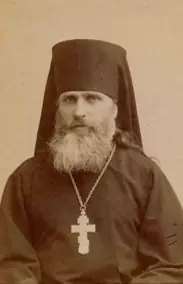
Hieromonk Ambrose during his studies at the Kazan Academy
In 1917 the saint returns to Georgia. He is consecrated metropolitan, first of Chqondidi and then of Tskhum-Abkhazia. On 14 October 1921 Metropolitan Ambrose was elected Catholicos-Patriarch of All Georgia.
A few months have passed since the Sovietisation of Georgia. Because of the persecution of the Church, the restriction of the rights of the Georgian language and the handing over of historic lands to the disposal of others, he sends documents to various authorities — without result. In 1922 he sends an appeal to the Genoa international conference. “The nation is reviled, and its native tongue is being taken from it, its national culture is being defiled, and at last its holy of holies, its religious feeling, is being trampled on,” says the catholicos in the memorandum, and in the name of the Georgian nation he demands the withdrawal of the Red Army from Georgia and the holding of a referendum.
The main purpose of the conference was to find the means for the economic recovery of Central and Eastern Europe. In reality it aimed to bring Russia, rich in raw materials, back to the international market, and also to demand of the government of Soviet Russia the debts of tsarist Russia. For this reason they did not set themselves against Russia on account of Georgia. The patriarch’s appeal met with no political response. The persecution of him grew stronger.
The Catholicos-Patriarch and 9 members of the Council of the Catholicosate are arrested. There are four charges: sending the memorandum to the conference; hiding the treasures kept in the churches and monasteries; keeping the inventory books of church property improperly; and the failure of a representative of the Patriarchate to appear at the procedure of handing over the Military Cathedral (which stood on the site of the present Government House) to the Komsomol.
We give a few extracts from the minutes of the court sessions:
Chairman: In the memorandum you say that the Georgian people’s land and water are being taken from them and handed out to other nations. Name what has been taken from the people and what has been given to whom!
Ambrose: Not only land and water — people too have been handed over to other nations. This will be proved when you bring a map of Georgia. If proof in this way is not needed in the court’s view, then I will be silent.
Prosecutor Okujava: Name by virtue of which document the independence of Georgia was taken away.
Ambrose: By intervention.
Prosecutor Machavariani: The memorandum you sent to the Genoa conference — is it religious, or what kind?
Ambrose: Religious. And if it took a political direction, that was caused by the existing situation.
Prosecutor Machavariani: Is the question of territory political or religious?
Ambrose: Both political and religious, for the loss of territory is a loss for the Church.
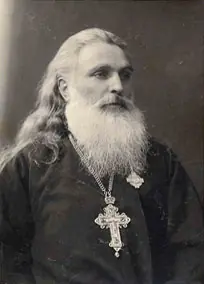
Archimandrite Ambrose, 1910
Alongside this, the newspapers cover the trial almost every day under the heading “The Trial of Catholicos Ambrose and his ‘Brethren’” (in inverted commas). There it is noted more than once: “When the accused are brought in, voices ring out in the hall: ‘Down with Ambrose’, ‘Down with the counter-revolution’, ‘Contempt for Ambrose’.”
The sessions are broken off because workers and employees gather outside and shout: give them to us, we will try the traitors of the working class ourselves. Insolent verses and articles are written, for example: “The accused do not plead guilty… lies, insinuations — they are, after all, traders in truth and conscience.” When the patriarch leaves the court building, Komsomol members specially summoned throw eggs at him.
And after all this the catholicos makes his final statement to the court, in which there is not a trace of the ingratitude he had met with. On the contrary, these are the words of the patriarch of the nation, who even in the face of the danger of death struggles, cares and loves:
“Can it be that the majority of the working people of the Georgian nation will be against my stand — the nation for whose interests I wished to sacrifice myself and my personal interests, and did sacrifice them? No, I will not believe it…” And again: “The peasantry, with whose forefathers’ blood the fields and meadows of the homeland are watered and with whose bones they are fattened — this peasantry, I believe, will always love its homeland, and will never come to hate the defender of the idea of its freedom, nor turn against him.”
Here are a few more extracts from his final statement concerning the chief charges, which may be regarded as a kind of example of church thinking: “We servants of God are bound by Christian teaching to be subject ‘unto the higher powers’ (he means the government), for those in authority ‘are God’s ministers’; we must pray for them and not speak evil of them; but not speaking evil does not mean that we should not look at their actions with a critical eye, or should not point out their mistakes… If I saw the danger of the nation’s destruction, I was bound to raise my voice.”
On the charge of hiding church treasures he writes: “I was serving in Sukhumi, and the things were hidden without me… But even if I really had taken part in hiding them, even then I could not count myself guilty, since the clergy were bound to care for the safekeeping of church property, and from time immemorial, in times of disorder and enemy invasion, they have resorted to this means.”
Ambrose, Metropolitan of Tskhum-Abkhazia
“Your proposal (he means the handing over of the church to the Komsomol) was unacceptable to us, since by accepting it we would have become betrayers of God’s ordinance and of the faith. That is all.”
And finally: “As our forefathers held it sweet to accept suffering for homeland and faith, so for me too the punishment to which the supreme court will sentence me for raising my voice in defence of the freedom of my native Church and nation will be sweet. It will be the crowning of the cross which I have taken up and have borne for almost 37 years of my life.
The voice I have raised in defence of the national interests, and the sentence the supreme court will pass on me, will find their place in the heart of every Georgian — of every Georgian who has not yet lost his faith and his love for his homeland. In this too I shall count myself happy. As a believer I will say: God’s will be done! — and I address you with the words of Christ: ‘Daughters of Jerusalem, weep not for me, but weep for yourselves, and for your children’ (Luke 23:28).”
Not one of the accused pleads guilty. The sentence on Catholicos-Patriarch Ambrose provides for the death penalty, but on account of his great age he is sentenced to up to 8 years’ deprivation of liberty, in strict isolation, with confiscation of all his property.
While he was in prison his children were several times given the chance to visit their father. They recalled that the catholicos always met them cheerful and calm, as if nothing troubled him. How hard the time of imprisonment was can be seen from the fact that he was required to resign the patriarchate of his own will, which he refused. After this there is probably no point in speaking of his bodily infirmity.
By an amnesty issued at the end of 1924 the catholicos is released from his sentence.
As his grandchild, Mrs Ana Kldiashvili, tells us, one day a neighbour’s boy brought her grandmother (the daughter of Catholicos-Patriarch Ambrose) the news that the catholicos was crossing the Metekhi bridge; the news spread through the city so quickly that when the catholicos came to Sioni, the cathedral was already full of the faithful. As soon as he entered Sioni, the people fell on their knees. Then, it is said, there broke from him with joy: “It seems no power can destroy Christianity in Georgia.”
Ambrose, Catholicos-Patriarch of All Georgia
Sermons survive that he preached after his release from prison. In his first sermon after two years’ separation he thanked his flock for the sympathy he had felt from them in this hard time, and said: “This came not from any worthiness of mine, but from your love for Mother Church and your esteem for the rank for whose bearing you chose my unworthiness… In matters of faith you have not been like a reed, which is always swaying and bends whichever way the wind blows, but you are firm and unshaken. This is a special joy to me.” His fatherly care for his flock shows with special force in the same sermon. He says that before taking up his duties he wishes to learn what state our Church is in. You will probably be surprised, he says, since it is well known in any case that the churches and monasteries are ruined and laid waste. But by the Church he meant them themselves and their hearts. As he goes on to say, this Church now seemed to him more beautiful than before.
Catholicos Ambrose died on 29 March 1927.
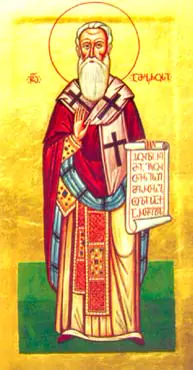
In 1995 the Orthodox Church of Georgia numbered him among the saints under the name of the Holy Hierarch Ambrose the Confessor.
Only a few things have survived from the holy patriarch’s life (his house in Sukhumi was bombed and destroyed a few years ago): drinking glasses, a paper knife given to him in prison, and a few photographs.
There is also the manuscript of the final statement read at the trial, remarkable sermons and historical and ethnographic works, a large part of which is unpublished.
But there is something far more precious than all this. It is the soul of a man who has taken his place with Him with whom he was in his earthly life too. He once said: “A believing heart always feels the nearness of Christ and bears Him within its being.” In a word, there is the soul of a God-loving patriarch — a new saint in the choir of the saints.