
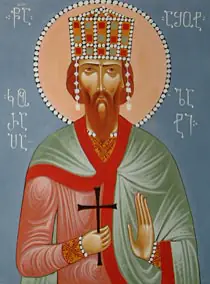
Holy Martyr Ashot the Kouropalates, Martyred in the Church of Artanuji (+829)
Saint Ashot the Great, the Kouropalates, was the son of Adarnase, eristavi of Kartli. Ashot became erismtavari of Kartli in 786. At that time Georgia was divided into four parts: Kartli, that is Tbilisi and its surroundings and the middle part of Georgia, was subject to the Arab emir; the east was held by Grigol, the ruler of Kakheti; western Georgia was governed by the king of the Abkhaz; and southern Georgia, by God’s will, became the inheritance of Ashot the Kouropalates and his descendants.
From the day he was installed as erismtavari Ashot began the struggle for the unification of Georgia; he took advantage of the weakening of the Arabs and drove the Hagarenes out of Tbilisi. “In Tbilisi there remained none of the Saracens except Ali son of Shuab.” Having secured Kartli, Ashot joined Bardav to Kartli as well, and for three years “his house was Tbilisi and Bardav”. Meanwhile a new ruler came to the throne of the Arab caliph; “the dominion of the Hagarenes grew strong, and they began to seek Ashot, and Ashot could not stand against them and fled from them”. Tbilisi fell into the hands of the Arabs once more. Ashot was forced to withdraw from Kartli and go to Greece with his wife and children and a small force. Having reached Javakheti, the fugitives stopped to rest by Lake Paravani. As they slept, an army of Saracens fell upon them. The small force was doomed to death, but “God helped Ashot the Kouropalates and his small army and gave him victory, and they slew a countless multitude”. The erismtavari saw in this victory a sign from God; he gave up going to Greece and decided to remain in Shavsheti-Klarjeti. At that time southern Georgia was in a wretched state. To the distress of the people plundered by the lawless an epidemic of cholera was added, and “few men remained here and there”.
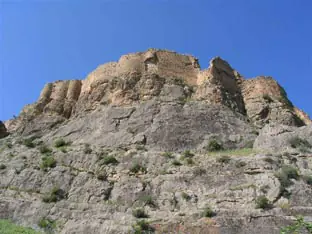
The despairing population, exhausted by misfortune, received Ashot the Kouropalates with joy. He set about restoring the ruined land: “some villages of that land he bought with money, others that lay waste he rebuilt, and Ashot the Kouropalates multiplied the villages in those lands”. Ashot the Kouropalates restored the fortress of Artanuji, built by the holy right-believing King Vakhtang Gorgasali (commemorated 30 November) and laid waste by Murvan the Deaf; he built a town beside it and proclaimed it the seat of the Bagratids of Klarjeti, and he built a church dedicated to the holy apostles Peter and Paul. “Many times God gave Ashot the Kouropalates victory and great glory in battle.”
Klarjeti was gaining new life. The region, which had become the political centre of all Georgia, was also growing firm and strong in spirit. Through the labours of the venerable Father Grigol of Khandzta (commemorated 5 October) and his fellow ascetics the desert was turned into villages, churches and monasteries were built, literary schools took shape, and the best sons of the nation went to Klarjeti and, beside the God-bearing fathers, forged the good future of Georgia.
Saint Ashot the Great, who fought for the unity of Georgia, feared and loved God. With great joy and honour he received in his palace the holy father Grigol, “a man of heaven and an angel of earth”. The venerable father blessed the sovereign: “May rule not fail your sons and their descendants in these lands unto the ages, but may they be firmer than the solid rocks and the everlasting mountains, and may they be glorified for ever.”
Saint Ashot the Kouropalates also helped the good work of the venerable Grigol materially. “He offered good lands, and the place of Shatberdi as an estate for Khandzta.” The king’s sons too — Adarnase, Bagrat and Guaram — gave great sums for the revival of the deserts of Klarjeti.
Unbending in battle, Ashot obeyed the servants of the Church without a word. The virtuous king came to love a woman “with excessive love”, forgot his dignity, his honour and his duty before God and the nation, and brought her to the palace at Artanuji that had been restored for the queen. The venerable Grigol learned of “that deed, corrupting to the soul”, “was greatly grieved”, came to the king and rebuked his unworthy conduct. Abashed, Ashot promised to send the woman away, but he could not keep his word, “for he had become a slave to the lust of his heart”. Without asking Ashot the Kouropalates, the venerable Grigol took the woman from the palace and brought her to the convent of Mere, to the abbess Tebronia (commemorated 5 October). The king asked Mother Tebronia to let the woman go: what is ours, he said, is in your hands. Mother Tebronia sternly reminded the king not “to make excuses for sins with men who work iniquity”. The sovereign, strong in the flesh, bowed his head before the mother “strong in spirit” and let slip with a sigh: “Blessed is the man who is no longer alive.” The God-fearing king, who “had his own mind as his accuser”, overcame his personal feelings and, despite the greatest inner struggle, “went away with joy, for with a pure heart he honoured those blessed ones as those who would crown his soul for ever”.
The fortress of Artanuji
The king, who loved God and his country, was preparing to recover the whole of Kartli, but “Khalil son of Yazid, the Arab, came and took Somkhiti, Kartli and Hereti”.
Saint Ashot prepared for battle and sent a swift messenger to gather the army, but before the army could assemble “the Saracens fell upon him unexpectedly and put him to flight”. The sovereign made for the Nigali gorge and “began to seek people, so that he might somehow increase his army”. Unhappily, among those called there were traitors too. The king realised the treachery too late. He took refuge in the church, but those weighed down with the sin of Judas broke in there too and killed the king “with the sword upon the altar”. “They slaughtered him like a sheep on the steps of the altar, and his blood that was shed there can be seen plainly to this day,” writes Sumbat son of Davit in his book “The Life and Tidings of the Bagratids”.
So the first sovereign of the Bagratids ended his life as a martyr, “the right-believing one, through whom his rule and that of his sons was established over the Georgians”.
The Georgians did not let the enemy go unpunished for the death of their beloved sovereign. Those who were at Doliskana heard that “their lord Ashot had been killed”, pursued the murderers, overtook the fugitives near the Chorokhi and slew them so completely that not one was left to carry the news.
The remains of the holy martyr Ashot the Great were buried in the church he had built, dedicated to the holy apostles Peter and Paul.



