
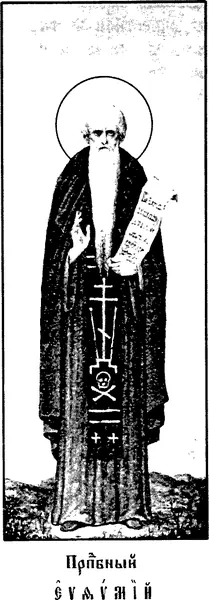
Our Venerable and God-bearing Father Euthymius the Great (+473)
The parents of the Venerable Euthymius, the rich and pious Christians Paul and Dionysia, were for a long time not granted a child, and fervently besought the Lord to have mercy on them. Once, as the couple stood in prayer, they were given the good news in a vision from on high: “Rejoice, rejoice, for God hath given you a son, and his name is Joy, for through his birth God shall give joy to His churches.” And indeed, soon they had a son, whom they named Euthymius, that is, Joy. The grateful parents vowed to dedicate their longed-for firstborn to God.
Three years later Euthymius’s father died. His mother brought him to her brother, the presbyter Eudoxius. His uncle presented the child to Bishop Otreius, who joyfully took on the care of God’s chosen one and soon made him a reader. Euthymius showed wonderful understanding in his studies: “he surpassed all of his own age in learning and in the love of God”. He was also distinguished by piety: “he was saved by humility and strictness and purity of body, and he greatly loved the Liturgy; he kept the lamp of virginity, and the oil of its light was mercy and almsgiving”. Burning with divine zeal, the young ascetic was tonsured a monk; then he was ordained priest as well, and was also charged with governing the monasteries of the city. The monk, a lover of stillness, would go out into the desert during the great fasts. At last, having reached the age of thirty, Euthymius secretly left the city, visited the holy places of Jerusalem, and then went to the lavra of Pharan and shut himself up in a small hut outside the monastery. The saint “had but one care, that he might please God by prayer and fasting”. He earned his living by weaving baskets and gave alms as well. Nearby the Venerable Theoctistus laboured. The brothers loved each other with the love of Christ, “and they were both of one mind, of one work and of one soul”. They usually went out into the desert after the feast of Theophany, to the shore of the Dead Sea, and remained there in God-pleasing labour until Palm Sunday. Once they found there “a fearful gorge, very deep, altogether inaccessible to anyone; and on the north side of that gorge a great cave”; they liked this place very much, stayed there to labour, and made the cave into a church. Soon, by God’s will, shepherds came upon the brothers’ dwelling and told the village about them. People seeking spiritual profit came to the blessed fathers, and many expressed the wish to stay there. So a monastery was founded, of which Theoctistus was appointed superior, while Euthymius took on the spiritual guidance of the brotherhood. The saint taught the brothers: “Know this, that it befitteth him who hath left the world not to do his own will, but to keep humility and obedience, and to look for death at every hour and for that fearful day of judgement, and to fear that unquenchable fire, and to love the glory of the Kingdom of heaven.” He said that monks, and especially young monks, must make their flesh toil, and always remember the Apostle’s words: “Labouring night and day with mine own hands, that I might not be chargeable to any.” Euthymius asked the brothers to keep silence in church, during the services, and at the table. Sometimes monks, especially young ones, expressed the wish to make their fasting stricter than the others; their teacher prevented this and advised them to take food in moderation at the common table.
In these years the Venerable Euthymius converted many Arabs to the law of Christ. Among them were the commander Aspebetus and his son Terebon, whom the saint miraculously healed. At baptism Aspebetus was named Peter, and afterwards he became a bishop among the Arabs.
The wonderworking father became famous, “and many sick came to him, and the mad also, and were healed”. Euthymius could not make his home in vain glory and turmoil; he left the place and settled with his disciple Domitian in the desert of Ruba, on the mountain of Marda. Seeking solitude, the father went into the depths of the desert, found the cave in which David had hidden when fleeing Saul’s persecution, and founded a monastery there. At this time the saint delivered many desert monks from the heresy of the Manichaeans, worked many miracles, and healed many sick and possessed people.
Here too visitors disturbed Euthymius’s quiet, and so he decided to return to Theoctistus’s monastery; but on the way he liked a place, secluded, wild, inaccessible, “exceeding good in its air”, and he stopped there with his disciple in a small cave.
When Saint Theoctistus learned of Euthymius’s coming, he “came up to him quickly”, asked his blessing, and begged the saint to return to them in the monastery. The hermit “would not go with him”, but promised that he would come down on Sundays for the Liturgy.
Euthymius did not wish ascetics to multiply around him, but God told him: “Turn away none that desireth to be saved.” Again spiritual children gathered around their teacher, and a new lavra was founded.
At first the monastery was very poor, but the venerable father trusted firmly in the Lord, who does not withhold His mercy from His chosen ones. Once four hundred travellers came to the lavra. Euthymius ordered the guests to be fed. The oikonomos answered that they did not have enough bread even for ten men; but, by God’s will, the bread, wine and oil multiplied so that the travellers ate their fill and the monks were left with enough supplies for months.
Once a monk was charged with bringing necessities for the brothers from a nearby town. He did not wish to go out into the world and stood firm in his refusal. Euthymius said to him: “I will beseech God to keep you from every temptation,” but the monk still refused. Then the saint said: “You know what the reward of disobedience is.” At these words the devil seized the wicked and disobedient monk, and he foamed at the mouth. At the brotherhood’s request Euthymius made the sign of the cross over the offender and healed him, after which he asked forgiveness and joyfully obeyed his teacher. “Obedience pleaseth God more than sacrifices, but disobedience bringeth unto death,” said Saint Euthymius.
Once two brothers could not bear the strict rule of monastic life and planned to flee. The holy father saw in a vision how the devil had put a bridle on them and was dragging them off to slaughter; he called the monks to him and instructed them to cast away their evil thoughts: “A tree that is moved from place to place bringeth forth no fruit. And so likewise a monk, when he moveth from place to place, cannot become fruitful. When a man would do good in his own place and cannot, let him not think that he will do good in another place.”
In 431 the Third Ecumenical Council was held in Ephesus, directed against the heresy of Nestorius. Euthymius rejoiced at the strengthening of the Orthodox faith and grieved over John, Archbishop of Antioch, who had sided with Nestorius.
In 451 the Fourth Ecumenical Council, held in Chalcedon, anathematised the heresy of Dioscorus, which, in opposition to Nestorius, maintained that there is only a divine nature in Christ.
The Venerable Euthymius accepted the decree of the Council of Chalcedon and acknowledged it as Orthodox. The news of this spread among the monks and hermits, and brought back to the true confession many ascetics who had been led astray by the heresy.
For his wonderfully strict, ascetic life and his firm confession of Orthodoxy Euthymius was called “the Great”. The holy father was clothed with wonderful grace: the brothers clearly saw how their teacher was clothed from on high when he celebrated the Mystery of the sacrifice; angels too visibly served him.
Euthymius had the gift of discerning, by looking at a person’s face, the hidden movements of his soul and his secret desires. At Communion some brothers shine with light, while others come to resemble the dead, he used to say.
When Euthymius was eighty-two, the young Sabbas (afterwards Sabbas the Sanctified, commemorated 5 December) came to him; he received him with love and foretold a great future for him. At ninety the saint buried with honour his faithful fellow labourer Theoctistus, and then God revealed to him that the hour of his own end was near too. On the eve of the commemoration of Anthony the Great, Euthymius ordered Vespers to be served and an all-night vigil kept, and he himself said to two presbyters: “This vigil is the end of my vigils with you in the flesh,” and asked them to gather all the brothers at dawn. The saint gave his spiritual children this last instruction: “If ye love me, keep my commandment, the beginning and end of good works: acquire love in which there is no guile. Without love ye can do nothing good. Every good work is made perfect by love and humility. Humility exalteth, and love letteth none fall from glory.” He asked that the monastery gate be shut to no one, that no one asking for alms be sent away with a refusal, and that they always help those in trouble as far as they could; then he appointed a new superior for the brothers, and three days later, on 20 January 473, committed his soul to the Lord in peace.
The saint’s disciple Domitian would not leave the precious grave. On the seventh day, at dawn, Euthymius appeared to him “in his radiance” and said to him: “Come, my son, to the glorious place that is prepared for thee, for I have besought Christ for thee, that thou mayest be with me.” The overjoyed monk went into the church, told the brothers of the vision, and reposed.



