
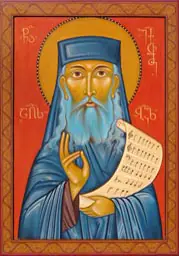
Saint Ekvtime the Confessor (Kereselidze) (+1944)
“Glory to Thee, O Lord Jesus Christ, power of my life, for what I did not know I have learned by Thy grace, and what I was not able to do Thou hast made me able to do, the writing of this book with gladness... And now the labourer departs, but this labour I commit to Thee, that it may live among the peoples always, now and ever and unto ages of ages. Amen.” — note of Abbot Ekvtime Kereselidze on a manuscript of chant in notation
Abbot Ekvtime (Estate Kereselidze) was born in 1865 in Racha, in the village of Sadmeli, into the devout family of Solomon and Martha Kereselidze. After finishing the parish school at Sadmeli, because of the hard economic conditions in Racha, the fifteen-year-old Estate went first to Kutaisi and then to Tbilisi, where he began to work as a cook’s assistant in a hotel. Here he came to know Maksime Rostomis-dze Sharadze, the treasurer and steward of Saint Ilia the Righteous (Chavchavadze). Together with other believing young people they founded in Tbilisi a free “Library of Divine Books”, whose aim was to strengthen the Orthodox faith among the people and to study and spread the ancient Georgian church chant. The spiritual guidance of the “Library of Divine Books” was given by the holy hierarch Alexander Okropiridze (+1907).
The members of the brotherhood studied the ancient Georgian church chant with a well-known chanter, Prince Melkisedek Nakashidze, who had been trained in the Georgian monastery on the Holy Mountain of Athos.
From the 1890s, through the mediation of Saint Ilia the Righteous, Maksime Sharadze and Estate Kereselidze acquired a printing press, by means of which they set energetically to printing and spreading divine books.
Maksime and Estate corresponded with the monks of the Georgian monastery on the Holy Mountain of Athos, and from them they received lives of saints and sermons copied from the library of the Iviron monastery, which they printed and distributed free of charge. Over twenty-five years they printed up to four thousand different publications of spiritual content on their press. People rightly called their press “the monks’ press”, because those who worked there were distinguished by their piety and holy life.
In 1891 the well-known singer and musician Pilimon Koridze taught Maksime and Estate European musical notation. Estate Kereselidze proved to have a special gift and a beautiful hand, and so Pilimon Koridze entrusted him with making fair copies of the manuscripts of chants in notation.
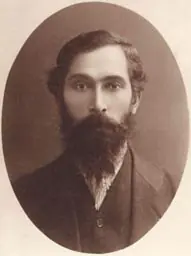
Estate Kereselidze before his monastic tonsure
At the beginning of the nineteenth century the forcible abolition of the autocephaly of the Church of Georgia had grievous consequences: the priceless treasures of the ancient Church were plundered and destroyed. Georgian church chant too faced a mortal danger. A way and means of fixing the Georgian church modes had to be found quickly, since those who knew the old notation of chant grew fewer day by day, and this treasury of music many centuries old was being lost forever.
The committee for the restoration of Georgian chant, founded in Kutaisi in 1884 on the initiative of the holy hierarch Gabriel, gathered together clergy and laymen who knew the ancient Georgian chant. Pilimon Koridze transcribed thousands of chants into notation, and Estate Kereselidze and Maksime Sharadze took upon themselves printing them at their own expense.
In 1907, six months after the martyr’s end of Saint Ilia the Righteous, Maksime Sharadze died. This very great loss was never made good for Estate Kereselidze. Trial came to the grieving Estate as soon as he had lost his most faithful friend: the labourer, left alone, was asked to divide the press and its property; to his sorrow the list of property included the most precious manuscripts. Part of them were taken from him and carried off no one knew where. Happily, the collections in notation ended up in the library of the Georgian Historical and Ethnographic Society, which was then headed by Saint Ekvtime the Man of God (Takaishvili).
Soon, with the help of the priest-martyr Svimon Mchedlidze, editor of the journal “Home Affairs”, Estate Kereselidze moved the press and the manuscripts to Kutaisi. Unfortunately, because of the hard circumstances of the time their collaboration did not come about. In Kutaisi Estate again tried to print the collections in notation, but, since he had no premises, the boxes in which the printed boxes were kept were plundered, and in his grief he found only a few of them at a meat-seller’s in the Kutaisi bazaar.
Soon afterwards the great labourer Pilimon Koridze died while staying at Bakhmaro. The work of thirty whole years — dozens of manuscripts — was left in Ekvtime’s care. He alone knew the real worth of this treasure.
Estate Kereselidze finally chose the path of monasticism, for which he had been preparing himself from his youth. His spiritual guide was the greatest ascetic of that time, the venerable Father Alexis Shushania.
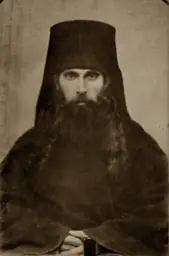
Hierodeacon Ekvtime of the Gelati monastery, the 1910s
From 1912, with the blessing of Bishop Giorgi Aladashvili of Imereti, Estate Kereselidze was received as a novice at the Gelati monastery, and on 23 December of the same year Abbot Anthimos tonsured him a monk in the name of the venerable Ekvtime the Athonite. From May 1913 he was a hierodeacon. From this time the most intense period of Father Ekvtime’s labours begins. Gelati was a place where the divine services were still celebrated keeping the full order of the Typikon. Father Ekvtime decided to set in exact order the chants that Pilimon Koridze had transcribed into notation and to arrange them according to the Typikon. For this he acquired a great deal of music paper and set to the heaviest and greatest of tasks — putting the handwritten notation in order and making fair copies of it.
In 1917 Father Ekvtime was ordained hieromonk by Bishop Giorgi of Imereti. In 1918 the state anthem of independent Georgia was printed by Father Ekvtime at the request of its author, Kote Potskhverashvili.
The ill-remembered year 1921 came. As soon as the communist government came to Kutaisi, Father Ekvtime was arrested as a person unreliable for the new order. Fortunately, as there was no charge against him, he was released after a few months. This was the heaviest period of persecution and oppression; the monks of Gelati expected insult and plunder every day. Even in these years Hieromonk Ekvtime went on working on the collections of chants. “I find great riches in this; it is an eternal treasure more precious than gold and silver and gems and pearls!.. I picture myself as a goldsmith and a setter of gems and pearls! Sometimes I am amazed: who let this precious wealth come down to me, that I, unworthy, should put my hand to it!” said the holy father.
In 1923 the godless government declared the Gelati monastery closed. The abbot of Gelati, Archimandrite Nestor Kubaneishvili, was given a few days to leave the monastery forever. Shaken, and fearing that the manuscripts of chants would be destroyed, Father Ekvtime hid up to forty huge collections with a trustworthy family in Kutaisi.
In 1924 members of the Komsomol razed to its foundations the huge church dedicated to the holy King David the Builder. In the same year Metropolitan Nazari of Kutaisi and Gaenati was shot by the godless together with faithful clergy. The hysteria of persecuting and destroying the clergy reached its peak.
Abbot Ekvtime of the Zedazeni monastery, the 1930s
Father Ekvtime was forced to leave Gelati and to move the manuscripts to a comparatively safe place. It is astonishing how, at a time when thousands of people were killed for no reason at all on the road between Tbilisi and Kutaisi, Father Ekvtime managed all alone to carry a cartload of manuscripts from Kutaisi to Mtskheta.
In this period Hieromonk Ekvtime was assigned to the cathedral of Svetitskhoveli, where he carefully hid the miraculously preserved manuscripts. In 1925, when Ambrosi, Catholicos-Patriarch of Georgia, was imprisoned in the Metekhi prison and every single servant of the Church of Georgia was suffering terrible persecution, by divine providence Father Ekvtime still went on saving rare examples of church chant. In the library of the Svetitskhoveli cathedral he came upon a very ancient collection of heirmoi with neumes. As the best expert in the ancient Georgian musical notation, he transcribed these chants too into the five-line staff.
From 1929 Father Ekvtime was assigned to the Zedazeni monastery. He now brought the manuscripts of Georgian chant up there and buried them in the earth, well protected in large iron boxes.
One of the staff of the “Metekhi” museum in Tbilisi, David Davitashvili, who was a secret Christian, while talking with the monks of Betania — the holy confessors Archimandrite Ioane Maisuradze and Giorgi Mkheidze — expressed his grief at the loss of the ancient Georgian chants recorded by Pilimon Koridze, and when he learned from them that these manuscripts were kept by Abbot Ekvtime at the Zedazeni monastery, he hurried that same day to the Zedazeni monastery.
A commission of historians and musicians was formed, which confirmed the exceptional value and great historical importance of these manuscripts. In November 1935 Father Ekvtime handed over to the State Museum 34 collections in notation, containing up to 6,000 chants. All these chants are now kept at the K. Kekelidze Institute of Manuscripts.
In the winter of 1944 the nuns of the Samtavro monastery, who went up to visit Father Ekvtime, who lived alone at the Zedazeni monastery, found the saint already weakened by illness; Father Ekvtime blessed the nuns and peacefully committed his soul to the Lord. He was buried in the courtyard of the Zedazeni monastery, by the sanctuary.



