
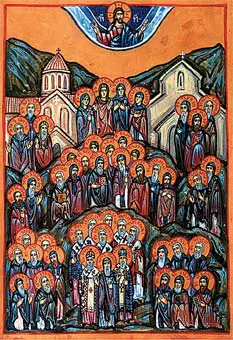
The Venerable Fathers and Mothers of the Desert of Klarjeti (VIII–IX)
In the mind of a Georgian, Tao-Klarjeti is always bound up with a longing and painful feeling of holiness, unity and strength. In the eighth to tenth centuries, when because of Arab rule cultural life in Kartli had died away, faith was flickering out and national self-awareness had declined, Tao-Klarjeti, emptied and depopulated by Arab invasions and an epidemic of cholera, was covered with churches and monasteries. “In every monastery there was a school, a seminary, where they taught reading and writing, the law of God, philosophy, Greek and other languages, chant, calligraphy, painting, goldsmith’s work and more. From here came priest-teachers, translators and copyists of books, miniaturists and goldsmiths” (Saint Ekvtime Takaishvili). Hagiographical works were written, liturgical collections were filled with original hymns, divine books were translated… The literary monuments of this period are so imbued with a national Georgian character and spirit that this age has been called the national age of our literature…
Information about the mothers and fathers who laboured in Tao-Klarjeti has been preserved by Saint Giorgi Merchule’s “Life of Grigol of Khandzta”. Giorgi Merchule laboured in the desert of Khandzta in the tenth century. His byname, Merchule, must mean one learned in the law, a theologian.
Giorgi Merchule gives us information about the holy Catholicos Nerse III. Nerse was an Armenian by nationality. He professed the Orthodox (Dyophysite) creed and laboured beside the Georgian fathers (in the sixth and seventh centuries Dyophysite Armenians persecuted in their homeland took refuge in Tao-Klarjeti). In the 630s Saint Nerse laid the foundation of the church of Ishkhani and laboured there in holiness and the working of miracles.
The holy Catholicos Hilarion was “the father and builder of Tsqarostavi”. For his holiness and wisdom he was elected catholicos of Kartli. The saint’s ministry in this rank covers the period from about the end of the 850s until 860. In the list of the catholicoi of Kartli Saint Hilarion is named after Gabriel II (about the 830s–850s) and before Saint Arsenius I the Great (about 860–887).
Saint Stephen of Tbeti was the first bishop of Tbeti. He is known as a church writer and hagiographer, one of the brilliant representatives of the literary school of Tao-Klarjeti. From his pen comes the original work “The Martyrdom of the Holy Martyr Gobron”.
Saint Zachariah of Anchi was distinguished from childhood by the fear and love of God; like the holy psalmist David, he was brought up from childhood in the free and hard life of a shepherd. With childlike sincerity the saint would gather his companions around him and repeat with astonishing exactness the actions and words of the clergy he had seen and heard in churches and monasteries. Once the bishop of Anchi came upon one of these childish games of his, and saw over the head of the boy Zachariah a pillar of light “come down from heaven”. At God’s indication the saint, when he came of age, soon became the teacher of the whole brotherhood. By his prayer a great many miracles took place: by prayer he stopped a huge boulder that had broken loose from a wall, drove away the birds and locusts that had fallen upon the monastery’s garden and vineyard, and crushed two terrible snakes for fear of which the brethren could no longer go to work in the vineyard. Saint Zachariah, distinguished by such holiness, was installed as hierarch on the see of Anchi.
Saint Macarius of Anchi held the see of Anchi at the time of the death of Saint Grigol of Khandzta, in 861.
Saint Ezra of Anchi — “son of the noble aznaurs Dapanchuli” — was a figure of the tenth century.
Saint Sabbas of Ishkhani was a cousin of Saint Grigol of Khandzta on his mother’s side and one of his first companions. He rebuilt the church of Ishkhani, built by the holy Catholicos Nerse, which by then had fallen into ruin, and became its bishop. In a firm and unyielding tone Saint Sabbas showed King Bagrat the Kuropalates the relation between the earthly and the heavenly kingship, and the superiority of Christ’s kingship over every kingship of this world: “Glorious king, thou art sovereign of the earth, but Christ of heaven and earth and the underworld. Thou art king of these nations, but Christ of all created things; thou art king of these passing times, but Christ is King eternal…”
With sincere humility and reverence Saint Sabbas entertained Saint Grigol and King Bagrat the Kuropalates when they came to see the church of Ishkhani. He seated Saint Grigol on his own episcopal throne and himself sat down beside him.
Saint John — “that new martyr of Christ… the blessed” — laboured in the monastery of Khandzta; he set out for Jerusalem to venerate the holy places; in the city of Baghdad the Saracens seized him and tried by torture to force him to deny Christianity, but by shedding his blood he proved his faithfulness to the faith of the Saviour.
Saint Theodore, the builder of Nedzvi, and Saint Christopher, the builder of Kvirikets, spiritual sons of Saint Grigol of Khandzta, his first companions and helpers, laboured with their teacher first at Opiza and then at Khandzta. The holy fathers resolved to go to the western region of Georgia, to Abkhazia, and to revive the monastic life there. On the way, in Samtskhe, the local aznaur Mirian entrusted to them his most beloved son, the six-year-old Arsenius (afterwards Arsenius the Great, catholicos of Kartli; commemorated 25 September), to be brought up.
Saint Grigol of Khandzta resolved to bring Theodore and Christopher back, and himself set out for Abkhazia. On the way he took the boy Ephrem (afterwards the wonderworking hierarch of Atskuri; commemorated 17 April) as his disciple. Saint Grigol entrusted Ephrem and Arsenius to Theodore and Christopher, who had returned to Khandzta, to be brought up, and made them promise not to leave Khandzta until they had brought up the boys.
When Ephrem and Arsenius had grown up “in perfect wisdom”, the holy fathers left the desert of Khandzta and founded the famous monasteries of Nedzvi and Kvirikets, where they laboured to the end of their lives.
Saints Abba George, Amona, Peter and Macarius laboured in the desert of Opiza. To share in the spiritual experience of the monks, Saint Grigol of Khandzta went with some brethren to the desert of Opiza, where he spent two years. At that time the monastery of Saint John the Baptist in the desert of Opiza was headed by Saint Abba George, the third hegumen of the house after Saint Andrew and Saint Samuel. Abba George “with divine understanding” perceived “the grace of their worthiness, and received them with joy not as disciples but as greater than he, for honour was to be granted them from on high by God”. It was by watching the holy life of these blessed fathers of Opiza that Saint Grigol was strengthened in the virtues of prayer, fasting, humility and meekness. History has preserved a holy Gospel book copied in the desert of Opiza in 913.
In the second half of the ninth century Saint Serapion of Zarzma (commemorated 29 October) founded the famous monastery of Zarzma. In this monastery Saint Serapion’s nephew, Saint Basil of Zarzma, author of “The Life of Serapion of Zarzma”, shone with holiness and the working of miracles. Saint Basil has also preserved for us information about other fathers who laboured in this monastery.
Saint George — “a man shining with good virtues and sweet in word and deed” — headed the house of Zarzma after Saint Serapion. Saint George was succeeded by Saint Michael, who, in accordance with Saint Serapion’s prophecy, began to build a second church at Zarzma. This work was completed by the next abbot of Zarzma, Saint Paul, “a man to whom all the people bore witness”.
Saint Khuedios, “a righteous and holy man”, was a recluse monk and laboured in the neighbourhood of Khandzta. The coming of Saint Grigol to Khandzta had been made known to him beforehand by divine revelation, and he joyfully received the company of brethren who came to him. Saint Khuedios blessed Saint Grigol of Khandzta and asked his blessing too, and wished to go on living in a separate cave so as not to break his vow of solitude. After Saint Khuedios’s death his cave was filled with a wonderful fragrance.
Saint Epiphanius was a spiritual son of Saint Grigol of Khandzta. The father, adorned with the working of miracles and with steadfastness, was distinguished by the greatest obedience and humility. His holy prayer healed many people doomed to die of sickness. Saint Grigol of Khandzta, who had been convinced many times of Epiphanius’s holiness and obedience, would call on the brethren to look at “the humility of Epiphanius, perfect in deed”.
Saint Mato laboured in the desert of Khandzta. After the death of the superior of the convent of Mere he headed that convent for forty years and “became for all an image of good”. His holiness and asceticism are shown by the fact that in all that time he never once ate bread with the mothers, nor took anything from them directly from hand to hand; when he was very old and ill, the saint avoided being served by the mothers’ hands, asked a relative of his who laboured in a monastery of fathers to take him away with him, and died a year later.
Saint Zenon was the son of a nobleman of Samtskhe. Brought up from childhood in the service of God, he had resolved to become a monk. A little before he carried out his intention, a certain “wicked man” carried off his sister. Zenon, mounted and armed, rode after his sister’s abductor, but on the way tormenting thoughts seized him: “I am a young man of renown, and he whom I pursue is utterly despicable.” If I catch him and kill him, I shall lose my soul; if I turn back, that too is a disgrace; and he resolved: “Now I will fulfil to the Lord the vow of monasticism.” Afterwards he became the closest disciple of Saint Grigol of Khandzta.
“A treasury of virtues, the holy pattern of monasticism, the rampart of the deserts of Klarjeti” — Saint Zenon died in deep old age.
The abbot of Khandzta, Father John, is known for having completed the building of the new church of Khandzta begun by his predecessor, Father Arsenius, “an aznaur by birth”. “Both of them died in the fatherhood of Khandzta.”
Saint Basil of Khandzta was the son of a maidservant of Grigol of Khandzta’s mother. Grigol had foretold to him that he would become abbot of Khandzta.
Saint Theodore and his brother Saint John laboured together in the monastery of Khandzta. Saint Theodore was abbot of the monastery; it is these holy fathers whom Saint Giorgi Merchule names as co-authors of his famous work, “The Life of Saint Grigol of Khandzta”, though, as historians suppose, they were not direct co-authors of the work but those who blessed and supported this holy undertaking.
In the same monastery laboured the monk Gabriel, known for holiness and the working of miracles, who faithfully served the sick and aged monks living in the monastery. Saint Gabriel told everyone of the labours of the fathers he had known, and urged them to keep firmly the rules of monastic life laid down by the fathers.
Saint Demetrius was brought up by the blessed mother, Saint Febronia. He became a disciple of the holy father Grigol of Khandzta, and this “Christ-clad” son of Grigol of Khandzta “was numbered with his first disciples”. He is named beside those holy fathers “of whom many attained the greatest measure of monasticism, and great miracles were wrought by them while they were in the flesh and after their death”. Saint Demetrius set out to venerate the holy places of Jerusalem and died there. Before his death he wrote a letter to Saint Febronia and Saint Grigol of Khandzta.
Saints Arsenius and Macarius — “good monks, perfect in wisdom and workers of miracles” — were kinsmen of Saint Ephrem of Matskveri (commemorated 17 April). They laboured in the monastery of Saint Sabbas in Jerusalem and were in constant touch with the monks of Khandzta. Saints Arsenius and Macarius often wrote letters to the fathers labouring at Khandzta — they were bound together by love in Christ and by devoted service to Mother Church and the homeland.
“The great Shio the wonderworker, who shone like the morning star in the land of Kartli”, according to Basil of Zarzma, was the teacher of Saint Michael of Parekhi (commemorated 27 May).
Saints Basil and Markelaoz, “perfect and radiant in virtues”, were disciples of Saint Michael of Parekhi. Father Basil, who after Saint Michael too “dwelt at Parekhi”, was buried near his teacher. Healing is granted to those who come to the holy graves with faith.
Saint David — a great and blessed father like “the holy bodiless ones”, “a builder of monasteries” — headed the house of Midznadzori. He was the spiritual teacher of the holy Catholicos Hilarion.
Saint Jacob — a great father of the tenth century adorned “with grace of many kinds” — laboured first at Shatberdi, and afterwards settled in the gorge of Midznadzori and “shone… like the morning star among the stars”.
“The great Sophronius, the blessed father, builder by renewal of the church of Shatberdi, and his crown for ever”, was a well-known church writer. Unhappily his literary legacy has not come down to us. Saint Giorgi Merchule, who wrote the life of Saint Grigol of Khandzta, counts him among those wise and perfect fathers from whom he expected “the writing of this life”. In the same monastery laboured Saint Grigol of Shatberdi too. Happily, written monuments of the tenth century made and copied in this monastery have escaped the misfortunes of time and come down to us, such as the Shatberdi Collection, the Udabno Mravaltavi, and the manuscripts known as the Adishi, Jruchi and Parkhali Gospels.
Saint Zachariah built the famous monastery of Beretelta and gave the beginning to the labours in holiness and wisdom of the holy fathers who later lived there.
Saint Hilarion of Parekhi, this holy and God-clad father, is mentioned by Saint Giorgi Merchule as one of the eminent writers and churchmen of his time.
Saint Hilarion, elder of Ubisi, laboured for a long time in the Georgian monastery of Saint Sabbas in Jerusalem. In his old age the holy father came to Georgia and settled to labour in the monastery of Khandzta. Saint Hilarion, a man of great learning and education, was charged with building the church of Ubisi, and he laboured there until his death.
Saint Febronia laboured in Samtskhe, in the convent of Mere. Saint Febronia and Saint Grigol of Khandzta were bound together by divine love and heartfelt friendship.
Saint Febronia’s holiness and wisdom are shown by the fact that the company of holy fathers would undertake nothing “without the counsel of Mother Febronia”. Saint Grigol of Khandzta entrusted to Saint Febronia a woman taken by force from the house of King Ashot the Kuropalates (the holy martyr; commemorated 29 January), for whom the king had “an unlawful love”. Saint Febronia was able to give the king a firm refusal to return the woman to the palace. It is known that heavenly angels made God’s will known to Saint Febronia.
Together with Saint Febronia laboured Saint Themistia, who for forty years served the priest Saint Mato, who celebrated in the convent of Mere. As Saint Themistia herself noted, most of them were so modest that Saint Mato never once took even the censer directly from her hand.
In the convent of Mere Saint Anatolia (“whom they called Antonia”) laboured as a recluse. Angels often appeared to the holy mother, who shone with a life like that of the heavenly bodiless powers. The blessed mothers Themistia and Anatolia were told by angels of the departure from this world of their teacher, Saint Mato.
Among the choir of holy mothers Saint Anastasia too laboured with outstanding holiness and humility. She came from Abkhazia; her name in the world has been preserved — Bevreli. She was the wife of King Adarnase, and as queen she gave great help to the convent of Mere. After King Adarnase unlawfully turned against the queen, Bevreli came to the convent and was tonsured there with the name Anastasia.
In the convent Saint Anastasia carried out the heaviest obediences; she always wore haircloth, carried firewood from the forest with her own hands, and prayed without ceasing.
Saint Anastasia’s former husband, King Adarnase, suddenly fell gravely ill. He sent messengers to the monastery of Persati, where Saint Anastasia was then labouring, and asked the saint’s forgiveness. Saint Anastasia prayed for the sick king: “May Christ forgive thee all thy sins and heal thee in soul and body,” after which Adarnase “was healed forthwith”.
Saint Anastasia, radiant with holiness and humility, laboured to the end of her life in the convent of Persati. God glorified with miracles after her death the saint who had been known for working miracles in her lifetime: at her grave her sick sons, Gurgen the Kuropalates and Sumbat, were healed, which was the beginning of healings at Saint Anastasia’s grave of people possessed by various diseases.
The land of Tao-Klarjeti, fertilised with the blood and sweat of these holy fathers and mothers — the most ancient historical territory of Georgia, still inhabited by Georgians today — has been since 1921 (after the communist regime abolished the statehood of independent Georgia) part of the Turkish state; the episcopal sees, churches and monasteries that belonged to the Apostolic Church of Georgia are often declared to be Armenian, but the historical reality cannot be ignored.
On 17 October 2002 the Apostolic Church of Georgia restored and nominally declared under its jurisdiction the eparchy of Tao-Klarjeti and Lazeti; and in the persons of the saints listed above the canonisation took place of the venerable fathers and mothers who laboured in Tao-Klarjeti, distinguished by “great spirituality, the working of miracles, and the building of monasteries”.



