
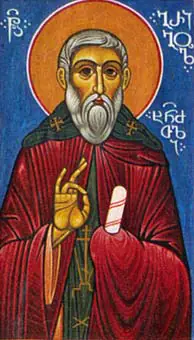
Venerable Grigol of Khandzta, Builder of the Houses of Klarjeti and Archimandrite (+861)
Saint Grigol of Khandzta was born around 759; he came of a noble family. He was brought up at the court of the eristavi Nerse, and “from his mother’s womb he had been offered to God by his mother”.
The boy, chosen by God, “was most wonderful in his understanding of learning, for he quickly learned the Psalter and all the church teaching that is learned by voice; he learned all the teaching in the Georgian tongue, and learned the letters of many tongues too, and got the divine books by heart”.
His tutors and parents wished to have the blessed Grigol ordained priest. Grigol desired the priesthood, but he also felt its very great responsibility, and he declined to the erismtavari and his parents: “Now I see the honour, and I fear the punishment.” Yet those close to him persuaded him: “Obey the command of Christ and serve Him in the priesthood, who suffered for us, the eternal Priest, and saved us all.”
At his ordination to the priesthood the divine grace that heals the infirm and supplies what is lacking made Saint Grigol’s person still more manifest; the people rejoiced “when by his holy hand they were made worthy to receive the Body and Blood of Christ”.
Afterwards they promised Grigol consecration as a bishop too, and this greatly alarmed the teacher: he felt “himself in glory according to the flesh”, and hastily escaped the wishes of those close to him; he left the temporary, “changeable honour of the earth, the reign of mortal men; he turned away from temporal and material natures, that the timeless light might lead him to the unchanging glory of the kingdom of heaven”.
Grigol took with him three fellow ascetics: his mother’s sister’s son, Sabbas of Ishkhani, Theodore, the builder of Nedzvi, and Christopher, the builder of Kvirikets. These four brothers were, by faith and divine love, “bound together in one mind, as one soul established in four bodies”.
The brothers went from Kartli down to Meskheti, came to Klarjeti, to the monastery of Saint John the Baptist at Opiza, and laboured for two years with the teacher there, Abba George.
Grigol knew of the labours of the hermit monks living in the desert of Klarjeti, and he learned from them prayer and fasting, humility and love, meekness, poverty, watchfulness and silence.
At that time Klarjeti, ravaged by Murvan the Deaf, lay desolate. Saint Ashot the Kuropalates (commemorated 29 January), escaping the wrath of the Arabs, came from Kartli to Klarjeti, proclaimed Artanuji, built by the holy King Vakhtang Gorgasali (commemorated 30 November), his royal city, and began to gather forces for the unification of Georgia.
After two years’ labour at Opiza the Venerable Grigol visited the desert-dweller of Khandzta, the righteous and holy monk Khuedios. God had revealed to Khuedios beforehand that a monastery would be built in this place “by the hand of Grigol the priest, a man of God, and the fragrance of his prayers and of his disciples’ shall rise before God like good incense”. The monk showed the venerable father the surroundings of Khandzta. Grigol liked the place very much and with the brethren began to build a monastery. The monks had to work in the hardest conditions, for the desert was mountainous and the ground rocky, and they had not even tools to work with.
Near Khandzta lived the aznaur Gabriel Dapanchuli, adorned with wealth, wisdom and valour. Grigol turned to him for help. Gabriel joyfully gave the holy father everything needed to build a church of stone and lime, and helped him with masons too. So the old church of Khandzta was built.
Gabriel Dapanchuli presented Grigol of Khandzta to King Ashot the Kuropalates. The holy king and the holy father grew dear to one another with honour and love. Ashot “offered good places, and the place of Shatberdi as an estate of Khandzta. Then the three glorious sons of the Kuropalates — Adarnerse, Bagrat and Guaram — each offered whatever his monastery needed, all of it generously”. In Georgia, bled white and despairing under Arab rule, the desert of Klarjeti was an oasis that gave life. Here the best sons of the nation gathered, fathers filled with divine grace.
For their God-pleasing life and their zeal the desert fathers of Klarjeti were granted by the Lord the gift of working miracles. They were “venerable and wonderworkers, pillars of patience, unshaken, like the pillars of heaven set firm and unfalling”.
Grigol, together with Sabbas of Ishkhani, went to venerate the holy places of Constantinople. On their way back they learned in Tao of the murder of the holy martyr Ashot the Kuropalates. “Then they were filled with tears of grief at the fall of that God-serving sovereign, and with weeping the houses prayed for the departed king.” As Grigol and Sabbas went on their way, God showed them the road to the ruined church of Ishkhani, lying in a place no man could reach, and also that this church would be renewed by the hand of Sabbas. The overjoyed Sabbas did not want to go back to Khandzta, but at Grigol’s request he stayed a little while with his spiritual father, and then went with two brothers to Ishkhani to restore the church.
The blessed Grigol “established the rule of his church and monastery, defined with wisdom and made radiant with knowledge, and gathered by choice from all the holy places, like a treasure of inexhaustible good things”.
The typikon of the monastery was strict. Father Grigol “would not receive the careless”. The brethren’s possessions were a small bed, a humble mat and one pitcher each for water. Many of them drank no wine at all, while others took a little. They lit neither fire nor candle in the cells. Grigol’s own virtues were known to the Lord alone.
Grigol was the very greatest authority not only for the fathers of the desert of Klarjeti but for the whole of Kartli. Under pressure from the aznaur Mirian a small council of bishops installed as catholicos of Kartli his son Arsenius (commemorated 25 September), the foster-son and spiritual son of Saint Grigol of Khandzta. Such a gross violation of the canons roused the anger of the clergy and the laity. Under the leadership of Guaram the Mampali a church council was held in Javakheti, which was to depose Arsenius. Church law was on the side of Guaram and those bishops. Until the blessed Grigol came, no one dared to speak. The bishop of Erusheti said: “When the star of the deserts comes, then shall the business and intention of all go forward.”
Grigol, when he appeared at the council, was a wonderful sight: “the humble garment that the old man wore looked like a garment of bright, unimaginable light, and on his head the cowl was seen like a royal crown.” The fathers understood that his word would be revealed by God, and indeed, when Saint Grigol said that “God ordained the catholicosate of Arsenius for his perfection”, they accepted what he had said without murmuring.
The grace-filled work of the Venerable Grigol reached western Georgia too. The venerable father went round all Abkhazia, warmed the Christians there with his grace-filled teaching and preaching, and afterwards built the monastery of Ubisi on the border between Imereti and Ameri.
The Lord worked many miracles by the hand of the Venerable Grigol. Once the dean said to the sacristan: “Go to Father Grigol and find out whether he is asleep or awake; it is the hour of Matins.” The sacristan went to Grigol’s cell and saw that light was coming out of the cell. He knew that the venerable father lit neither fire nor lamp in his cell, and he was frightened, thinking a fire had broken out; the dean calmed the sacristan: “Fear not! This is not a burning fire, but the enlightening Spirit of God” — he had seen this glorious sight many times. And indeed the saint, standing in prayer with raised hands, shone like the sun, and arrows of light came forth from his body in the form of a cross.
One winter the brethren had gone out to the forest for firewood. Suddenly a great tree slid down and was about to crush an old monk, when the Venerable Grigol made the sign of the cross over it and said: “In the name of Christ, stand, O tree!” “His word, like an unmoving rock, stopped on that steep place what was hurtling down terribly.” Through the Venerable Grigol’s prayer many healings took place.
Grigol was a strict guardian of morals. He rebuked King Ashot the Kuropalates (commemorated 29 January), not fearing his high rank, for he knew that the king’s wrong conduct was a stumbling block and ruinous for the nation.
The Venerable Grigol rejoiced with divine love among his fellow ascetics, but tares appeared among the wheat: the widowed see of Anchi was seized by force by a certain Tskiri, a favourite of Sahak, the emir of Tbilisi. The unworthy hierarch did much evil. The fathers, and especially Grigol, sternly rebuked Tskiri, and he, overcome by pride, cast away the fear of God and bribed a man of Anchi to kill the Venerable Grigol. The murderer saw “a great sign upon that holy one from on high, for a very bright pillar of light reaching to heaven covered him. And over his head was a cross that the eye could not bear, and around him as it were a rainbow, such as appears beautifully in time of rain”. The murderer’s arm suddenly stiffened, and he was healed only by the prayer of the Venerable Grigol. A council called at Anchi deprived Tskiri of his rank. The deposed Tskiri went to Tbilisi to the emir Sahak, with his help seized the throne of Anchi again, and set the people on to plunder the monastery of Khandzta. The Venerable Grigol besought the Lord with tears to protect the monastery and the brethren. It was made known to him by an angel of the Lord that Tskiri would be punished. And indeed, two days later Tskiri suddenly died.
The day of his departure from the body was made known to the Venerable Grigol by the Lord beforehand. He sent candles to the monasteries of the desert of Klarjeti and asked them to pray for him. On the day of his death the desert fathers came to the saint to pay their respects and ask his blessing.
Grigol blessed the fathers, instructed them for the last time, and in prayer commended his soul to the Lord. A voice was heard from heaven: “Fear not to come to us, blessed servant of Christ, for Christ the King of heaven calls thee an earthly angel and a heavenly man. Now come with joy and rejoice with thy Lord without end, for blessed art thou among men, made ready to inherit that blessed glory and to rejoice for ever.”
The venerable father Grigol of Khandzta was buried, as he had asked, in the monastery of Khandzta, among the graves of the brethren.
“Lives of the Georgian Saints”, Tbilisi, 2004.
The Life and Labours of the Venerable Father Grigol of Khandzta
Chapters: [ 1-6 ], [ 7-12 ], [ 13-23 ], [ 24-29 ], [ 30-41 ], [ 42-48 ], [ 49-59 ], [ 60-73 ], [ 74-87 ]



