
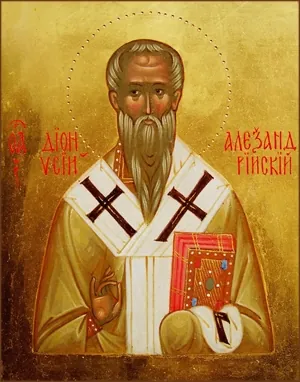
Hieromartyr Dionysius, Bishop of Alexandria (+264–265)
The Hieromartyr Dionysius, bishop of Alexandria, was born into a family of wealthy pagans. He received a good education and became a rhetor. When he came of age the saint was converted to Christianity under the influence of the famous father of the Church Origen (3rd century); he became his disciple and, advancing in the virtues, was soon ordained priest. From 231 Dionysius became the teacher of the school of Alexandria, and in 247 he was consecrated bishop. He laboured greatly to expose and root out various heretical teachings, and especially the heresy of the Sabellians.
During the persecution of the Orthodox by the emperors Decius (249–251) and Valerian (253–260), the gentle and loving hierarch stood as a faithful guardian over the souls of the Christians and strengthened them in the labour of confession.
The holy father managed to help and comfort everyone. In time of plague he called on his flock to help the sick, Christian and pagan alike, and to bury the dead. Of those spiritual children who died while carrying out this blessing, the blessed chief shepherd wrote: “In this way the best among our brethren departed this life. Such a death, the fruit of great piety and firm faith, is in no way inferior to martyrdom.”
Saint Dionysius was twice sent into exile. He returned to his see in the time of the Emperor Gallienus (260–268) and reposed in peace in 264 or 265. Although Saint Dionysius did not die a martyr’s death, he endured so much suffering for God throughout his life that the holy Church numbered him among the martyrs.
Saint Dionysius of Alexandria left us several excellent works interpreting Holy Scripture and refuting heretical teachings. His writings played an important part in the history of the development of Christian thought and had a great influence on the theology of the fourth century.



