
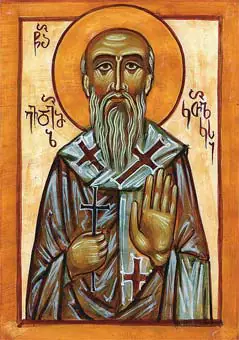
Holy Hieromartyr Evdemoz I, Catholicos (+1642)
Saint Evdemoz (Diasamidze) governed the Apostolic Church of Georgia from 1634, in the time of Rostom Khan (1632–38), a king who had turned Muslim. By origin Saint Evdemoz belonged to one of the distinguished families of Meskheti, the Diasamidzes. Unhappily this family, because of enemies and the foolish conduct of their countrymen, was scattered over various regions of Georgia. One branch settled in Lower and Inner Kartli, the other in Adjara. Very scant biographical information about the holy patriarch has come down to us. We know only that his brother was called Levan, whose daughter Elene was the wife of David, son of Teimuraz I, the mother of Erekle I and the mother-in-law of King Archil. Levan Diasamidze actively supported a political alliance of the kingdom of Kartli-Kakheti with Russia.
Shah Abbas had given Rostom the rule of Kartli-Kakheti after driving Teimuraz out of Kartli. The king who had turned Muslim seemed both to carry out the shah’s policy in Georgia and to be a Georgian too. He appointed salaries for the clergy, treated them kindly and even built churches; but it was in his very reign that “the order and ways of Kartli began to change. Fornication and uncleanness multiplied, that sin of Sodom and Gomorrah, and harlotry and consorting with women… here and there the sale of captives by princes came in”, and “harlots and doers of abominations” were exalted. The king’s love of luxury and sin gradually spread to the nation; “the priests themselves and the hierarchs turned aside from the good and mingled with the people… the law grew weak and the order of the Church was corrupted, for they no longer sought spiritual things, but all took care for the flesh”.
“Those who did righteousness, and the upright in heart, and those who shunned sin”, dishonoured and called worthless and feeble, bore every hardship with hope.
It was hard for the spiritual father of the nation; he could not look on calmly at the Georgians’ fall, and he acted with the fearlessness and self-sacrifice befitting a chief shepherd: several times he gathered the distinguished warriors of Kartli to fight the Persians. Under his influence certain princes would not submit to Rostom Khan’s policy and protected their principalities from the influence of Muslim customs. Catholicos Evdemoz set himself against the custom of that time of bringing up the children of the Bagrationi and other noble families at the shah’s court from childhood. Nor did Evdemoz shrink from rebuking the king to his face: wherever he met Rostom Khan, he would say to him: “You are a father to the Muslims and a stepfather to the Christians.” The spiritual daughter of Catholicos Evdemoz was Rostom Khan’s wife, the right-believing Queen Mariam, daughter of Manuchar Dadiani. Through the holy catholicos’s labours and with Queen Mariam’s support, the spirit of faith and nation was reviving again in the country; churches were built, literature of a spiritual character was written, and the patriotic spirit rose.
Rostom Khan saw clearly the catholicos’s leanings and his authority: Evdemoz preached everywhere and drew up concrete plans for returning the Christian king Teimuraz to the throne of Kartli.
Rostom Khan and those of like mind did not dare to oppose the authority of the unbending catholicos openly; they avoided open conflict and preferred to act in secret. Rostom was looking for a suitable moment to remove the right-believing catholicos from his path. And indeed the Muslim king found a quite insignificant pretext for deposing Saint Evdemoz from the catholicosate, though he did not yet dare to punish him.
It is true that no document recording the deposition of Evdemoz from the catholicosate has survived, but according to the existing manuscripts Christopher is named as catholicos from 1638. All this led to the Kartlian aristocracy, discontented with Rostom Khan’s rule, organising a conspiracy to set the Christian king Teimuraz I on the united throne of Kartli-Kakheti in place of the Muslim ruler. One of the active participants in this conspiracy and its inspirer was Catholicos Evdemoz.
The conspiracy was betrayed: one of the participants, an Armenian melik, told Rostom Khan everything. The lawless king prepared himself carefully and met the rebels in the fortress of Gori, resorting to a crafty device: he kept Queen Mariam and her spiritual father, Catholicos Evdemoz, with him. One of the leaders of the conspirators, Nodar Tsitsishvili, took fright at the first failure and fled to Samtskhe, while Teimuraz I, who had crossed the border of Kartli, went back to Kakheti. Only Sekhnia and Zurab Chkheidze engaged Rostom, and they died bravely in an unequal fight. Rostom Khan destroyed the fortress of Ateni and fortified himself at Tskhireti, and this time too he did not let the queen and the catholicos leave his side.
Saint Evdemoz nevertheless managed to send word to Teimuraz not to be put off by the betrayal and not to lose time, but his letter was first brought to Rostom Khan and read to him, and only then taken to Teimuraz. Rostom Khan waited for the rebels in the fortress of Gori, and then ordered the conspirators to be seized and punished. And indeed they were seized and punished, while Catholicos Evdemoz was brought to Tbilisi and locked in the prison of the fortress of Shuri (the fortress of Tbilisi, Narikala).
Saint Evdemoz spent several months in a cell. All that time he prayed fervently and lived a strict ascetic life; as if he already knew of the sentence that awaited him, he rebuked the king’s lawlessness all the more and called the people to fight.
The embittered Rostom Khan, betrayer of the nation and the Church, had the holy catholicos secretly killed in the fortress. Prince Vakhushti writes of his execution: “King Rostom seized Catholicos Evdemoz and imprisoned him in the fortress of Tiflis. Afterwards he threw him down from the tower of the Ganja fortress.” And “The Life of Kartli” tells us: “He seized Catholicos Evdemoz… and sent him to the city fortress and made him a prisoner, and some time later had him strangled there in the fortress.”
It seems that Rostom Khan used the traditional method of execution established at the Iranian court: the catholicos was strangled with a bowstring and a cord, and then his body was thrown from the tower on the side of the baths. This horrifying deed took place in 1642.
Christians secretly took away the body of the catholicos-patriarch of blessed memory, martyred for Christianity, and buried it in the church of Anchiskhati, in the north-west corner. As “The Life of Kartli” relates, after his execution lawlessness reigned in Kartli: “There was no spiritual care among the laity, but they lived in luxury and love of the flesh, for the priests themselves and the hierarchs turned aside from the good and mingled with the people, according to the lamentation of Jeremiah, for they were lovers of wine and feasting, of merriment and pleasure; they sang to one another of fornication, adultery and harlotry. In this the law grew weak and the order of the Church was corrupted, for they no longer sought spiritual things, but all took care for the flesh.” But the self-sacrifice of the devoted catholicos was not in vain: it was his very death that kept the Georgian nation faithful to the Orthodox Christian religion, showed a nation led astray by the treacherous policy of its conquerors an example of self-sacrifice for faith and nation, and all this was followed by the Georgian people’s struggle for national liberation and the country’s winning of independence.
The Holy Synod of the Church of Georgia numbered among the saints Catholicos-Patriarch Evdemoz I, who gave himself for nation and faith, and appointed 4 (17) October as the day of his commemoration.



