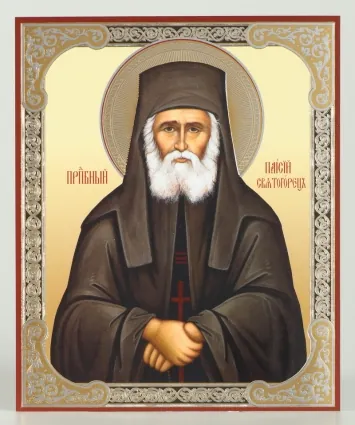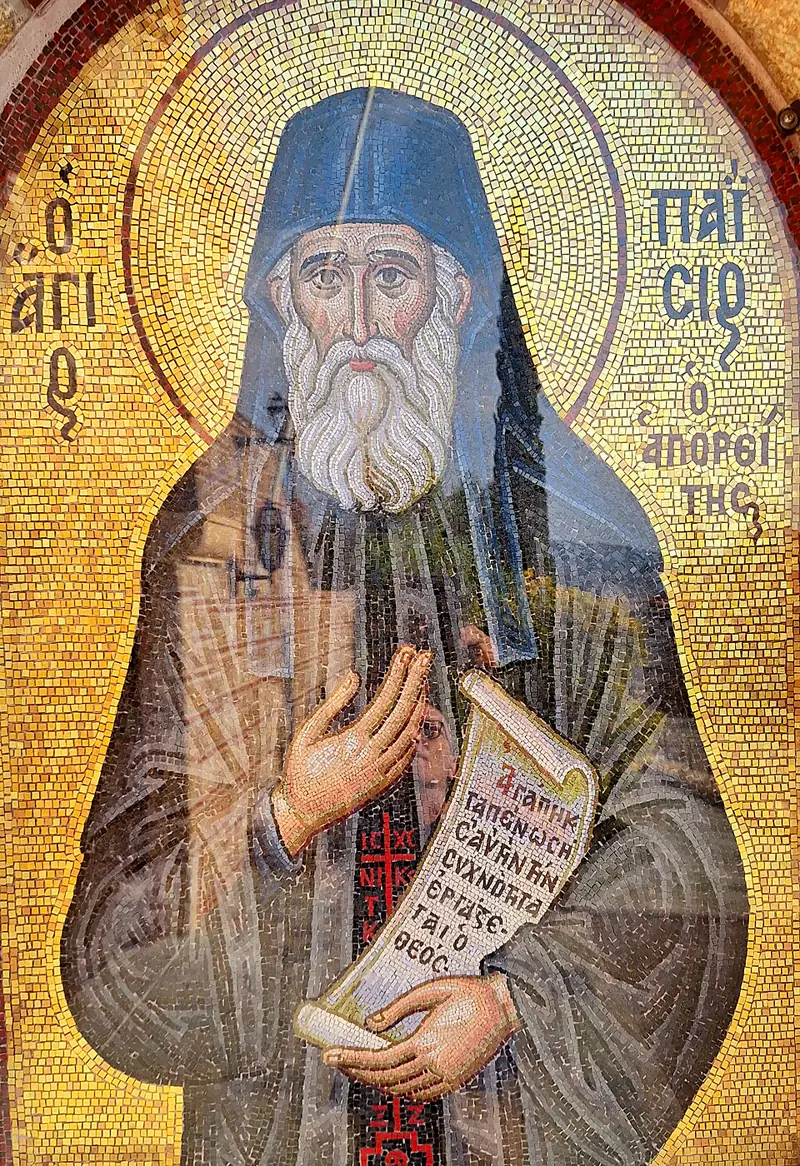
Venerable Paisios of the Holy Mountain (the Athonite) (+1994)
Paisios of the Holy Mountain (Greek Γέρων Παΐσιος; Arsenios Eznepidis, Greek Αρσένιος Εζνεπίδης; known in his lifetime as Elder Paisios, Greek Γέροντος Παϊσίου; b. 25 July 1924, Farasa, Cappadocia – d. 12 July 1994, Greece) was a Greek Orthodox ascetic of Mount Athos, a schemamonk and spiritual figure, who became widely known for his monastic life and labours. Today he is greatly revered by Orthodox Christians, especially in Greece, Romania, Russia, Serbia, Montenegro and Syria.
Paisios was numbered among the saints on 13 January 2015 by the Holy Synod of the Ecumenical Patriarchate.
Arsenios Eznepidis was born on 7 August 1924 in the Cappadocian village of Farasa (Çamlıca), during the period of the population exchange between Greece and Turkey. Arsenios was named by Arsenios the Cappadocian, who baptised him, gave the child his own name, and foretold his monastic future. After the population exchange the Eznepidis family settled in Konitsa, in the region of Epirus. Arsenios grew up there and, after finishing public secondary school, learned carpentry.
In 2017, by decision of the Holy Synod of the Orthodox Church of Greece, he was proclaimed patron saint of the military signal corps in which he himself had served.
In 1950, after finishing his military service, he went to Mount Athos: first to Father Cyril, the future abbot of the monastery of Koutloumousiou, and then to the monastery of Esphigmenou.
After four years as a novice, on 27 March 1954, Arsenios was tonsured a monk and received the name Averkios.
Soon Averkios moved to the idiorrhythmic brotherhood of the monastery of Philotheou, where his uncle was living. While there he was under obedience to Father Symeon. On 12 March 1957 Father Symeon tonsured Averkios into the little schema and gave him the name Paisios, in honour of Paisios II, the tireless Metropolitan of Caesarea, whose native village was also Farasa.
In 1958 Paisios was asked to spend some time in his native village and its surroundings, in order to protect the faithful from the proselytism of Protestant groups. He gave great comfort to the local faithful and helped many people. Later, in 1962, he went on pilgrimage to the monastery of Saint Catherine on Mount Sinai, where he stayed for two years. During this period he became much loved by the Bedouin, who benefited from his presence both spiritually and materially: Paisios used the money he received from selling his hand-carved wooden objects to buy food for the Bedouin.
In 1964, after returning to Mount Athos, Father Paisios settled in the skete of Iviron, and later moved to Katounakia, at the far southern end of Mount Athos, where he laboured for a short time in the desert. One of the reasons for his leaving there may have been his declining health. In 1966 he underwent an operation on his lungs. It was while he was in hospital that his long friendship began with the then young sisterhood of the women’s monastery of Saint John the Theologian at Souroti, near Thessaloniki. Later Father Paisios laid the holy relics of Arsenios the Cappadocian in this very monastery. During the operation he needed a great deal of blood, and to save him the novices of this monastery gave their blood.
On 11 January 1966, in the cell of the Holy Cross belonging to the monastery of Stavronikita, Father Paisios received the great and angelic schema from Father Tikhon. After Father Tikhon died on 10 September 1968, Father Paisios settled in this cell.
In 1968 he also spent some time in the monastery of Stavronikita.
Father Gabriel (of the cell of Saint Christodoulos of the monastery of Koutloumousiou) and Mother Philothei (of the monastery of Souroti) are spiritual children of Paisios the Athonite.
In 1979 Father Paisios moved to Panagouda, a cell belonging to the monastery of Koutloumousiou. It was here that he became universally known. Between prayer and helping those who came to him, he slept only two or three hours a night.
On 5 October 1993 Father Paisios left Mount Athos to receive medical care. Although he intended to be away only a few days, he was diagnosed with cancer, which required urgent surgery. After recovering from the operation he was taken to the monastery of Saint John the Theologian at Souroti. Despite his great desire to return to Mount Athos, his state of health did not allow it, and so he asked Mother Philothei of the monastery of Souroti to convey his wish to the local metropolitan: he wished to be buried at Souroti. The metropolitan agreed to this request.
Father Paisios died on 12 July 1994; the day before he had received Holy Communion. He was buried near Thessaloniki, in the women’s monastery of Saint John the Theologian at Souroti, beside Saint Arsenios the Cappadocian, the saint whose life Father Paisios himself had written.