
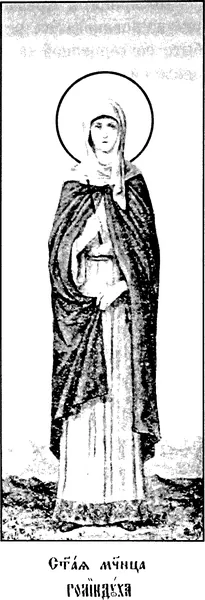
St Golinduch, in Holy Baptism Mary (+591)
Saint Golinduch, in baptism Mary, lived in Persia in the reign of Chosroes I the Elder. She was the wife of the chief priest of the kingdom. Adorned with a bright mind, Golinduch felt the vanity of pagan false wisdom and thought much about which faith was the true one. When she learned of the existence of the Christian teaching, she longed with her whole being to know what it taught. Soon, by God’s will, her sincere desire was fulfilled: in her sleep an angel showed her the torments of hell and showed her paradise too. Through an angel again the all-good Lord pointed her to an Orthodox presbyter, who baptised the future saint and named her Mary.
After her baptism Mary left her husband the priest, and he denounced his wife, now a Christian, to the king. Chosroes himself, his noble courtiers and high-born ladies urged Golinduch for a long time to return to her family, but the saint’s decision remained unshaken. Then the king sentenced the blessed one to life imprisonment, and Mary spent eighteen years in prison.
In the reign of Hormisdas, Chosroes’s heir, Aristobulus, the envoy of the Byzantine Emperor Maurice (582–602), came to Persia. When he learned that a Christian woman, Mary, had been suffering in prison for many years, he visited the blessed one several times with the king’s permission and taught her to sing the psalms. When Aristobulus set off for his homeland, Hormisdas had the saint brought out of the dungeon and cruelly tortured her. Then Mary was thrown to debauched men to be dishonoured, but God hid her from the eyes of the foul and lawless. At last the king gave orders for the blessed mother to be beheaded, but by the Lord’s providence the saint became invisible even to the executioners and found herself in a refuge of the Christians.
When with the help of the Byzantine Emperor Maurice Chosroes II ascended the throne and the persecution of Christians in Persia ceased, Saint Mary-Golinduch began to preach Christianity openly. At the end of her life she made a pilgrimage to Jerusalem and venerated the Saviour’s tomb and the other holy places, and on her way back she commended her soul to the Lord in Nisibis, in the church of the holy Martyr Sergius (+591).



