
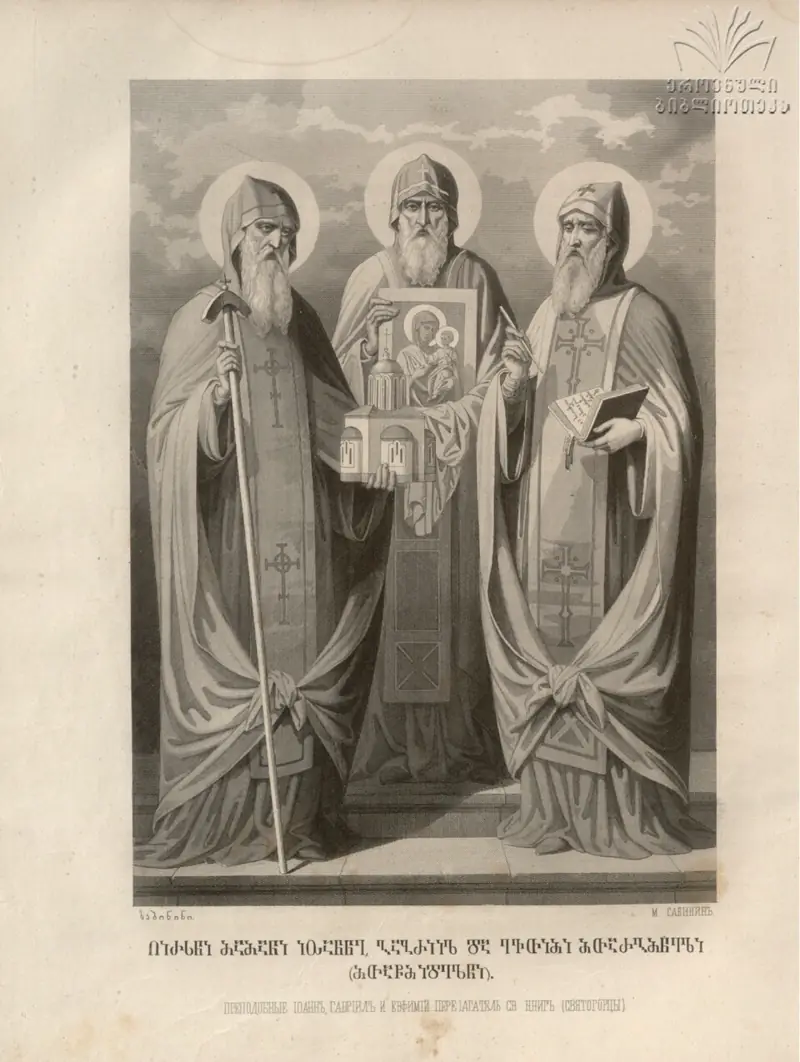
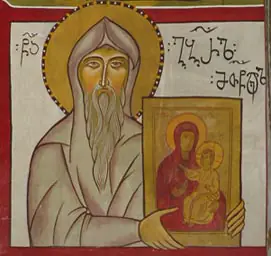
Our Venerable Fathers of Athos: John, Father of Euthymius, and Gabriel (X)
The Apostolic Church of Georgia commemorates together the fathers who founded the house of the Georgian ascetics on the holy mountain of Athos, the Venerable John and Gabriel.
The blessed father John (in the world Varaz-Vache Chordvaneli) was born in Samtskhe around 920. The saint’s father was a nobleman close to the court of David the Kuropalates, king of Georgia. From childhood John was given the best education: “from his youth he was trained in the liberal arts, keen of mind and understanding, knowing the Hellenic tongue and thoroughly learned in other tongues also, and full of wisdom and the fear of God”.
Saint John entered secular service in his father’s place. God granted the blessed one every earthly honour and happiness in abundance: he had a wife and child, he had wealth, and he was surrounded by loving and faithful friends and by the king’s love; but for the love of Christ he left earthly glory, honours, family, wife and child and kinsfolk, and secretly made his way to the lavra of the glorious Four Churches.
Father John’s wife and son were taken into the care of his father-in-law Abuharb and his brothers-in-law. When it became known at the king’s court that John had been tonsured a monk, he went with the fathers’ blessing to Greece and began to labour in one of the monasteries of Mount Olympus.
Meanwhile the emperor of Greece gave the upper lands to David the Kuropalates and in return, as a sign of loyalty, demanded the sons of the aznaurs of those lands as hostages. Father John’s kinsfolk, together with the others, brought John’s son Euthymius to the king of the Greeks. When John heard of it, he went to Constantinople, begged his son back from the emperor, and reproached his father-in-law: “What is this? Have you no sons? But this is plain: you had mercy on them as your own children, while my son you gave up as a hostage like an orphan! But may the Lord forgive you!”
Father John took his son, the boy Euthymius (commemorated 13 May), and with several other disciples went to the mountain of Athos (around 965); here he settled in the lavra of Saint Athanasius and spent two years in obedience.
At this time the famous Georgian general, the eristavi Tornike (commemorated 12 June), came to Saint John, was tonsured a monk with the name John, and with Saint Athanasius’s blessing settled in the lavra to labour.
So many Georgians came to the lavra of Athanasius that John was obliged to build, away from the lavra, a church for the Georgians alone in the name of John the Evangelist. Together with the church the Iberians built cells to live in as well.
Not long after this Bardas Skleros rebelled against the emperors of Greece, Basil and Constantine, and pressed them hard. The emperors’ mother, Theophano, sent a letter to the Athonite fathers and asked that Tornike come to the palace. Tornike did not want to meddle in worldly affairs, but on the advice of John and Athanasius he presented himself at the Greek imperial court and, at the empress’s request, went to David the Kuropalates in Georgia.
David the Kuropalates rejoiced to see his beloved spasalar, granted the empress’s request, and appointed Tornike commander of the auxiliary army. The monk, who had withdrawn from the world, feared to anger the Lord by disobedience, and once again, with the authority of spasalar, took command of the Georgian host.
With God’s help the rebel Bardas Skleros was defeated. The Georgian host had the lion’s share in the victory. The spoil taken from the battlefield John-Tornike, at the wish of David the Kuropalates, carried to the holy mountain of Athos. “The fathers came out joyfully to meet him, and kissed him, and gave thanks to God, who had brought him back in peace.”
The labour of the two worthy fathers so multiplied the Georgians on the Holy Mountain that Saints John and Tornike undertook to build new churches and monasteries. Very soon two churches were built on Athos: one dedicated to the Theotokos, the other to John the Baptist. The venerable fathers also held out a helping hand to other churches and monasteries of the Holy Mountain.
John, the former Tornike, a general undefeated on the field of battle and a victor over the invisible enemy, peacefully gave up to the Lord his soul, cleansed by repentance.
After Tornike’s death, because of strife that broke out on the Holy Mountain, it became hard for Father John to live there, and he resolved to go elsewhere with a few disciples to labour; but at the request of the Greek emperor he remained on Athos.
Father John fell ill with gout, and “for many years he lay bedridden and endured great pains”. Before his death he called his son, Saint Euthymius, and handed over to him the abbacy of the monastery. Then, as to one who was now abbot, he asked him to forgive his human weaknesses and charged him to hand the abbacy on after him to George (commemorated 18 July); he blessed the fathers and brethren, and blessed blessed Euthymius too “with a blessing from on high, and in his hands commended his holy soul to God, and lay down upon him in peace and fell asleep”.
The Venerable Euthymius clothed his father’s holy body with due honour, and afterwards built over his grave a church of the holy Archangels.
Saint Gabriel the Georgian was a monk labouring on the mountain of Athos; in summer he lived among inaccessible rocks, and in winter he came down to the house and there too abode in the labour of silence; he always wore sackcloth and fed on herbs — truly a heavenly man and an earthly angel.
As is supposed, Saint Gabriel the Georgian had known Saint John and John-Tornike already in the world; he too was of a noble family. Saint Gabriel so cast away from himself everything of this world that even we know of his life only the general outline of his labour and the miracles known to the whole world.
One evening the Athonite monks saw a pillar of light on the sea. This vision went on for several days. The fathers of the Holy Mountain gathered, went down to the seashore, and saw that the heavenly light stood over an icon of the Theotokos. The fathers went out into the sea in a boat, but when they drew near, “that radiance would flee far from them, and they were grieved at this”. The monks stood in prayer and cried to the Lord to reveal His holy will. The all-holy Theotokos appeared to the fathers and told them that only Gabriel the Georgian was worthy to bring out her holy icon; at the same time she appeared to him too and said: “Go into the sea, walk on the waves with faith, and all shall see my love and mercy towards your house.”
The fathers came to the monastery of the Iberians, made enquiries and sought out the monk shut away in the mountains. The monks let the holy father go into the sea. The fiery icon came near to Saint Gabriel. He pressed the holy icon to his breast, walked on the waves and brought the holy thing to the shore. At the place where the icon was set down a healing spring burst forth, which to this day refreshes monks and pilgrims wearied by the heat.
This miracle took place on the Tuesday of Bright Week.
The icon brought out of the sea was placed in the sanctuary of the monastery of the Iberians. The next morning a monk who came to light the lamp did not find the icon of the Theotokos there. The frightened fathers found the icon on the wall above the monastery gate, took it down and placed it again in the sanctuary. This was repeated several times. The all-holy Virgin appeared to Saint Gabriel and said to him: “Tell the brethren that from now on they tempt me no more, for I do not wish you to guard me, but I myself to guard you, not only in this life but in that to come; and as long as my icon is seen in this house, the grace and mercy of my Son shall not fail you.”
The monks were filled with unspeakable joy; they built a small church there to the glory of the all-holy Theotokos and placed the wonderworking icon in it.
Today in the monastery of the Iberians on Athos abides the icon of the all-holy Theotokos called the Iveron icon, which is held to be the heart of all Athos; at the entrance of the monastery there is a large icon of the Georgian monks who founded Iviron — John, Euthymius and George — whom the whole mountain of Athos always commemorates as founders. There everyone is told of the wonderful Georgian monk Gabriel; there too is the burial vault of the Georgians, the coat of mail of John the former Tornike, and a great many Georgian manuscripts.



