
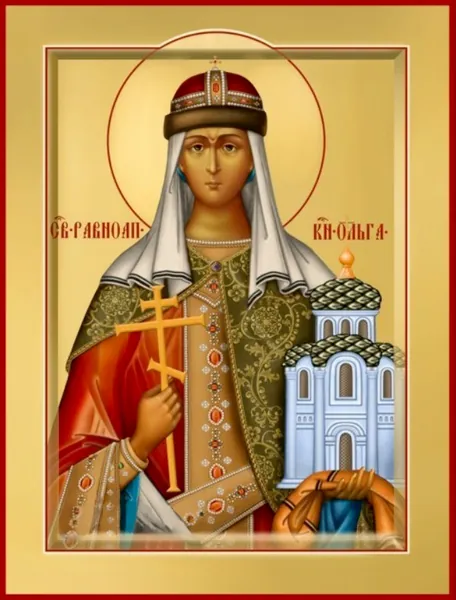
Olga, Equal to the Apostles, in Holy Baptism Helen (+969)
Saint Olga, Equal to the Apostles, a descendant of the noble family of Izborsk, was the wife of Igor, Grand Prince of Kiev. After his murder (+945), because the heir to the throne, Svyatoslav, was still a child, the reins of power passed to Olga. The future saint had been brought up among idol-worshippers, and pagan customs were ingrained in her to the bone; so she took cruel revenge on the Drevlians, her husband’s murderers: she conquered their land, laid it waste and burned it, slaughtered thousands of people and took many captive… After this Olga strengthened central authority; she travelled through the lands of Kiev, recorded them and divided them into districts, and set the first borders of the country… She was a just and merciful judge; she loved the poor, the old and the infirm; she listened attentively to everyone who came, and tirelessly granted every just request…
At this time the Christian faith was already beginning to spread in Kiev. In the city stood a church dedicated to the holy Prophet Elijah, built by Askold, the first Orthodox prince; the services were held in Slavonic, and there was a Slavonic Gospel too… Olga liked the way of life of the Orthodox; from the example of Byzantium she saw too that the people’s spiritual progress was the guarantee of a country’s strength, and so she went to Greece to inquire into the true faith. In Constantinople Olga was deeply impressed by the splendour of the Christian churches; she attended the services in the churches of Hagia Sophia and of the Mother of God at Blachernae… Her heart opened to Christ, and she decided to be baptised. The holy Mystery was performed by Theophylact, Patriarch of Constantinople (933–956), and her godfather was the Emperor Constantine VII Porphyrogenitus (912–959) himself. The newly baptised was named Helen in honour of the holy Empress Helen, Equal to the Apostles, the mother of Constantine the Great (commemorated 21 May). The patriarch blessed her thus: “Blessed art thou, for thou hast forsaken darkness and loved the light; the generations to come will remember thy name with blessing!”
Olga stayed in Byzantium and came to know the law of Christ thoroughly. She took back with her church vessels, icons, and a cross carved from the life-giving Tree which the patriarch had given her, and she brought several presbyters with her as well.
Deeply filled with love for the Saviour, the princess began a wonderfully pious life; the building of the churches of Saint Nicholas and Hagia Sophia in Kiev, of the Annunciation in Vitebsk, of the Most Holy Trinity in Pskov and of many others is connected with her name. The blessed one wished to enlighten the whole principality with the light of Christ, but this attempt proved vain: her son Svyatoslav could not accept the truth, and other pagan nobles rose up as well…
Olga yielded the throne to her idol-worshipping son, and herself governed the principality only when he was absent from Kiev. Once, before Svyatoslav’s arrival, the saint herself led the people of Kiev in battle against the invading Pechenegs.
Saint Olga reposed in 969. Her incorrupt relics were uncovered by Saint Vladimir in 989, or according to other sources in 1007. The remains of the blessed one were translated to the church of the Dormition of the Mother of God in Kiev and laid in a sarcophagus in which a small window had been made. The window opened only for those who approached with the fear of God. At the beginning of the eighteenth century the holy relics were lost.
It is true that Olga could not bring about the Christianisation of her country, but she laboured greatly to hasten this event. That is why she was called Equal to the Apostles.



