
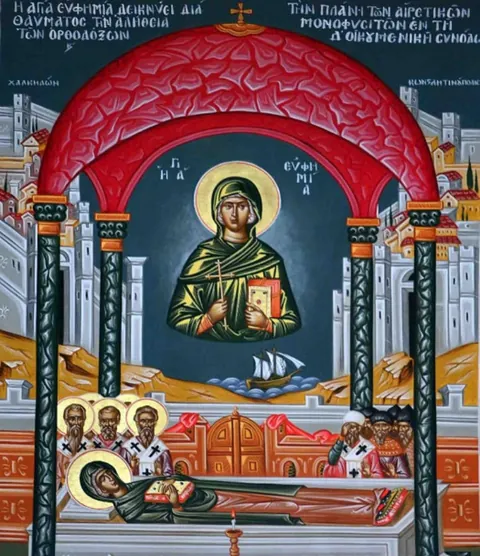
Commemoration of the Miracle of the All-praised Great Martyr Euphemia (451)
The All-praised Great Martyr Euphemia (commemorated 16 September) died a martyr in 304, during the persecution of Christians under the Emperor Diocletian (284–305). Half a century later, when Christianity had been proclaimed the state religion of the Roman Empire, God made the blessed martyr worthy to bear public witness once more to the purity of the Orthodox faith and to confess it.
In 451 the sessions of the Fourth Ecumenical Council (commemorated 16 July) were held in the church in Chalcedon where the holy relics of the Great Martyr Euphemia, radiant with miracles, were laid. Six hundred and thirty representatives of the local Christian Churches gathered in Chalcedon. On the Orthodox side the work of the council was attended by Anatolius, Patriarch of Constantinople (commemorated 3 July), Juvenal, the hierarch of Jerusalem (commemorated 2 July), and the representatives of Pope Leo of Rome (commemorated 18 February). The Monophysites, led by Dioscorus, Patriarch of Alexandria, and Eutyches, an archimandrite of Constantinople, had gathered in great numbers.
In spite of long deliberations, the parties could not reach a common decree.
Then Anatolius, Patriarch of Constantinople, proposed to the council that the settling of the Church’s division be entrusted to the Holy Spirit, through the intercession of His chosen vessel, the All-praised Euphemia, beside whose holy remains the dispute was being held. The Orthodox chief shepherds on one side and their opponents on the other wrote out a confession of their faith and sealed it with their own seals; in the presence of the Emperor Marcian (450–457) they opened the blessed great martyr’s coffin and laid both scrolls on her breast; then the coffin was sealed with the emperor’s seal and guards were set around it. Both sides gave themselves up to intensified fasting and prayer. On the third day the patriarch and the emperor, in the presence of the members of the council, opened the coffin: the scroll with the Orthodox confession was held in Euphemia’s right hand, while the heretics’ manuscript lay at her feet. The saint raised her hand as if alive and handed the scroll containing the unerring confession to the patriarch.
After this miracle many who had gone astray returned to Orthodoxy, while the hardened part of the heretics was unanimously condemned by the members of the council and cut off from the Church.
In the seventh century, during an invasion by the Persians, the holy remains of the blessed Euphemia were translated from Chalcedon to Constantinople, to a church consecrated in her name. Many years later, when iconoclasm was raging, the coffin with the incorrupt relics was thrown into the sea by order of the heretical Emperor Leo the Isaurian (717–741). The holy thing was found by two seafaring brothers, Sergius and Sergonus, who handed it over to the local bishop, and he buried it in secret. After iconoclasm was finally condemned at the Seventh Ecumenical Council (787), the remains of the blessed one were solemnly translated to Constantinople once more in the presence of Tarasius, Patriarch of Constantinople (784–806), the Emperor Constantine VI (780–797) and his mother Irene (797–802). (See the life of the All-praised Saint Euphemia in the reading for 16 September.)



