
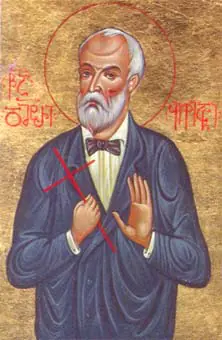
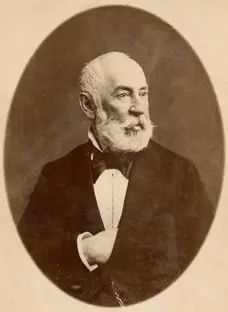
Saint Dimitri Kipiani (+1887)
Saint Dimitri Kipiani was born on 14 (27) April 1814 in the village of Mereti in the Gori district, into the family of Ivane Kipiani and Barbare Purtseladze. Dimitri was brought up in Tiflis by his relatives, Mariam Kipiani and Nikifor Fyodorov.
In 1830 Dimitri Kipiani graduated from the Tiflis school for the nobility and was appointed a teacher there.
The young Dimitri took part in the cultural and educational movement of the 1820s and 1830s, whose aim was the reawakening and revival of Georgian culture.
It was the revival of cultural and educational life that Dimitri Kipiani considered the foundation for uniting and strengthening the national self-awareness of the Georgian people.
Dimitri Kipiani took an active part in the conspiracy of 1832. It appears from the documents that he was close to the group that organised the conspiracy. For his part in the conspiracy Dimitri was exiled to Vologda and assigned to the governor’s chancellery.
In 1837 Dimitri returned to Georgia and entered state service. At that time Georgia was part of the Russian Empire, and national ideas had little scope in the country. Dimitri was able to use his high offices to strengthen the country and revive the Church. Together with other Georgian patriots he fought actively for the restoration of the autocephaly of the Church of Georgia and for the strengthening of the Orthodox worldview in the country.
In 1845 Dimitri Kipiani married Nino Chilashvili. Nino had been brought up in St Petersburg in the care of Mariam, the wife of the holy King Solomon. They had six children, three of whom died young. Dimitri Kipiani was left with three children: Nikoloz, Konstantine and Elene.
With the support and direct participation of Saint Dimitri Kipiani there were founded: the public library, the professional Georgian theatre, national journalism, the Tiflis Nobility Land Bank, “The Society for the Spreading of Literacy among Georgians”, and much else. Besides this, at various times Dimitri Kipiani was marshal of the nobility of the Tiflis and Kutaisi provinces and mayor of Tiflis.
Through Dimitri Kipiani’s intercession the first Georgian journal, “Tsiskari”, was founded. He himself set out the journal’s range of subjects, meant for readers of every class and social rank. Nor did Dimitri Kipiani lose sight of the interests of the Georgians living outside the homeland. Dimitri Kipiani’s scholarly historical works treat more than one key question of Georgian history: the ethnogenesis of the Georgians, the history of statehood and of religion, particular questions of historical geography, the origin and development of Georgian writing, and others.
On the national question Dimitri Kipiani’s starting point was the principle that only a nation which thinks and speaks in its native tongue can set out on the road of progress. Once a tendency to persecute and suppress the Georgian language had shown itself in the schools, Dimitri Kipiani went into open opposition to the Caucasian authorities and began a sharp and uncompromising criticism of the existing educational policy: “And of what language do the revilers of mankind say that it must die out? Of the language which Vakhtang Gorgasali, David the Builder and Tamar the Radiant spoke; in which the Equals-to-the-Apostles and the thirteen Syrian fathers preached Christianity to us; in which poets wrote, like Shota Rustaveli, philosophers, like Petritsi, lawgivers, like King Vakhtang; which has the simplest and most natural alphabet of all alphabets!..” wrote Dimitri.
In 1886, over the murder of Chudetsky, rector of the Tiflis Seminary, Pavel Lebedev, Exarch of Georgia, cursed the Georgian nation from the ambo. When Dimitri Kipiani learned of this, he sent the exarch a telegram from Khashuri in which he wrote respectfully, but with unbending directness: “…if all this is true, your dignity can be saved only if the one who is disgraced leaves the cursed country without delay…” In effect Kipiani demanded that the exarch leave Georgia.
For this Dimitri was removed from office and exiled to Stavropol. Dimitri Kipiani did not have to remain long in exile. On 24 October 1887 he was treacherously murdered. At night an assassin crept into his house, struck him on the head with a hammer and killed him. “The brain that thought of Georgia they spilled out over his head… over the heart that beat for the homeland they folded cold hands,” wrote Akaki Tsereteli.



