
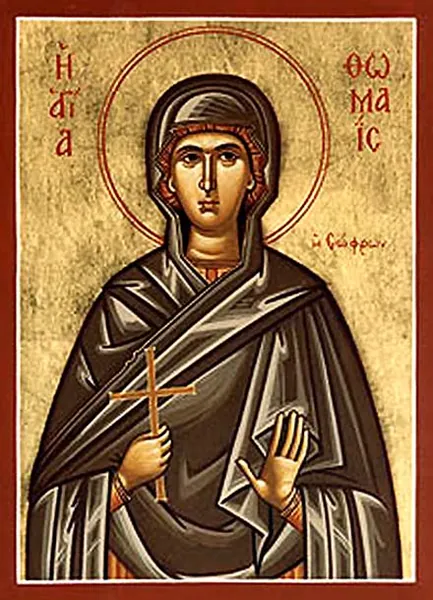
Martyr Thomais of Egypt (+476)
The holy Martyr Thomais of Egypt (+476) lived in Alexandria, in a Christian family. The saint loved very much to read Holy Scripture. At fifteen Thomais was married to a Christian fisherman. The woman, adorned with every virtue, was greatly loved by all.
At the prompting of the devil, Saint Thomais’s father-in-law was captivated by her beauty and, while his son was away fishing, sought to carry out his foul intention. The saint reminded the old man, who had lost his mind from passion, of the dread judgement and the punishment of sinners, but all in vain. Enraged by his daughter-in-law’s firmness, he seized a sword and threatened her. The saint answered: “Even if thou cut me in two, I will not break the commandment of God.” The father-in-law, blinded by passion, ran the saint through with the sword. Saint Thomais met a martyr’s end for keeping the commandment of God in 476.
A terrible punishment fell on the murderer: he went blind and could not find the door. In the morning, when her husband’s friends came, they found in the house the cold body of the holy martyr and the bloodstained, blinded father-in-law.
At that time the Venerable Daniel came to Alexandria from the desert. He urged the monks of the Octodecadus monastery to bury Saint Thomais’s body in the monastery’s burial vault. Some monks were surprised and asked how a woman could be buried among monks. The Venerable Daniel said that “Thomais is a mother who died for chastity.” After the saint’s burial Daniel returned to the desert. Soon a young monk came to him and told him that he was tormented by fleshly passions. The Venerable Daniel advised him to pray at the tomb of Saint Thomais. The monk did as his elder advised. As he prayed he fell asleep in spite of himself, and the holy martyr appeared to him and said: “Father, receive a blessing and go in peace.”
When he woke the monk felt peace and joy. After this fleshly passions no longer troubled him.
Later the holy martyr’s relics were translated to Constantinople, to one of the convents.



