
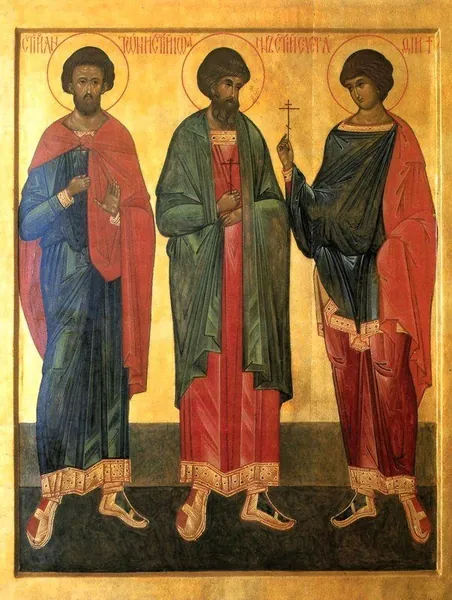
Martyrs Anthony, John and Eustathius (+1347)
The holy Martyrs Anthony, John and Eustathius (+1347) met their end in the time of Olgerd (1345–1377), Grand Prince of Lithuania. The prince was married to Maria (+1346), daughter of the Prince of Vitebsk; he confessed Christ, and during his wife’s lifetime even permitted Christianity to be preached. His two courtiers, the brothers Nezhilo and Kumets, were baptised by Maria’s confessor and received the names Anthony and John. At Queen Maria’s request an Orthodox church was even built in Vilna.
After his wife’s death Prince Olgerd began to patronise the fire-worshippers, who persecuted the Christians. Saints John and Anthony tried not to show their faith openly, but neither did they keep the pagan customs.
Soon the prince noticed the brothers’ defection and questioned them. The saints confessed Christianity. Olgerd ordered them to eat meat (it was then a fast), but the brothers refused. The saints were thrown into prison, where they suffered for a whole year. John took fright and declared that he would carry out all the prince’s orders. The delighted Olgerd set both brothers free. Anthony remained faithful to Christ, and when he again refused to eat meat during a fast, he was thrown back into prison. The brother who had denied Christ was free, but not only the Christians but the pagans too broke off relations with him. The repentant John went to Nestor and asked him to intercede with his brother to forgive him his sin. Once Saint John declared to Olgerd that he had returned to the Church. The prince gave him to understand that this was his private affair: he could be a Christian, but in others’ eyes he must live like a pagan. In reply Saint John confessed Christianity before the whole court, for which he was cruelly beaten and thrown into prison. The martyrs met each other with joy.
People came to the prison in an unbroken stream. The brothers converted many pagans to the law of Christ. The prison turned into a Christian school. The frightened priests demanded that the brothers be punished. On 14 April 1347 Saint Anthony was hanged on a tree.
The priests’ hopes were not fulfilled: people kept gathering by the walls of the prison where Saint John was held. On 24 April 1347 Saint John too was hanged on the same tree. The Christians buried the remains of both saints with honour in the churchyard of the church of Saint Nicholas the Wonderworker.
Soon a kinsman of the holy brothers, Kruglets, in baptism Eustathius, met his end for Christ. He served in the prince’s army and was distinguished by his good looks, manliness, courage, intelligence and kindness. Olgerd loved him above others. Once at a festive banquet Saint Eustathius would not take meat, and declared that he was a Christian and did not eat meat during the Nativity Fast. They began to beat the holy confessor with iron rods, but the young man did not utter a word. Olgerd ordered Saint Eustathius to be taken out into the frost and doused with cold water. This punishment too could not break the Christian’s spirit. By order of the enraged prince Eustathius’s shins were broken, his hair was torn out with the skin, and his ears and nose were cut off. The martyr of Christ bore his torments bravely. The executioners themselves were astounded by the divine power that strengthened him. After the torture Saint Eustathius was hanged on the same oak on which Saints John and Anthony had met their end.
By Olgerd’s order the saint’s body hung on the tree for three days, but a pillar of cloud protected it from beasts and birds. Later a church was built on this spot. The three martyrs had glorified the Holy Trinity at the cost of their lives, and so the church was consecrated in the name of the Most Holy Trinity. The holy altar table was set on the roots of the oak on which the holy martyrs had met their end. Soon the incorrupt relics of Anthony, John and Eustathius were uncovered. In 1364 Philotheus, Patriarch of Constantinople, sent the Venerable Sergius of Radonezh (+1392; commemorated 25 September) a cross containing relics of the holy martyrs. The Church appointed 14 April as the day of the commemoration of all three saints.



