
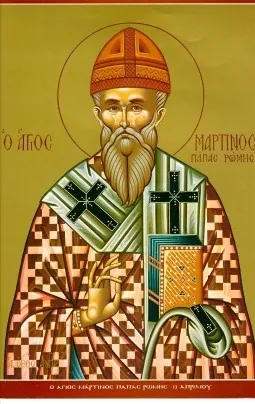
St Martin the Confessor, Pope of Rome (+655)
Saint Martin the Confessor, Pope of Rome (+655), was a Tuscan by origin. He received a good education and entered the service of the Church of Rome. After the death of Pope Theodore I (642–649) he was elected hierarch of Rome.
At that time the peace of the Church was disturbed by the Monothelite heresy, which spread widely through every level of society. The heresy had the sympathy of the Emperor Constans himself (641–668) and of Paul II, Patriarch of Constantinople (641–654). On the emperor’s instruction the heretical “Model of the Faith” (the Typos) was issued, which was binding on all and forbade further debate.
The Church of Rome learned of the heretical “Model of the Faith” in 649. The holy Pope Martin, a firm defender of Orthodoxy, convened a local council in Rome and condemned the Monothelite heresy; at the same time he sent a letter to the Patriarch of Constantinople urging him to return to the Orthodox confession. The angry emperor ordered the commander Olympius to seize the pope. When Olympius arrived in Rome he feared an uprising of the clergy and people, and ordered one of his soldiers to kill Saint Martin secretly. As soon as the soldier approached the pope, he went blind. The frightened Olympius hurriedly left for Sicily and soon perished in one of his campaigns.
In 654 the emperor, with the same aim, sent another commander, Theodore, to Rome, who brought charges against the pope: secret relations with the enemies of the empire, blasphemous speech about the Most Holy Mother of God, and unlawful accession to the papal throne. Although the clergy and laity testified to the pope’s complete innocence, Theodore seized Saint Martin at night and exiled him to an island in the Aegean Sea. For a whole year the holy hierarch suffered on the almost uninhabited island, bearing without complaint the insults of the guards. The tormented confessor was later taken to Constantinople.
The sick hierarch was carried into the court on a stretcher, but the judges required him to answer the questions standing. Soldiers held up by the arms the old man, drained of strength by illness. False witnesses came forward at the trial and accused the saint of dealings with the Saracens. The judges paid no heed to Saint Martin’s defence. Heartbroken at the injustice, the old man said: “The Lord knows what a kindness you would do me if you soon took my life.”
After the trial the holy hierarch, stripped of his vestments, was led out to the crowd, which shouted: “Anathema to Pope Martin!” Those who knew the truth left the square in tears. At last the sentence of the court was announced: the imperial court deprived the saint of the rank of pope and condemned him to death. The half-naked hierarch was put in chains and thrown into prison with robbers.
The emperor went to the dying Patriarch Paul and told him about the trial. The patriarch asked him to stop tormenting Saint Martin. The emperor sent people to the hierarch to question him further. The saint said to them: “Even if you cut me to pieces, I will have no communion with the Church of Constantinople while it is in heresy.” The executioners were astounded by the confessor’s firmness, and his death sentence was commuted to exile in Cherson.
Saint Martin died in exile, worn out by illness, hunger and every kind of hardship (+16 September 655). He was buried in the church of the Most Holy Mother of God of Blachernae.
In 680 the Sixth Ecumenical Council condemned the Monothelite heresy. The relics of the holy confessor were translated first to Constantinople and later to Rome.



