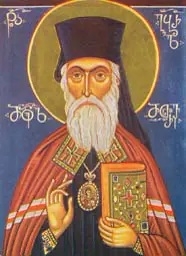
Saint Gabriel the Hierarch (Kikodze) (+1896)
The holy hierarch Gabriel was born on 15 November 1825 in the village of Bakhvi in the Ozurgeti district, in the family of Maksime Kikodze, the court confessor of Mamia Gurieli, ruler of Guria.
In 1840–45 Gabriel (Gerasime in the world) studied at the seminary of Tbilisi, then of Pskov and finally of St Petersburg. In 1849 he graduated from the St Petersburg Theological Academy with the degree of master. In the same year he married and returned to Georgia; in 1849 he was appointed inspector of the Tbilisi seminary, and in 1854 he was ordained deacon by the exarch, and then priest.
In 1856, at the age of thirty-two, misfortune struck him: his wife and five children died. After this tragedy Father Gabriel, with the blessing of Exarch Isidore, was tonsured a monk at the monastery of David of Gareji. In 1858 Gabriel was appointed abbot of the monastery. In the same year he was made Bishop of Gori, and on 2 July 1860 he was consecrated bishop of the diocese of Imereti, and he remained the hierarch of this flock until his death. In 1869 the diocese of Abkhazia came under his administration, and in 1873 the diocese of Samegrelo was added. Bishop Gabriel twice travelled through Svaneti, in 1866 and 1877. After his labours the Christian faith was strengthened in Svaneti. 18,000 Abkhaz received Christianity. More than 200 churches were built, and the churches of Nikortsminda, Bichvinta, Mokvi, Katskhi and Ilori were restored. About a hundred parish schools were founded; in 1887 the “Committee for the Restoration of Georgian Church Chant” was created, and in 1889 a committee for renewing the parish chapel over the tomb of David the Builder and for making a new reliquary for the relics of the great martyrs David and Constantine. In 1890 a school for girls was founded in Kutaisi, and in 1894 a theological seminary was opened. To enlighten his flock Bishop Gabriel travelled often through his diocese, and he set great store by meeting and talking with the people in person. He went from village to village and would instruct his flock in three or four places in a day. But what most influenced the flock was Bishop Gabriel’s personality, his own example. As a teacher and pastor he knew the means of moral upbringing. Already while he was at the seminary he had, in the words of Iakob Gogebashvili, “clearly, sharply and categorically defined the important and essential rules of prudent conduct... He held the alternation of mental and physical work to be the best means of a good, healthy and moral life. He himself kept this rule strictly.” He chopped wood, hoed, carried fodder to the cattle and fed the hens. When new churches were being built he was often the architect himself; he searched the villages for good craftsmen and saw to good order. It is said that “if he saw dirt anywhere in a church, he would fetch a broom and sweep it with his own hands”. Bishop Gabriel ordained as servants of the Church only people adorned with personal worth, and took no account of prince, ruler or governor. It is known how he rebuked Count Levashov for crude interference in church affairs. Bishop Gabriel “trusted people, because he saw in them above all the image of God, and therefore he had no fear of them”. On one journey a robber fell upon him and meant to rob him. Gabriel was not flustered; he made the sign of the Cross and said: “My son, I am a poor monk, Bishop Gabriel; where would I have money?” The robber had heard this name, and he was taken aback. The bishop did not let him go until he had taken him with him, brought him up and appointed him a teacher in a school.
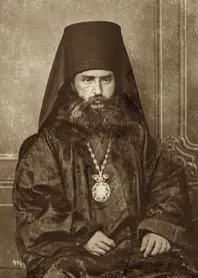
Bishop Gabriel of Imereti, the 1860s
The bishop did not pick and choose among those who asked of him. Great or small, far or near, prince or peasant, were all one to him. He asked nothing unlawful, and he fulfilled no one’s immoral request. His simple and plain character showed in his clothing. In his living room and at table visitors often took the monk dressed in old clothes for a servant.
Bishop Gabriel was wonderfully merciful and generous, the one who put bread into the mouths of the widows and orphans of his flock. He used to say: I will not feed the full, for I know there are many who are hungry. One great and bitter winter, when the poor of Kutaisi fell into great need and distress, the hierarch went round the hovels of the needy on foot and gave them help as far as he could. He was deeply in sympathy with the spreading of learning and education among the common people; he held out a helping hand to many pupils, kept them in his own house and paid for their schooling, and dined and talked with these young people so as to awaken noble thoughts in them. He planted in their young hearts the love of humility. His motto was: “Nothing belongs to me; everything is God’s.” Bishop Gabriel’s diaries allow us to learn how many dead with no one to bury them he buried, how many naked he clothed, how many fares he paid, for how many pupils he bought school things, how many sick he had treated. In the hard winter he often sent firewood and money to widows and orphans at night, in secret. The following story is known: once the bishop learned the number of prisoners in the Kutaisi prison, had underclothes sewn and sent them to the prisoners together with two packhorse-loads of white bread. At the same time he charged them on no account to mention his name.
Bishop Gabriel’s contemporaries note with one voice that the bishop standing at prayer was a wonderful sight. He celebrated the Liturgy and the services with great devotion.
In spite of this, there were often venomous letters against Bishop Gabriel, suspicions and groundless slanders. He was accused of injustice, immorality, careerism and trading in church objects. Once, when the bishop preached in the church of the Archangels in Kutaisi on the necessity of abolishing serfdom, a nobleman resolved to kill him. The bishop was warned, but he did not flinch; he did not turn aside from his way and calmly passed by the evil-minded man. Those present said that the bishop looked at the nobleman with such gentleness that he was ashamed of his own wickedness. Even his enemies recall him as “a most gifted and in every way remarkable teacher of teachers”, compare him to “the very first holy teachers of the Church”, and call him “a wonderful educator”, “an extraordinary master of the word”, “a teacher of righteousness”.
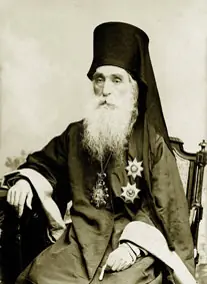
Bishop Gabriel, the early 1890s
Bishop Gabriel was one of the fervent defenders of the Georgian language, which in the nineteenth century, unhappily, found itself facing the deadly threat of degeneration. He fought boldly against all who called into question the need for the mother tongue to exist. To this end he wrote many articles and sermons. He exposed the false Georgian Mukhranski, who wrote that small nations, the Georgians among them, could not escape being dissolved into a “great” people, and that the sooner this happened the better. “How do you prove that this phenomenon (the dying out of a small people’s language) is a law of nature?” Bishop Gabriel asks Mukhranski. “On the contrary, a people must strive to spread and enrich its language, not to bury and lose it.” Gabriel held that it is precisely language that is “the chief element of a people’s individuality”. Every people deprived of its mother tongue is deprived of every individual trait and is “useless both to itself and to others”.
Bishop Gabriel firmly opposed the proposal of Yanovsky, the curator of the Caucasian educational district, to appoint Russian clergy to the primary schools “because of the limited minds of the Georgian clergy”. He acted in the same way when Levitsky, director of the schools of the Kutaisi province and executor of Yanovsky’s policy, tried to drive Georgian out of the schools. For this Levitsky fought Gabriel furiously and demanded his removal from the episcopate.
Gabriel also had great disagreements on national grounds with Exarch Evsevi, which later went as far as a rupture. Such opposition to higher institutions and persons often brought their anger upon him. From time to time he was even placed under secret surveillance, since the government regarded him as unreliable.
In 1885 Bishop Gabriel’s secretary, the well-known publicist Estate Mchedlidze (Bosleveli), was murdered. The bishop too received threatening letters. He considered leaving Georgia. “It was the smallness of my soul that I was afraid, but I was not afraid only for myself. I am an old man. I have not long to live in any case; but if I were really killed, what a stain would fall upon the whole people, who so cruelly gave up their pastor.”
The reposed hierarch Gabriel, February 1896
At the end of his life Bishop Gabriel entered into heavy spiritual battles, and terrible apparitions often tormented him. The enemy of mankind fought a last battle to overcome spiritually the physically weakened old man. On the day before his repose the bishop kept repeating the words: “God, be merciful to me a sinner,” and before his soul departed he said: “Remember me, O Lord, when Thou comest into Thy Kingdom.” On 25 January 1896 the hierarch reposed. The winter was unusually severe in Kutaisi that year. The roads were locked with snow. Because of the weather it was impossible not only to pay due honour to the departed and to carry him to Gelati and bury him there — even neighbour could hardly reach neighbour — so they decided to wait until spring, until the snow melted and the roads opened. Until then Gabriel’s body was laid in the Kutaisi cathedral. There was so much snow that the procession that followed the body from the Bishop’s Hill went more over the roofs of the houses than along the street. In spite of the weather a great multitude of people attended the translation of the departed to the cathedral.
For 46 days all Georgia bade farewell to Bishop Gabriel, and all that time his body did not decay.
The personal property of the departed, by his own wish, was given away entirely to widows, orphans and the poor.
Bishop Gabriel’s farewell address was published. The bishop asked forgiveness of everyone for the last time, and he himself forgave everyone their offences.