
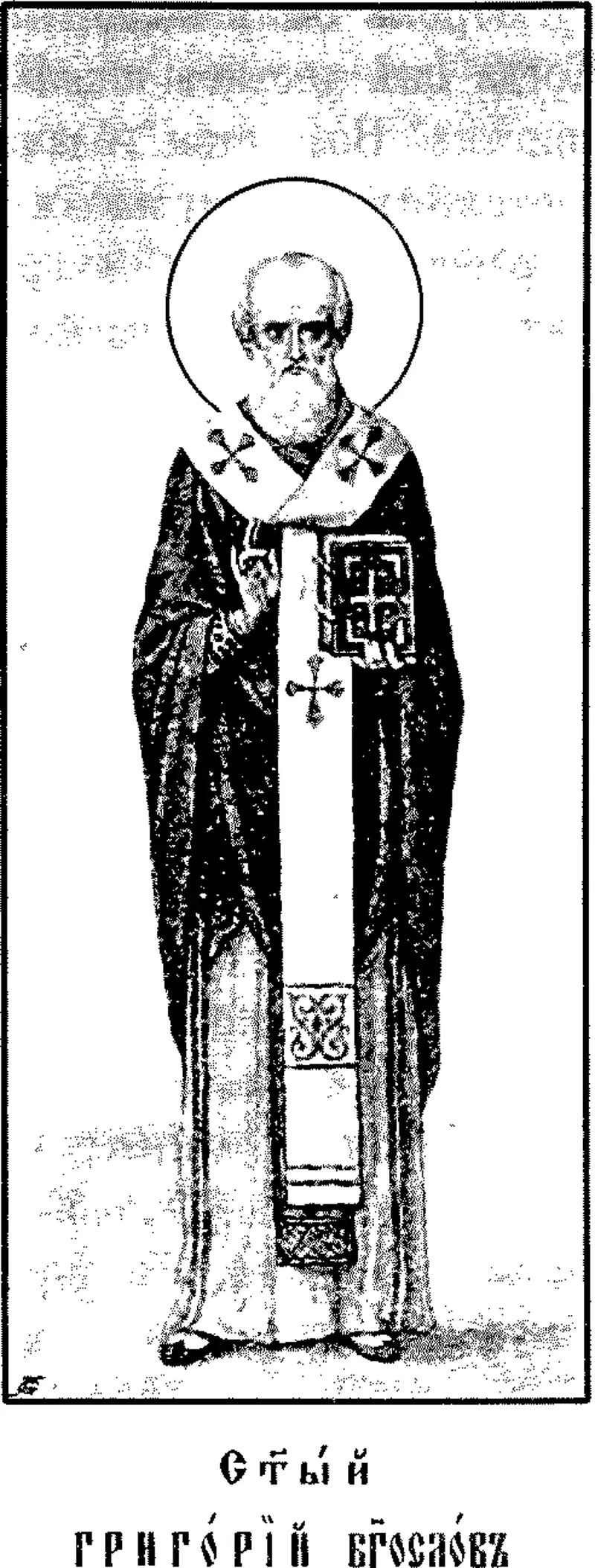
Our Father among the Saints Gregory the Theologian, Archbishop of Constantinople (+389)
Saint Gregory, who like the Apostle John was called the Theologian, was born in 329 in Cappadocia, into an educated and well-to-do family. His father was called Gregory and his mother Nonna. For many years they were childless. The parents asked the Lord for a child and promised to dedicate him to Him. And indeed Nonna had a vision, in which the face of her future child was shown to her and his name made known. When Gregory the Theologian tells of himself and his parents, he writes: “If I am worthy of the vow, this is a mercy given by God; but if I am not worthy of the vow, this is now my sin.”
It is true that Gregory’s father was baptised late, but afterwards he chose the path of God’s service and became Bishop of Nazianzus. The saint’s mother was in no way behind her pious husband: she was a woman only in body, while in her thinking she stood higher than a man. Gregory the Theologian kept the loveliest memories of his childhood. His zeal for the perfection of his own soul grew and grew stronger day by day. He read divine books with joy, and contact with morally perfect people made him happy. While still a boy he felt a desire to study various sciences. For this purpose he first went to Alexandria, where he acquainted himself to some extent with certain kinds of learning, and then from there set out straight for Hellas, namely for Athens. As he himself writes, he chose an exceedingly unfavourable time for travelling by sea. Near the island of Cyprus the sea, stirred up by raging winds, threatened the ship with destruction. All who had not known the true God before called on Christ with one voice for help, for fear is the most persuasive lesson. At this time of terrible danger Gregory the Theologian besought Christ: “I will live for Thee if I escape this terrible danger; and if not, Thou wilt lose a faithful servant.” The Lord heard his entreaty and the sea quickly grew calm. As a result of this prayer all who were on the ship came off it filled with the deepest reverence for Christ.
While studying at the Academy of Athens, Saint Gregory, as he himself writes, tried to be first among those “who know what the First itself is”. Together with knowledge, his years of study in Athens also gained him his best friend, in the person of Basil the Great. The foundation of their friendship was their common spiritual aspirations, or, in Gregory of Nazianzus’s own words, “one soul in two bodies”.
After finishing his studies Gregory thought a great deal, and at last settled on a kind of middle way between the hermits and those who live in society. His aged parents also needed looking after, and so he decided to live with them.
In 362 Gregory, Bishop of Nazianzus, ordained his son priest almost by force, though he knew his plans perfectly well. Distressed and inwardly troubled, Gregory the Theologian went to Pontus to calm himself, to his divine friend Basil the Great; but some time later Basil the Great treated him just as his father had. That is, with his father’s consent, he appointed him Bishop of Sasima in Cappadocia; Saint Gregory firmly refused this and continued to live in Nazianzus with his parents. In 379 Gregory of Nazianzus, by then a person known for his word and his way of life, was invited to Constantinople. He writes: “I was invited there by many souls, unwatered, yet still green, from among both the shepherds and the flock, so that I might revive them with streams of piety and, by supplying the oil of the olive, prolong the life of the light in the lampstand.”
To defend the Orthodox faith against the heresy of the followers of Arius, Gregory the Theologian delivered five most brilliant orations in Constantinople. These orations played a special part in strengthening the Orthodox.
In 380, with the support of the Emperor Theodosius, he was installed as Patriarch of Constantinople, but Saint Gregory’s sensitive soul again chose solitude. He finally settled on his family estate, where he died in 390.
Forty-five theological orations of Saint Gregory of Nazianzus have been preserved; besides these, poetical works of a theological and autobiographical character belong to the saint.



