
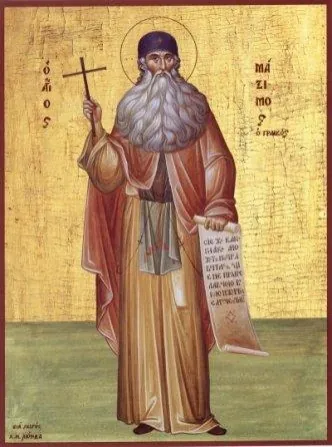
Venerable Maximus the Greek (+1556)
The Venerable Maximus the Greek (XV–XVI), son of a rich and distinguished Greek, was born in the Albanian town of Arta. In his youth he travelled a great deal, mastered many languages and came to know many sciences, and at last went to Mount Athos and was tonsured a monk in the Vatopedi monastery. At that time the Grand Prince of Moscow Vasily Ivanovich (1505–1533) wished to make sense of the Greek manuscripts and books of his mother, Sophia Palaeologina, and asked the Patriarch of Constantinople to send him a learned Greek. The patriarch judged the monk Maximus to be such a man. When the saint arrived in Moscow he was charged with translating into Slavonic the commentary on the Psalms and on the Acts of the Apostles, as well as several service books.
The Venerable Maximus set to work diligently, but since Slavonic was not his native language, inaccuracies naturally crept into the translation.
Metropolitan Varlaam of Moscow valued the Venerable Maximus’s works highly, but under his successor Daniel the situation changed sharply.
The new metropolitan demanded that the holy monk translate the Church History of Theodoret into Slavonic. Maximus refused, because this work included writings of the heretic Arius. This refusal caused discord between the venerable father and the metropolitan. In spite of this the saint continued his literary work: he wrote letters against Muslims, papists and pagans; translated John Chrysostom’s commentaries on the Gospels of Matthew and John; and created several original works as well.
When the grand prince was about to divorce his wife Solomonia because of her barrenness, Saint Maximus denounced him, and for this the venerable father was thrown into prison. From this time began the period of his life full of suffering: the inaccuracies in his translations were counted against the saint as deliberate corruption of the books. It was hard for the saint, but God’s mercy did not fail him either. An angel appeared to him and said: “Be patient, elder! Through these torments you will inherit eternal life.”
Six years later the Venerable Maximus was released from prison, a church penance was imposed on him, and he was sent to Tver, where he lived for twenty years under the supervision of the warm-hearted and loving Bishop Acacius. The holy father, by then over seventy, spent the last years of his life in the Trinity-Sergius Lavra. Persecution and heavy labour broke his health, but in spirit he remained as unbending as before. In the evening of his life he worked with his disciple Nilus on translating the Psalms.
The Venerable Maximus the Greek died on 21 January 1556. He is buried in the Trinity-Sergius Lavra. Many miracles took place at his grave.



