
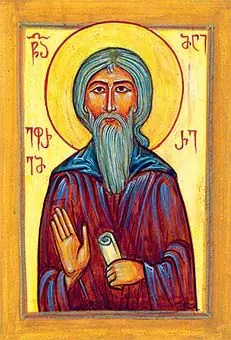
Our Venerable Father Ephrem Mtsire (the Lesser), the Philosopher (+1101)
The life of Saint Ephrem Mtsire — the greatest churchman, writer, translator and philosopher of the eleventh century — is unfortunately unknown, but his “Commemoration” and other sources allow us to learn the chief stages of the venerable father’s life and work.
In 1027, when King Bagrat IV of Georgia ascended the throne, nobles of Tao went to live in Greece. The reason they left their homeland was the enmity that had broken out between Georgia and Byzantium over the “upper lands”, that is, the lands of Tao-Klarjeti, and the internal strife that followed this political tension.
Among the nobles were “Vache, son of Karich, and John, Bishop of Bana”. Scholars hold that Ephrem Mtsire was the son of Vache.
Ephrem received his education in Constantinople and learned Greek thoroughly, and then withdrew to the Black Mountain near Antioch to labour there. At that time up to seventy Georgian monks lived there, and great literary work was going on.
When he came to the Black Mountain, Ephrem at first became a disciple of the Georgian ascetics there. In his “Commemoration” the venerable Ephrem says that Saba Tukhareli of the Black Mountain “with a goodness made like unto Christ’s bore with me in the time of my foolishness and youth, and together with his other good deeds showed me this also, that he laboured to have me taught the reading of Greek books too, in a place fittingly prepared, which is the monastery of Saint Symeon the Wonderworker”. It seems that Ephrem learned from Saba Tukhareli the rules for reading church books. Ephrem also counts himself much indebted to John Parakneli. In one colophon the blessed one tells us: “While that blessed elder, chosen among all the ascetics, John Parakneli was still with us, he... taught me the use of the marks of punctuation.” The priest Gabriel chose books for Ephrem to translate.
Ephrem’s colophons recall with gratitude the fathers labouring on the Black Mountain: Saba Tukhareli, Anton Tbeli, Ephrem Oshkeli, Arsen Iqaltoeli, Stephane Chulevli, John Parakneli, the priest Gabriel and others. Ephrem’s service to Georgian spiritual and philosophical literature is beyond measure. The number of his works reaches almost a hundred, and they touch nearly every branch of church writing.
Saint Ephrem created his own theory of translation, which became the foundation of Georgian writing in the time that followed. Three essential features mark this theory:
1. A work must always be translated from the original, from the language in which it was composed;
2. The translation made must be exact to the letter, but exactness must not violate the nature of the language into which the work is translated;
3. Special commentaries must be attached to the translation, in which the historical, grammatical and textual questions connected with the work are discussed.
To make the thought of the original easier and better to understand, Ephrem Mtsire also worked out his own rules for punctuation. As he himself writes, he used the full stop “for a small pause, two points to divide the word, three points for a great pause, and six points to end completely and begin the word anew”.
Ephrem translated the five works known under the name of Dionysius the Areopagite, the “Asceticon” of Basil the Great and of Ephrem the Syrian, commentaries on the Epistles and the Psalms, “The Fount of Knowledge” of John of Damascus and a great many others.
Among Ephrem Mtsire’s original works the “Account of the Cause of the Conversion of the Georgians, in Which Books It Is Recorded” stands out.
In the second half of the eleventh century the Greek monks of Antioch and the Black Mountain did not recognise the independence of the Georgian Church. Among other reasons they claimed that no apostle had preached Christianity in Georgia. It became necessary to defend and confirm the right of the Georgian Church to autocephaly. The Georgian ascetics there entrusted Ephrem with settling this matter. Ephrem made a special study of the Greek sources, gathered together “small words, like a gatherer of seeds, scattered through the holy writings”, and with scholarly arguments established the autocephaly of the Georgian Church.
With Greek sources Ephrem proves the fact of Saint Nino’s preaching among the Georgians, and the date when the right to consecrate catholicoi and to bless the holy chrism was obtained.
The venerable Ephrem Mtsire never left the Black Mountain. Around 1091 he was elected abbot of the monastery of Kastana.
The venerable Ephrem reposed around 1101. The acts of the Council of Ruisi-Urbnisi (1103) recall him among the departed.
For his great service to the Church and the nation, and for his God-pleasing life and labours, the Apostolic Autocephalous Orthodox Church of Georgia numbered Ephrem among the saints.



