
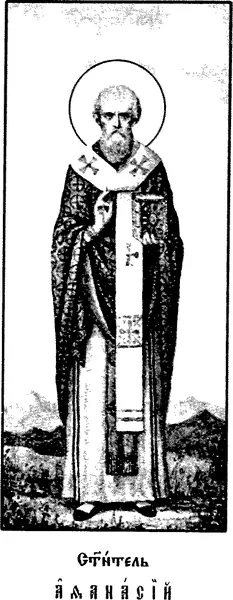
Sts Athanasius (+373) and Cyril (+444), Archbishops of Alexandria
Mother Church appoints the commemoration of Saints Athanasius and Cyril, Archbishops of Alexandria, on one day as a sign of gratitude for the tireless labours they undertook to establish the dogmas of the Orthodox faith and to defend them against heretical teachings.
Saint Athanasius the Great, Archbishop of Alexandria (+373), a very great father of the Church and a pillar of Orthodoxy, was born around 297 in Alexandria, into a family of pious Christians. He received an excellent secular education, but he studied Holy Scripture most fully of all. The Patriarch of Alexandria, Saint Alexander (commemorated 29 May), came to know the future hierarch in his childhood. Once some children, and little Athanasius with them, were playing on the seashore. The Christian children decided to baptise their pagan playmates. The boy Athanasius, whom the children had chosen as their “bishop”, performed the rite of baptism and repeated exactly the words he had heard in church. Patriarch Alexander was watching this scene from a window. He called the children and their parents to him, talked with them for a long time, and was convinced that the baptism the children had performed in play fully accorded with the order of the Church; he recognised the baptism as accomplished and performed only the Mystery of chrismation. From that day the patriarch watched over the boy Athanasius’s spiritual growth; he made him first a reader, and then ordained him deacon too. At this time the saint wrote his first theological works, “Against the Pagans” and “On the Incarnation”. In the rank of deacon Saint Athanasius accompanied Patriarch Alexander to the First Ecumenical Council at Nicaea in 325. At the council Saint Athanasius exposed the heresy of Arius and demanded that to the formula proposed by Eusebius a single, very short definition be added: “consubstantial with the Father”. This word was approved by the Orthodox fathers of the council, while the open and secret Arians came to hate Saint Athanasius and persecuted him all his life. After the death of the holy Patriarch Alexander, Saint Athanasius was unanimously chosen for the hierarchical see. For a long time he refused, considering himself unworthy, but the wish of the whole diocese could not be disregarded: at twenty-eight Athanasius was consecrated bishop. For forty-seven years Saint Athanasius governed his flock, and in that time he had to endure many sorrows and trials: several times he was driven out of Alexandria, and many times he himself fled into the desert from the followers of Arius who were bent on killing him; the saint spent twenty years in exile, now returning to his homeland, now hiding. There was a time when “the whole world groaned, finding itself, to its astonishment, Arian”; and the one Orthodox bishop who had escaped the heretics’ snare, Athanasius, followed attentively from his lonely refuge the events taking place in the bosom of the Church, wrote letters and treatises against the heresy of Arius, and stood as a firm pillar of the true faith. At a false council of Arian bishops the saint was even stripped of his rank of hierarch. When Julian the Apostate (361–363) began to persecute the Christians, his wrath fell first of all on Saint Athanasius. By putting him to death Julian wished to deal Christianity a crushing blow, but he himself soon met an inglorious end. The last words of Julian, mortally wounded in battle, were: “Thou hast conquered, O Galilean!” After the death of Julian the Apostate Saint Athanasius governed his flock for seven years, and reposed in 373 at the age of seventy-six.
Many works of Saint Athanasius have come down to us.
The Church commemorates Saint Athanasius twice: on 2 May, and on 18 January together with Saint Cyril of Alexandria.
Saint Cyril of Alexandria (+444) was the son of a distinguished and pious family. He received a good secular education and was deeply learned in philosophy too, but he strove more for the study of Holy Scripture and the knowledge of Christian truths. While still quite young, Cyril settled in the monastery of Saint Macarius in the mountains of Nitria, where he spent six years. Theophilus, Patriarch of Alexandria (385–412), ordained the saint deacon, and when he saw his understanding, charged him with preaching. After the death of Theophilus Saint Cyril was unanimously chosen Patriarch of Alexandria. The hierarch, a preacher and champion of Orthodoxy, led the struggle against the heresy of Novatian, which had spread in his flock and taught that Christians who had fallen away from Orthodoxy during persecution had no right to return to Mother Church.
More dangerous enemies of the Church were the Jews, who often stirred up disturbances in the city, accompanied by savage murders of Christians. Saint Cyril had to struggle with them for a long time. To root out the remnants of paganism too, the hierarch drove the evil spirits out of an old idol-temple, built an Orthodox church on that site, and translated into it the incorrupt relics of the unmercenary physicians Cyrus and John. Meanwhile a new heresy arose and grew strong: Nestorianism.
Nestorius, a presbyter of Antioch, was enthroned on the patriarchal throne of Constantinople in 428 and gained wide scope for spreading his heresy. His heresy was directed against the dogma of the two natures of Christ. Nestorius called the Theotokos the Christotokos, for he held that the Christ born of her was a man and not God. Saint Cyril wrote to Nestorius more than once and explained his error to him, but the hardened heretic still stood his ground. Then the patriarch sent the clergy of Constantinople a letter against Nestorianism, and to the holy and pious King Theodosius the Younger (408–450) two treatises exposing the heresy. Saint Cyril sent letters to other Churches too, and warned hierarchs and the monks of certain monasteries of the rise of a dangerous heresy.
Nestorius declared open persecution of the Orthodox. His follower, Bishop Dorotheus, in the presence of Nestorius himself, anathematised from the church cathedra all who called the Most Holy Virgin Mary the Theotokos.
Nestorius hated the hierarch Cyril, spread a thousand rumours and slanders about him, and branded him a heretic. But the holy patriarch continued his struggle to defend Orthodoxy. The situation grew so acute that it became necessary to convene an Ecumenical Council. The council opened in Ephesus in 431. It was attended by two hundred bishops from all the Christian Churches. Nestorius was against opening the council before the arrival of John of Antioch and the other Syrian bishops, but the sessions began. Under the presidency of Saint Cyril of Alexandria they examined the teaching of Nestorius and judged it a heresy. Nestorius himself did not submit to this council. Bishop John, arriving in Ephesus, opened another, unlawful council, at which he declared Cyril a heretic. The disagreement deepened. Then, by the emperor’s order, the hierarchs Cyril of Alexandria and Memnon of Ephesus were placed under arrest. Nestorius shared their lot.
Soon Cyril and Memnon were released and the sessions continued. Nestorius, who would not submit to the council’s decisions, did not escape the Lord’s punishment: he was deposed from the priesthood and, by the emperor’s order, exiled to distant Sisim, in the Libyan desert, where the reviler of the Theotokos met his end in terrible suffering. His tongue was eaten by worms. Among others, John of Antioch and the other Syrian fathers also signed the decree of the Council of Ephesus.
The hierarch Cyril governed his flock for thirty-two years. By the end of his labours the Church of Alexandria had been completely cleansed of heretics. The saint treated with care and love those who fell into vain wisdom through simplicity and ignorance.
The blessed Cyril managed to overcome a wrong opinion about Saint John Chrysostom (+407; commemorated 13 November). The Patriarch of Alexandria Theophilus, the saint’s uncle, was an opponent of John Chrysostom and presided over the council that condemned the holy hierarch. Cyril, surrounded from his youth by Chrysostom’s opponents, naturally formed a mistaken opinion of him. The Venerable Isidore of Pelusium (+c. 436–440; commemorated 4 February) wrote to the hierarch more than once, urging him to enter the great father of the Church in the diptychs of the saints, but in vain. Once, however, in his sleep Cyril saw a beautiful church, and in the middle of the church the Theotokos herself, accompanied by a choir of angels and saints, among whom John Chrysostom shone. The hierarch wished to approach the Most Holy Virgin and bow down to her, but the Venerable John held him back. Then Mary asked the saint to forgive Cyril, who had sinned against him out of ignorance. When she noticed that Chrysostom hesitated, she added: “Forgive him for my sake. He has laboured much to defend my honour; he called me the Theotokos and glorified me among men.” Then John said: “All-holy Lady, I forgive him through thy intercession,” and then embraced the holy hierarch with love and kissed him.
Cyril repented of his hatred for the God-pleasing father, gathered the bishops of Egypt, and held a great celebration in honour of John Chrysostom.



