
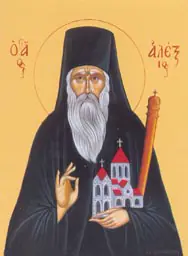
Our Venerable Father Hieromonk Alexis (Shushania) (+1923)
Saint Alexis (Shushania) was born on 23 September 1852 in the village of Nokalakevi in the district of Senaki, into a family of deeply believing Christians. At the age of seven Alexis was sent to school. There he showed great gifts, but soon fell gravely ill and could not continue his studies, and his father took him to Ozurgeti, where he himself traded.
In 1868 Alexis’s father died. Before his death he blessed his son and charged him in his will to care for the family. The future hieromonk was then sixteen.
In the same year Alexis travelled to Jerusalem and venerated the holy places there, and then went to Constantinople to his uncle, Islam Shushania, who was a great merchant and at the same time a very learned man, versed in many Eastern languages and deeply devout.
While staying with his uncle Alexis grew used to the merchants, and he liked the trade so much that he wished to become a merchant himself, but God’s providence showed him another way.
Alexis took from his uncle a small icon of Saint John the Baptist, withdrew alone to his room, and a great inner struggle began: on one side he was drawn by worldly life with its youthful pleasures, by his love for his mother, grandmother, brother and companions, and on the other an invisible power called him to a holy and exalted life. Several hours passed in this struggle. At last Alexis asked: “What am I to do with my father’s will — he entrusted the family to me — what am I to do with my duty?” The invisible teacher answered with a question: “If you were to die now, who would arrange your affairs?” Alexis replied: “God!” Again the voice was heard: “Then die to this passing world for God, and entrust all your affairs to God, and He will arrange them.”
After this Alexis was wonderfully changed: almost without ceasing, for months on end, he sat in his room, read the divine books and fasted strictly.
This way of life of Alexis turned his uncle’s heart against Constantinople, and soon they all returned to Georgia.
Having returned home, Alexis told his family that he had made a vow to become a monk. His sisters and brother were much grieved, but his mother gave thanks to God and blessed her son.
Alexis went up to the Teklati convent, put off his worldly clothing and set out on the path of monastic struggle. Alexis was then twenty. From that day he began a strict ascetic life. He went round the villages, cared for those sick with consumption, cholera and other grave diseases, and buried the dead who had no one to bury them.
So several years went by. For a time Alexis also laboured as a fool for Christ. He was a powerful preacher of the word of God. His life and labours were a good example for many. Under the influence of his preaching his mother Elene, his younger sister Salome and his brother Besarion soon received monastic tonsure. Besarion made the pilgrimage to the holy places of Jerusalem and laboured there for several years; then he was ordained priest at the monastery of Martvili, received the schema too, and at last reposed.
Alexis himself also laboured on Athos and copied many books. Returning from Athos, he venerated with great devotion the Kiev Caves Lavra, came back to Georgia and again continued his customary labour of prayer, fasting and good works.
Around 1885 Alexis Shushania settled in the monastery of Gelati, where he studied and copied many divine books. In 1886 he was ordained deacon, and in 1888 hieromonk.
In 1890, because of illness, the elder Alexis settled in the Teklati monastery together with his mother, a nun, and his sisters.
By God’s providence, in 1891 the elder Alexis began to build a monk’s cell at Menji, on the so-called Hill of the Archangels. With the help of God-fearing people the old, half-ruined church of the Archangels was gradually uncovered. He gathered disciples and began a life of seclusion in this retreat. Father Alexis’s health improved so much that he was able to serve the Liturgy and the services. He divided the money that was offered into three parts: one he set aside for his own needs, the second for the church and for guests, and the third for the infirm and the poor. When his strict ascetic labours had broken him physically, he sent his disciples away, and in his last years, from about 1915 until his departure from this world, he was cared for by his cousins, the schema-nuns Akepsima and Pasto.
From 1898 the elder Alexis began a life of seclusion. In his cell he had a wooden cross the height of a man, which he would hold on his back during prayer, because, as he himself said, holding the cross in this way reminded him of Christ going up to Golgotha. He came out to receive visitors only on Saturdays and Sundays.
In spite of the elder Alexis’s strict, ascetic life and labours, he was still wonderfully close to the people and knew how to be near them in spirit.
Worn out by his long labours, the elder reposed on 18 January 1923.
By God’s mercy and at a sign from the Lord, before Alexis’s tonsure his middle sister Sophia received her mother’s blessing and was tonsured a nun in the newly founded Teklati convent. Alexis himself meant to leave the world after Pascha. He even began to prepare to fulfil his vow: he kept Great Lent strictly, taking food every other day, and received Communion on Great Thursday. On Great Friday, at night, he had a vision: it was as if he had entered a wondrous church. On the ambo, with the chalice and the Communion spoon, stood the Saviour Himself, who gave Communion to the future saint. The venerable one took this vision as the Lord’s will; on Great Saturday he sincerely confessed his sins before a priest and received Communion.
For forty days after his repose the elder Alexis appeared every day to the schema-nun Pasto, who, together with her sister, the schema-nun Akepsima, remained to labour in Father Alexis’s retreat.
Fearing the expected sacking of the retreat by the Christ-hating government, the sisters Pasto and Akepsima buried the holy elder in the Teklati convent, while they themselves remained in the monastery of the Archangels.
On 8 January 1960 Pasto and Akepsima, with the blessing of Ephrem, then Metropolitan of Batumi and Shemokmedi and of Chqondidi, translated Father Alexis’s incorrupt body from the Teklati convent to his retreat and buried it near the eastern wall of the church.



