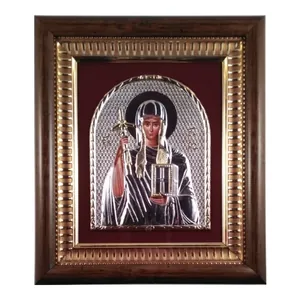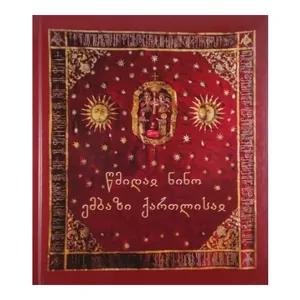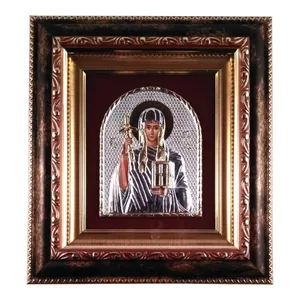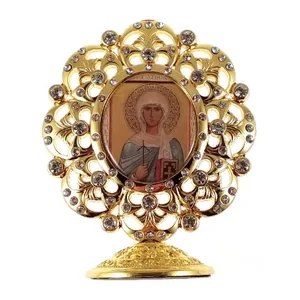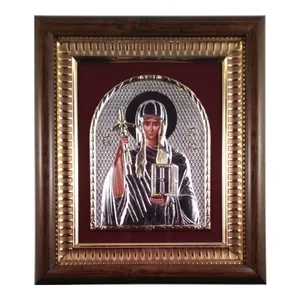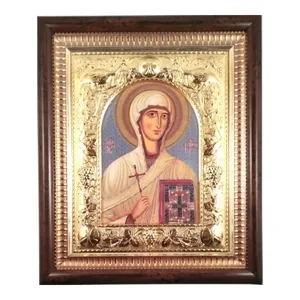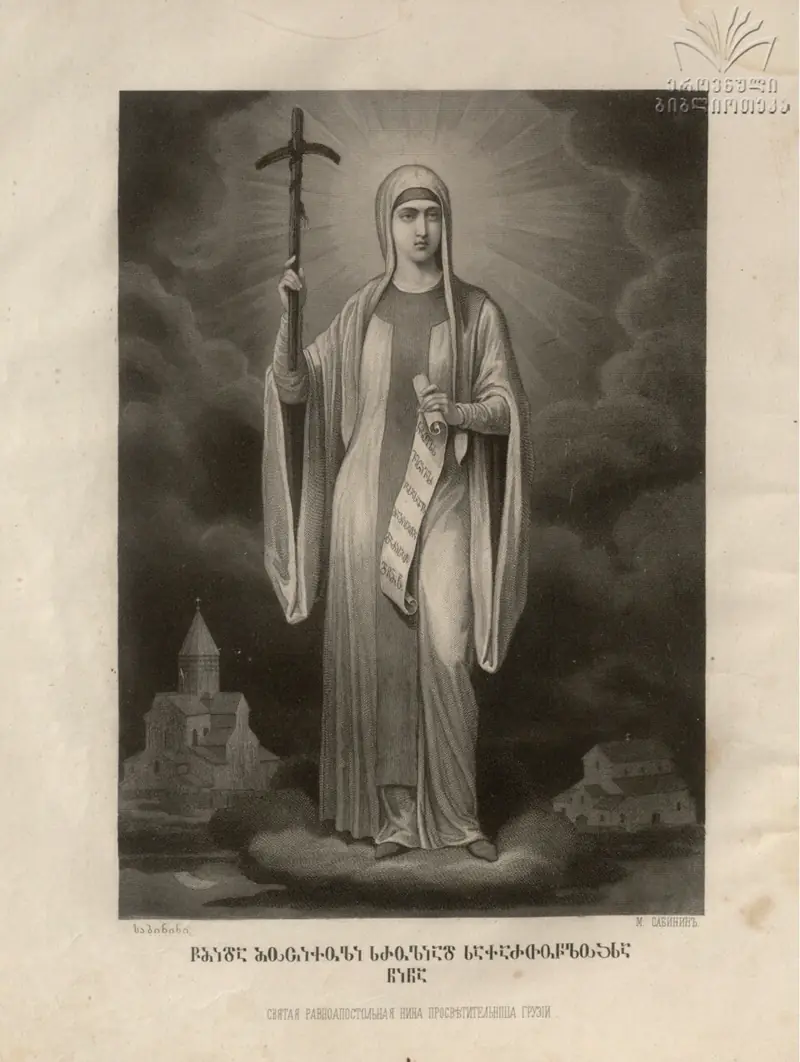
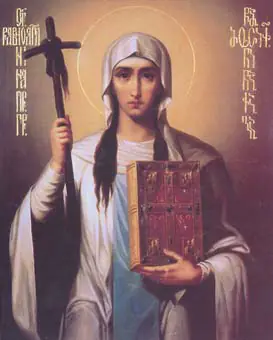
Our Holy Mother Nino, Equal to the Apostles, Enlightener of the Georgians (IV)
The Cappadocian virgin Saint Nino was a close relative of the great-martyr George. She was the only daughter of renowned and honourable parents, Zabulon, a Roman military commander, and Sosana, the sister of Juvenal, Patriarch of Jerusalem. When Nino reached the age of twelve, her parents sold everything and moved to Jerusalem.
After arriving in the holy city, Nino’s father Zabulon decided to be tonsured a monk; he took leave of his family and went into the desert beyond the Jordan to labour there.
After her husband’s departure Sosana was ordained a deaconess by Juvenal, Patriarch of Jerusalem, and Nino was given to an old woman, Sara Niaphora, to be brought up. Her guardian raised Nino in the Christian way and told her the story of the Saviour’s earthly life and Passion. From Sara Nino also learned how the Tunic of Christ had come to a pagan land — to Georgia.
From that day Nino fervently entreated the Most Holy Theotokos to make her worthy to see Georgia and to venerate the garment which the Theotokos herself had woven for her beloved Son. The All-holy Virgin heard her prayer, appeared to her in a dream and said: “Go to Georgia, the land allotted to me, and preach there the Gospel of the Lord Jesus Christ; you will find grace from Him, and I will be your protector.” To this the blessed Nino answered: “How can I, a weak woman, render so great a service to Christ, and by what can I believe the truth of such a vision?” The Most Holy Theotokos gave Nino a cross of vine and said: “Receive this cross as a shield and defence against enemies visible and invisible.” When Nino awoke she was indeed holding the cross in her hand. She bathed it with tears of joy and bound it with her own hair.
After this Nino told her uncle, Patriarch Juvenal, of the miraculous appearance of the Most Holy Theotokos and revealed her wish to go to Georgia to preach.
Juvenal stood his niece before the Royal Doors, laid his hand upon her head and cried out to the Lord: “O Lord, God of eternity, I commit to Thee the orphan child of my sister and send her to preach Thy Godhead, that she may proclaim Thy Resurrection; and wherever it be pleasing to Thee that she go and preach, be Thou, O Christ God, her guide, her haven, her teacher and the giver of understanding of tongues, even as Thou didst for those who went before, who feared Thy name.”
Arriving in Ephesus, Nino met the princess Rhipsime and her nurse Gaiane, whom she converted to the law of Christ. At that time the Roman emperor was Diocletian, a cruel persecutor of Christians. Rhipsime pleased him greatly, and he decided to take her as his wife. The holy virgins understood that this was a hidden snare of the enemy: a king who worshipped foul and abominable idols could not be the husband of a Christian woman who had chosen the Heavenly Bridegroom. Saint Nino, Rhipsime, Gaiane and fifty virgins with them fled to Armenia.
Diocletian sent swift runners to find the fugitives, and then sent a letter to Tiridates, king of the Armenians, told him what had happened and commanded: “Search for her, and when you find her, put her companions to death, and send to me herself, whose name is Rhipsime. And if you wish, keep her for yourself, for there is none to be found like her in the land of the Greeks.”
King Tiridates found the women, was captivated by Rhipsime’s beauty and resolved to take her as his wife. The saint did not submit to the king’s desire, and for this Tiridates put her to death together with her nurse Gaiane and the other fifty virgins.
Saint Nino hid among the rose bushes. The Lord was preparing the virgin, aflame with His love, for another labour. Saint Nino set out towards Georgia. By Lake Paravani she met shepherds from Mtskheta, again received from God a blessing from on high “to preach to the pagans of Mtskheta”, found companions and with toil and suffering reached the town of Urbnisi. The saint stayed there a whole month, joined the Georgians who were going to worship the idol Armazi, and came to Mtskheta.
A terrible sight met the saint there: kings, princes and all the people trembling with fear before the idols. The virgin was grieved. “O Lord, look with mercy upon these peoples, that all the nation may worship Thee, the only God, through Jesus Thy Son,” she cried out to God. A terrible wind blew up, hail came down, and the idols were shattered. The frightened people scattered in all directions.
Saint Nino settled in the royal garden; to the childless family God granted a child through Saint Nino’s prayer. The rejoicing husband and wife confessed Christ and became the saint’s disciples. Little by little worshippers of the law of Christ gathered around Nino. Once Queen Nana fell mortally ill; the queen’s despairing servants went to Saint Nino, told her everything and asked her to come with them to the house. “It is not commanded me to go out to a place where there is no rest for us; but let the queen come to this dwelling of mine, and she will truly be healed by the power of Christ,” the saint answered. Queen Nana obeyed the command of the one equal to the apostles. Saint Nino prayed, made the sign of the Cross and healed the queen. After this Nana confessed Christ.
Once King Mirian went hunting; he had decided that on his return to Mtskheta he would wipe out those who worshipped the Crucified, among them Queen Nana herself, if she did not abandon the law of Christ. During the hunt the sun was suddenly darkened. Left alone, King Mirian long called in vain on the idols for help. When he had lost hope, he entreated Christ: “God of Nino, lighten this night for me and show me my dwelling, and I will confess Thy name, I will raise up the wood of the Cross and venerate it, I will build a house of prayer for myself, and I will be obedient to Nino in the law of the Romans.” At once the sun shone forth. The rejoicing Mirian gave thanks to the Creator of the world. Returning to Mtskheta, the king visited Saint Nino and told her of his resolve.
Through the labours of the holy equal of the apostles Christianity was established in Georgia.
The life of Saint Nino was written down from her own account by Salome of Ujarma and Perozhavra of Sivnia (commemorated 15 January).
According to the saint’s wish her precious body was buried at Bodbe. Afterwards King Mirian built a church in the name of Saint George over her tomb.