
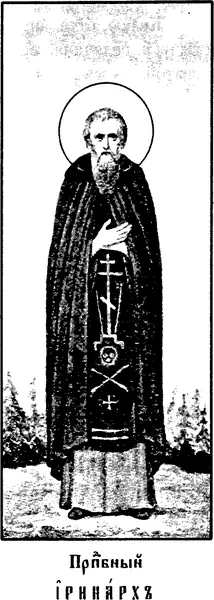
Venerable Irenarchus, Recluse of Rostov (+1616)
The Venerable Irenarchus was born in the village of Kondakovo in the Rostov district, into a peasant family. At baptism the child was named Elijah. The newborn grew astonishingly fast: he was twelve weeks old when he began to walk. From childhood Elijah was distinguished by the fear of God; amusements did not attract him; he loved conversations about God, and was gentle, quiet and affectionate. From childhood his soul longed wonderfully for the heavy yoke of monasticism. He was six when he said prophetically to his mother: “When I grow up I shall become a monk, wear iron and labour for God, and I shall become a teacher to all.” The saint was tonsured at thirty in the monastery of Boris and Gleb. Some time later he went to the monastery of Saint Lazarus and spent three years in a narrow cell. The venerable father made his rule of life stricter: in his cell he chained himself to his wooden bench with an iron chain, and hung heavy chains on his neck too. Because of this the monks laughed at him and mocked him. For the peace of the monastery, by order of the superior, the humble monk once again obediently left the place. A year later the hegumen of the monastery repented of what he had done and sent brothers to bring Irenarchus back. And the saint returned. The venerable father went on wearing heavy fetters, and also took up work: he made clothing for the poor, and slept only one or two hours at night.
Before the Polish attack on Russia, Irenarchus saw in a revelation in his sleep Moscow plundered by foreigners, and at God’s prompting warned King Vasily Ivanovich Shuisky (1606–1610) of the coming disaster. For his tireless labours the Lord granted the holy father the gift of wonderworking: the day of his repose was revealed to him beforehand; he called his disciples, instructed them, and committed his soul to the Lord in peace on 13 January 1616, in the sixty-eighth year after his birth. Many healings took place from the saint’s incorrupt relics, and especially from touching his cross, fetters and chains.



