
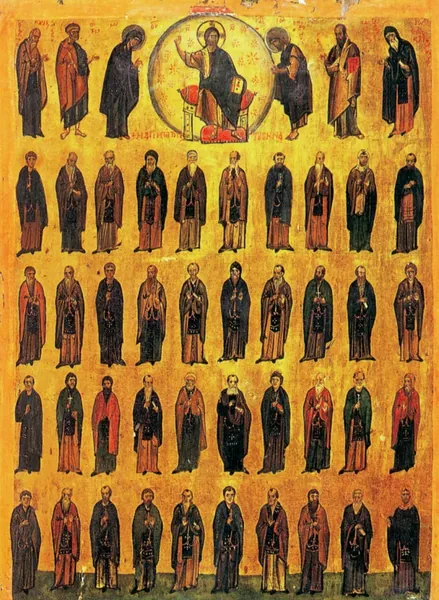
The Venerable Fathers Slain by the Saracens at Sinai and Raithu: Sabbas, Isaiah, Moses and His Disciple Moses; Jeremiah, Paul, Adam, Sergius, Domnus, Proclus, Isaac, Hypatius, Macarius, Mark, Benjamin, Eusebius and Elias (IV–V)
The venerable fathers slain at Sinai and Raithu laboured on Mount Sinai and near it, in the monastery of Raithu on the shore of the Red Sea, “in caves and mountains and holes of the earth”. The monks were distinguished by a wonderfully abstinent, ascetic life: the whole week through they kept silence, laboured apart from one another, and met only on Saturday and Sunday for divine service; they fed on a few dates and water, and took no bread at all. “And they were as angels in the service of God, and their faces were yellow, and their flesh withered with fasting and vigil.”
In 312, on the third day after the Nativity of Christ, the Saracens fell upon the monastery of Sinai and began a terrible slaughter. The monks who were near the church took refuge in a tower and fervently besought the Lord for help. And God looked with the eye of mercy on His chosen ones, and “showed upon the top of that mountain a very great fire, for the whole mountain smoked, and the fire went up unto heaven”. The wondrous sight frightened the Saracens and they fled; “some of them left their camels and their weapons for fear”.
The next day the monks who had survived began “to go round the mountain to the cells of the monks”. They found thirty-eight slain and two gravely wounded. The bodies of the aged monks, rich in labours, were a terrible sight: “of one, his head hung from his neck by the skin only, and another lay wholly cut in two; and of one, from the multitude of his wounds his eyes had burst forth, and another lay hacked in hand and foot like a block”. They hoped that one of the wounded, Abba Sabbas, would survive, but he himself grieved greatly over this; he “wept and mourned and said: Woe is me, who saw the haven of the King and entered not therein”. He fervently besought the Lord not to separate him from the holy fathers who had been counted worthy of death for His name. God looked with mercy on the monk, and four days after the slaughter of the saints received his soul too. “And God fulfilled through him their number, according to the number of the holy Forty.”
As it turned out, on that very day a terrible bloodshed had broken out in Raithu too. The monastery of Raithu was attacked from the sea by Arab tribes, the Habash, “their number about three hundred men”. At that time some two hundred laymen with their families were in the monastery; they rose to defend their wives and children and the monks of the monastery, but could do nothing: the enemy, experienced in battle and superior in numbers, defeated them “and carried off captive the children and the women with them”.
After this the godless reached the monks who had taken refuge in the church too: “like raging beasts they ran, and cried with a loud and hideous voice”. The superior of the monastery, Paul, strengthened the brothers, and then, facing the altar, lifted up his hands to heaven and asked the Lord for help.
Meanwhile the godless seized Jeremiah, who was sitting at the doors of the church, and demanded that he show them the superior. “I will not show you our father”, the monk answered firmly. The lawless ones bound him hand and foot, “and set him up naked, and so shot at him with arrows until his flesh was filled”. Saint Jeremiah did not even stir; he bore the torment with joy and thanksgiving and calmly committed his soul to the Lord.
When Paul saw this, he stepped out from among the brothers and declared: “Behold, here am I, whom ye seek.” The lawless ones now turned to beating him and demanded that he hand over hidden treasure; but when they realised they would get nothing, one of them split the saint’s head with a sword, “and he fell dead after great torment”.
After this the warriors burst into the church with a roar and fell upon the holy fathers: “they began to smite them with the sword as each would: of one they cut off the head, and another they cut in two, and of another they drew forth the entrails with the sword, and another they smote upon the shoulder and clove him in two even unto the breast, until thus they had slain those holy fathers”.
The godless took a great liking to Abba Solomon’s son, the fifteen-year-old Sergius, and decided to take him with them. When the boy saw that “they would not slay him together with his companions, but were minded to carry him off with them”, he first wept bitterly, and then gathered his strength, cast off fear, “took the sword of one of them, and smote the Habash upon the shoulder only”: seeking death, he wished to enrage the enemy. And he achieved his aim: “they were all enraged against him and cut him down with the sword”.
When they had finished the slaughter, the barbarians began to search the church and the cells, looking for treasure. “The wretches knew not that those saints had nothing upon earth, but they have their treasure in heaven, and joy unfading through Christ our Lord.” The cruelty of the lawless knew no bounds: they killed even the women and children they had taken captive; but a terrible punishment fell upon them too: not one of them escaped the army of Christians that came to help their neighbours.
The fathers who met their end on this day “were servants of God, good and chosen, and God made them worthy of the joy of His Kingdom. Let us beseech those saints to ask help for us.”
The slaughter of the fathers of Sinai and Raithu was described for us by an eyewitness of these events, the Egyptian monk Ammonius. A similar disaster befell this monastery a hundred years later too, of which Nilus the Faster (commemorated 12 November), who was miraculously saved from death, has told us.
Of the saints who shone forth in these days in the monasteries of Sinai and Raithu the names of only a few are known: Sabbas, Isaiah, Moses, his disciple Moses, Jeremiah, Paul, Adam, Sergius, Domnus, Proclus, Isaac, Hypatius, Macarius, Mark, Benjamin, Eusebius and Elias.



